PuniCodex

Extended Lore

Gawain

Etymology · Phonology · Orthography · Cultural Legacy · Primary Sources

Tier 2 Gawain
Gawain — Knight, Sun Hero
01

Quick Facts

Essential information about Gawain, Knight, Sun Hero

Scholarly TransliterationGawain
Unicode RestorationGawain
Reconstructed Pronunciation/ˈɡwalx.mai/
PantheonCeltic
DomainKnight, Sun Hero
MeaningLittle falcon
ClassificationTier 2
Primary DomainGawain
Sacred SymbolsThe hawk, The pentangle, The green girdle, The waxing strength, The nick in the neck
02

Etymology & Word Family

From original script to Unicode restoration

Scholarly Transliteration Gawain Gawain — "Little falcon"
Unicode Restoration Gawain Restored stress, length, and script
Modern ASCII gawain Plain-ASCII fallback

Gwalchmai is a transparent Welsh compound: gwalch ('hawk') + Mai ('May'), whence the standard scholarly rendering 'hawk of May' (Bromwich, Trioedd Ynys Prydein; Koch); the PuniCodex lexicon keeps the traditional English gloss 'little falcon' for the same root-image. The temple form Gawain is Tier 2 by the mechanical rule: the English name is already plain ASCII — there is no diacritic and no distinctive letter for the ASCII alphabet to lose. The capital alone distinguishes the temple form from the input.

03

Unicode Character Breakdown

Character-by-character philological analysis

CharacterUnicodeNameBlockPhonetic Role
GU+0047Latin Capital Letter GBasic LatinSame, capitalized
aU+0061Latin Small Letter ABasic LatinSame
wU+0077Latin Small Letter WBasic LatinSame
aU+0061Latin Small Letter ABasic LatinSame
iU+0069Latin Small Letter IBasic LatinSame
nU+006ELatin Small Letter NBasic LatinSame

The Tier 2 classification reflects how much of the original phonology this restoration preserves — stress and vowel length for Greek names, distinctive letters and diacritics for every other tradition.

04

Cultural Significance

From ancient cult to modern Unicode

Ancient Domain

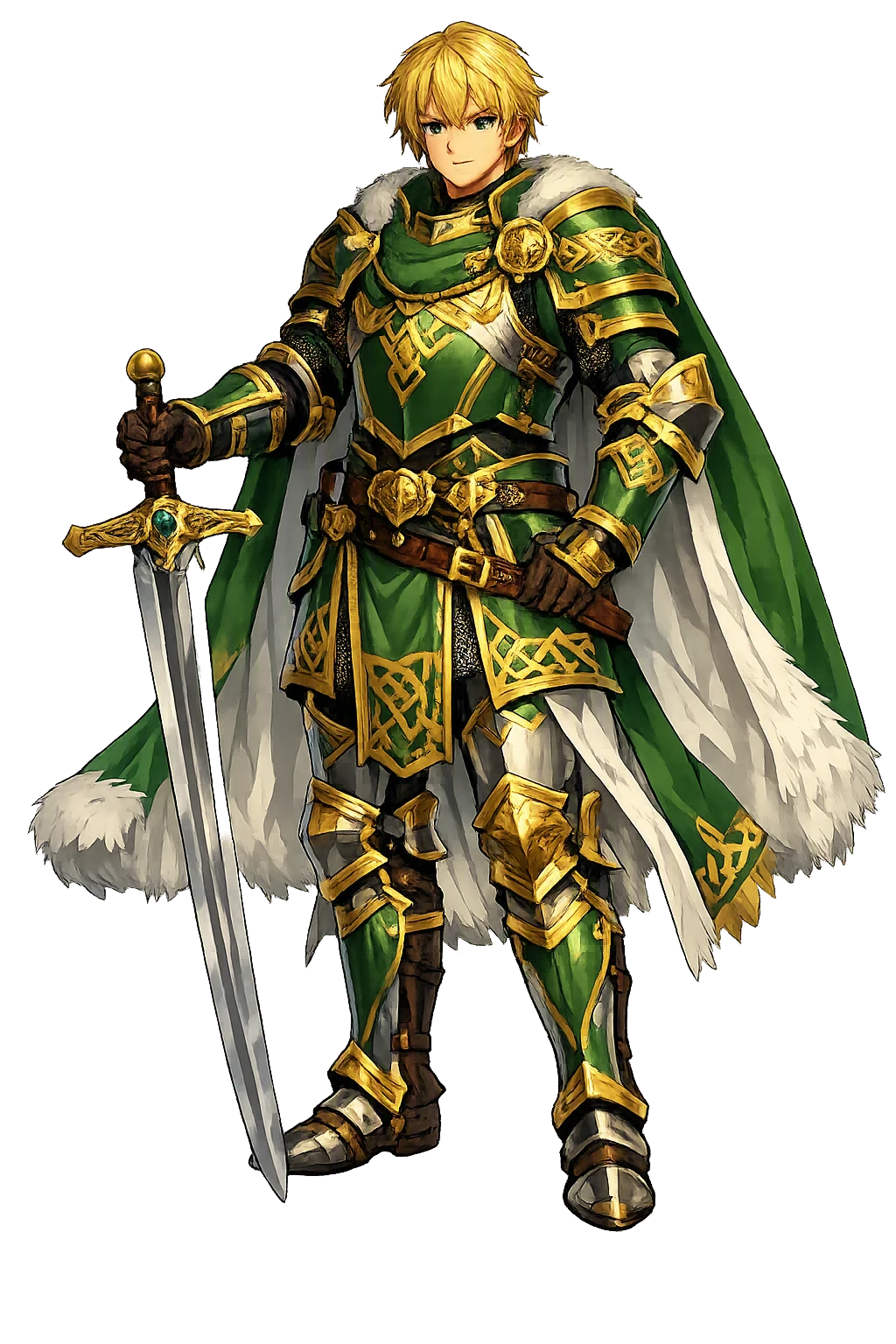
Gawain — Welsh Gwalchmai, Arthur's nephew — is the courteous knight of the Welsh and continental cycles: the one who never came home without the quest he went to seek, the measure against whom Chrétien ranks every other knight of the Round Table, and the man the Green Knight chose to test, at the turning of a year, for the one virtue the pentangle guards — truth.

Gawain in Later Traditions

Gawain's deepest comparative file is Irish. The beheading game itself has its classic Celtic witness in Fled Bricrenn, Bricriu's Feast, where the giant Uath — 'Horror' — offers the Ulster heroes exactly the Green Knight's bargain: strike off my head today, and I strike yours tomorrow. Only Cúchulainn takes the axe twice and kneels for the return stroke; the giant brings the blade down blunt, and the champion's portion is judged his. Kittredge's Study of Gawain and the Green Knight (1916) made the Irish episode the standing source-analogue of the English poem, and the comparison has been refined, never abandoned. The loathly-lady strand of Gawain's story — Dame Ragnelle, whose riddle is answered with sovereignty — has its own Irish kin in the sovereignty-goddess tales, where a hag by a well becomes a queen when a king will kiss her. Within the pantheon his standing kin are [[kai|Cei]] and [[bedwyr|Bedwyr]], the two companions Culhwch pairs beside him, and [[cuchulainn|Cúchulainn]], the only other hero in Celtic story who knelt under the return stroke. The Welsh tradition itself never made him a god; it made him something rarer — the knight every other knight is measured against.

Modern Legacy

Gawain is the Arthurian figure with the longest continuous critical life. Chrétien made him the definition of cortoisie; the Gawain-poet made him the test-case of truth; Malory made him the tragedy of loyalty. Tennyson split him in two, taking his courtesy for the early idylls and his Orkney darkness for the last; the twentieth century gave him back to the scholars — Weston and Loomis argued his solar and Celtic pedigrees, and the Tolkien–Gordon edition of 1925 made Sir Gawain and the Green Knight a fixed star of the English canon. Harrison Birtwistle's opera Gawain (1991) set the Green Chapel to music, and the twenty-first century has filmed the poem twice. Through it all the Welsh name never went anywhere: Gwalchmai still stands in the Triads, the hawk of May, waiting at Arthur's court for the quest to be finished.

Unicode Restoration as Cultural Act

Restoring Gawain in a domain name is more than orthographic accuracy. It is a statement that the internet should recognize the full range of human writing — not only the ASCII keyboard.

05

Frequently Asked Questions

Common questions about Gawain, Knight, Sun Hero, and Unicode restoration

01How do you pronounce Gawain?

In reconstructed pronunciation, Gawain is /ˈɡwalx.mai/ — approximately GWALH-my — the gw of 'Guinevere', the ch of Scottish 'loch', and 'my' like the month of May. The later English form Gawain runs 'guh-WAYN', stress on the second syllable..

02What does Gawain mean?

Gawain means Little falcon in the celtic tradition.

03What are the symbols of Gawain?

Gawain is associated with The hawk (The name made image: gwalch, the raptor of the Welsh genealogies — swift sight, swift return), The pentangle (The endless knot of five fives: senses, fingers, wounds, joys, and the five knightly virtues bound by truth), The green girdle (The kept-back token: one small failure of truth worn openly, until shame becomes the court's badge), The waxing strength (The romancers give him a power that rises with the sun to noon and fails after — the trace the scholars read as a faded solar hero), The nick in the neck (The single cut of the third stroke: the wound that is also a judgment, and a verdict he refuses to forget).

04Why restore Gawain in Unicode?

Plain ASCII gawain strips the stress, length, and script that make the name specific. Unicode restoration returns the name to its original written dignity.

05What is the most important myth about Gawain?

The oldest Arthurian tale in Welsh names him in its great muster at Arthur's court: Gwalchmei mab Gwyar — Gwalchmai son of Gwyar — 'because he never returned home without achieving the quest he had gone to seek; he was the best of walkers and the best of riders; he was nephew to Arthur, the son of his sister, and his first cousin.' In a catalogue of hundreds of warriors, giants, and wonders, that is the whole of his entry, and it is the whole of his character: the Welsh tradition remembers him not for a single exploit but for completion itself — the errand that always comes home.

06

Scholarly Sources

The philological foundations of this restoration

Every claim on this page is grounded in established scholarship. The orthographic restorations follow disciplinary convention. The etymological chain follows the best available reference works. This is not invention — it is resurrection through scholarship.

Lexicography & Philology

  • Arthurian legend
  • MacKillop

Primary Texts

  • The Immram Brain (Voyage of Bran); Tochmarc Étaíne; Cóir Anmann; medieval Irish saga literature.

Archaeology & Art History

  • Material evidence — iconography, inscriptions, and temple archaeology — for Gawain and related cults.
  • Gawain is a textual figure with one famous epigraphic witness. The Modena Archivolt — the carved portal relief of Modena Cathedral, dated c. 1120–1140 — depicts an Arthurian rescue scene with the figures labeled in stone: Artus de Bretania, Che (Cei), and GALVAGIN(VS), Gawain himself — the earliest Arthurian image in medieval art, carved a generation before Geoffrey of Monmouth finished the Historia. William of Malmesbury (c. 1125) adds the tradition's one grave: the tomb of Walwen, he reports, was found in his own time on the seashore at Rhos in Pembrokeshire, fourteen feet long. His manuscript witnesses are exact: Culhwch ac Olwen survives in the White Book of Rhydderch (NLW Peniarth 4–5, c. 1350) and the Red Book of Hergest (Jesus College MS 111, c. 1382–1410); Sir Gawain and the Green Knight survives uniquely in British Library MS Cotton Nero A.x (c. 1400), the small quarto it shares with Pearl, Cleanness, and Patience.

Religious Studies

  • Culhwch and Olwen, ed. Rachel Bromwich and D. Simon Evans — Gwalchmei mab Gwyar in the court-list: the quest that always comes home
  • Trioedd Ynys Prydein, ed. and trans. Rachel Bromwich — Triad 4, the Three Well-Endowed Men; the name's etymology
  • Geoffrey of Monmouth, Historia Regum Britanniae — Walganus, the Roman campaign, and the death at the landing
  • William of Malmesbury, Gesta Regum Anglorum III.287 — Walwen and the tomb at Rhos
  • Chrétien de Troyes, Arthurian Romances — Gauvain as the measure of courtesy; the Continuations and the waxing strength
  • Sir Gawain and the Green Knight, ed. Tolkien and Gordon — the beheading game, the pentangle, the girdle, the nick
  • Malory, Le Morte Darthur — the Orkney feud, the letter to Lancelot, the dream on Salisbury eve
  • Fled Bricrenn (Bricriu's Feast), ed. George Henderson — the Uath episode: the Celtic beheading game
  • Kittredge, A Study of Gawain and the Green Knight (1916) — the Irish source-analogue
  • Loomis, Celtic Myth and Arthurian Romance; Weston, The Legend of Sir Gawain — the solar-hero reading
  • Koch, ed., Celtic Culture: A Historical Encyclopedia, s.v. Gwalchmai; MacKillop, Dictionary of Celtic Mythology
Return

The Surface Awaits

You have traced the name from its earliest attestation to its Unicode restoration. Now return to the myth. The story is where the name lives.

Back to Lore
Gawain mascot