PuniCodex

Extended Lore

गौरी Gaurī

Etymology · Orthography · Cult · Iconography · Reception · Sources

Tier 1 Gaurī.com
Gaurī — Motherhood, Beauty, Austerity
01

Quick Facts

Essential information about Gaurī, Motherhood, Beauty, Austerity

Original Scriptगौरी
Unicode RestorationGaurī
Reconstructed Pronunciation/ɡɐʊ̯.riː/
PantheonSanskrit
DomainMotherhood, Beauty, Austerity
Meaning"The Golden One" — the radiant form of the Great Goddess, mother of the universe
ClassificationTier 1
Primary DomainGaurī.com
Sacred SymbolsThe golden complexion, The lotus, The bilva leaf
02

Etymology & Word Family

From original script to Unicode restoration

Original Script गौरी Gaurī — ""The Golden One" — the radiant form of the Great Goddess, mother of the universe"
Unicode Restoration Gaurī Restored stress, length, and script
Modern ASCII gauri Plain-ASCII fallback

The name Gaurī carries the orthographic signature of the sanskrit tradition: गौरी. Unicode restoration recovers what ASCII flattens.

03

Unicode Character Breakdown

Character-by-character philological analysis

CharacterUnicodeNameBlockPhonetic Role
GU+0047Latin Capital Letter GBasic LatinSame
aU+0061Latin Small Letter ABasic LatinSame
uU+0075Latin Small Letter UBasic LatinSame
rU+0072Latin Small Letter RBasic LatinSame
īU+012BLatin Small Letter I with MacronLatin Extended-ALong ī

The Tier 1 classification reflects how much of the original phonology this restoration preserves — stress and vowel length for Greek names, distinctive letters and diacritics for every other tradition.

04

Cult & Worship

How the sacred was kept — rites, sanctuaries, remains

The Cult

Gaurī is worshipped as the radiant, married form of the Goddess, her cult overlapping with Pārvatī's. In Maharashtra the annual Gaurī festival sees married women install temporary clay or turmeric images in their homes, dress them in silk, and observe fasts for the health of their husbands. Gaurī-Shankar temples across the Kathmandu valley enshrine her beside Śiva as the divine couple. Tuesday and Friday vows, haldi and kumkum offerings, and the singing of ovi songs accompany her domestic rites. The great Śiva-Pārvatī temples from Elephanta to Ellora witness the same pairing on a monumental scale, their courtyards and processional routes still hosting her festivals.

In the Earth

Her temples stand with Pārvatī's: the great Śiva-Pārvatī shrines from Elephanta's marriage-panel to the Kailāsa of Ellora — where the wedding of Gaurī and Śiva fills the whole south wall — document her in stone. The Gaurī Shankar temples of the Kathmandu valley and the festival-images of Maharashtra (made annually in the potters' quarters) carry her golden form into the present.

05

Iconography

How Gaurī was imaged across the ages

The Image

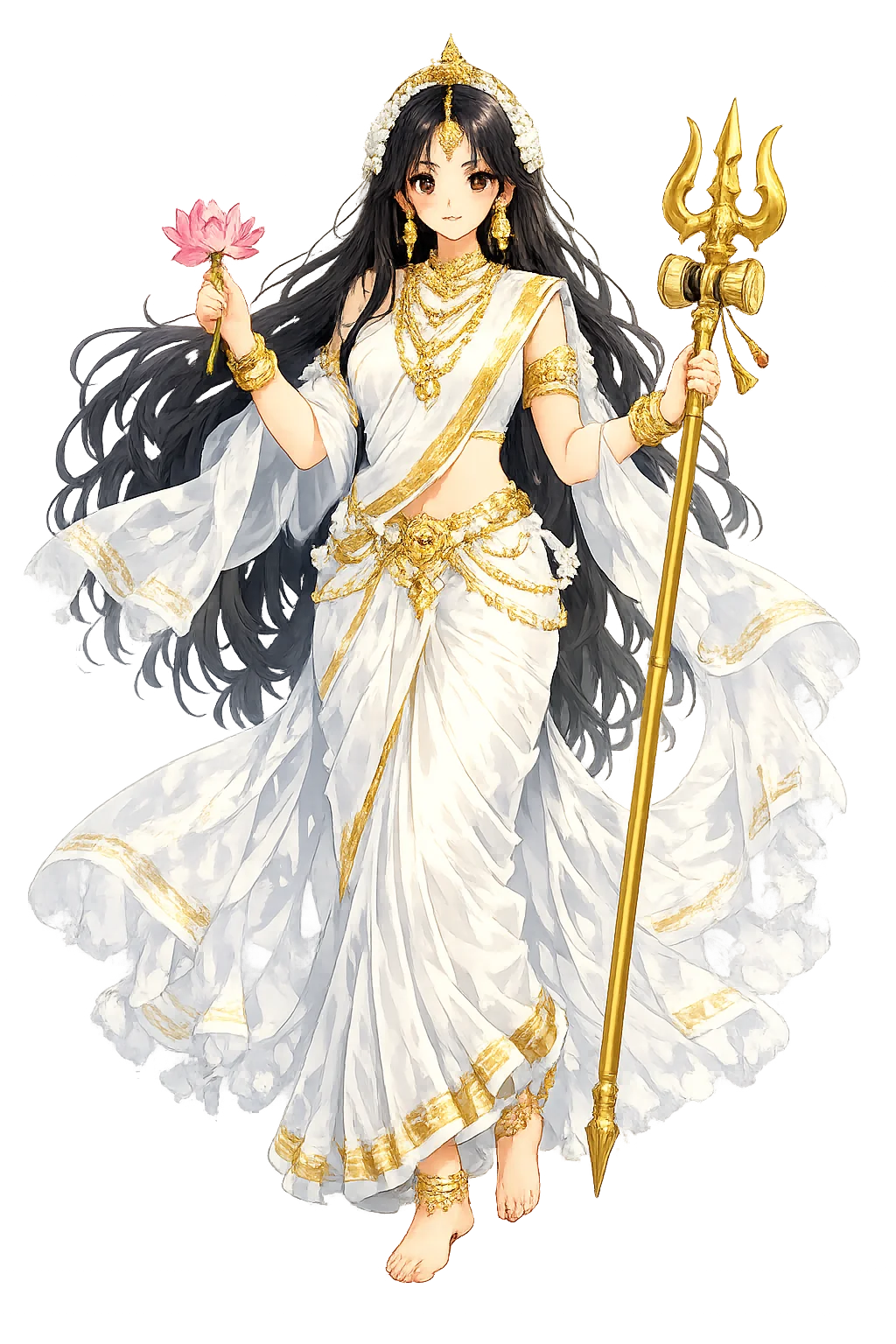
Gaurī's visual identity turns on gold and marriage. She is the fair or golden goddess, seated beside Śiva or standing in wedding procession, crowned and bejeweled, one hand raised in blessing, the other holding a lotus or mirror. The Kailāsa temple at Ellora devotes its south wall to the marriage of Śiva and Pārvatī/Gaurī, carving the event across the living rock. Pahari painters loved the theme of the divine bridal couple, while Maharashtra's potters' quarters still mold her festival image fresh each year. Her attributes overlap with Pārvatī's—trident, lion, serpent—because the two names describe phases of one goddess rather than separate beings.

06

Reception & Transformation

The name after its own age — transmission, translation, survival

Afterlives

Gaurī enters Sanskrit literature as Umā Haimavatī in the Kena Upaniṣad, the daughter of the Himalaya who instructs the gods. The Purāṇic corpus then wove her into the marriage-and-penance cycle with Śiva, the Devī Māhātmya claimed her fierce and gentle aspects alike, and medieval Tantra elevated her as one face of the Supreme Goddess. Kashmiri Śaiva theologians and Bengali Śākta poets alike found in her golden form a bridge between domestic virtue and cosmic power. Under colonial ethnography she was classified as a "benevolent" goddess in contrast to "terrible" Kālī, a binary that modern Hindu feminism has rightly questioned. Today Gaurī persists in festival calendars, bridal rituals, and goddess spirituality worldwide, her golden name invoked wherever the divine feminine is imagined as radiant wife and world-mother.

Identifications Across Traditions

She is the gentle face of the same goddess who is Durgā in battle and Kālī in wrath — the Śākta tradition's proof that power has a domestic form. Her golden form travels: as the benevolent mother of Balinese Hinduism (Mā Gaurī), and into the syncretic Devi temples of the diaspora from Fiji to Trinidad, where her immersion-festivals kept the homeland's calendar across two oceans.

Modern Legacy

The Gaurī festivals — Gaṇeśa's mother welcomed for three days before her son's own ten — anchor the Maharashtrian religious year; the phrase "gaurī kā vivāha" (the ideal marriage) is everyday Hindi. Turmeric, her color, remains the ritual substance of Indian womanhood. She is the Śākta answer to the question of what a goddess of the home looks like when she also happens to be the energy of the universe.

07

The Meditation

What Gaurī means — beyond the dictionary

Gaurī is the goddess of earned tenderness. Nothing in her story is granted: the marriage is won by penance, the sons by her own making, the goldenness by her own nature. She asks the household's hardest question — the one every patient person eventually faces: how long can you keep the faith of the golden work before anyone notices — and will you still be radiant when they do?

The festivals keep her schedule better than any temple: three days the household hosts her, then the image is carried to the water and given back — the mother received as a daughter and released as a goddess. It is the gentlest theology in the pantheon: what you love, you keep only by letting it go home.

Her goldenness is not decoration but doctrine: the same goddess who is terror on the battlefield is turmeric in the kitchen. Power, the Śākta tradition insists, is not diminished by the household — it is proven there.

08

Frequently Asked Questions

Common questions about Gaurī, Motherhood, Beauty, Austerity, and Unicode restoration

01How do you pronounce Gaurī?

In reconstructed pronunciation, Gaurī is /ɡɐʊ̯.riː/ — approximately GOW-ree — the diphthong of "cow," then a long ee.

02What does Gaurī mean?

Gaurī means "The Golden One" — the radiant form of the Great Goddess, mother of the universe in the sanskrit tradition.

03What are the symbols of Gaurī?

Gaurī is associated with The golden complexion (Radiance as nature — beauty without artifice), The lotus (Her seat and offering — purity of the household goddess), The bilva leaf (Her austerity — the tree of Śiva she tended in penance).

04Why restore Gaurī in Unicode?

Plain ASCII gauri strips the stress, length, and script that make the name specific. Unicode restoration returns the name to its original written dignity.

05What is the most important myth about Gaurī?

“Daughter of the Mountain” — the The Birth story that anchors the mythology of Gaurī, told in full on the lore page.

09

Scholarly Sources

The philological foundations of this restoration

Every claim on this page is grounded in established scholarship. The orthographic restorations follow disciplinary convention. The etymological chain follows the best available reference works. This is not invention — it is resurrection through scholarship.

◈

Lexicography & Philology

  • Puranas
  • Devi Mahatmya
  • Monier-Williams
  • MW
  • Cambridge
◎

Primary Texts

  • Shiva Purana
  • Kena Upaniṣad 3.12 (Umā, daughter of the Himalaya)
  • Śiva Purāṇa, Rudrasaṃhitā (the penance, the test, and the wedding)
  • Kālikā Purāṇa (Kārttikeya's birth from the gods' combined fire)
◉

Archaeology & Art History

  • Material evidence — iconography, inscriptions, and temple archaeology — for Gaurī and related cults.
✦

Religious Studies

  • Kinsley, David, Hindu Goddesses: Visions of the Divine Feminine (1986)
  • Monier-Williams, Sanskrit-English Dictionary, s.v. gaurī
  • Coburn, Thomas, Devi-Māhātmya: The Crystallization of the Goddess Tradition (1991)
Return

The Surface Awaits

You have traced the name from its earliest attestation to its Unicode restoration. Now return to the myth. The story is where the name lives.

Back to Lore
Gaurī mascot