PuniCodex

Extended Lore

𒀭𒊕𒆠𒃲 Ereškigal

Etymology · Orthography · Cult · Iconography · Reception · Sources

Tier 1 Ereškigal.com
Ereškigal — Queen of the Underworld
01

Quick Facts

Essential information about Ereškigal, Queen of the Underworld

Original Script𒀭𒊕𒆠𒃲
Unicode RestorationEreškigal
Reconstructed Pronunciation/eˌreʃ.ki.ˈɡal/
PantheonMesopotamian
DomainQueen of the Underworld
MeaningLady of the great earth
ClassificationTier 1
Primary DomainEreškigal.com
Sacred SymbolsThe throne of the dead, The seven gates, The peg of the dead, The gala-tura and kur-tura, Dust and silence
02

Etymology & Word Family

From original script to Unicode restoration

Original Script 𒀭𒊕𒆠𒃲 Ereškigal — "Lady of the great earth"
Unicode Restoration Ereškigal Restored stress, length, and script
Modern ASCII ereshkigal Plain-ASCII fallback

Sumerian Ereškigal, 'Lady of the Great Earth', queen of the Mesopotamian underworld Kur.

03

Unicode Character Breakdown

Character-by-character philological analysis

CharacterUnicodeNameBlockPhonetic Role
EU+0045Latin Capital Letter EBasic LatinSame, capitalized
rU+0072Latin Small Letter RBasic LatinSame
eU+0065Latin Small Letter EBasic LatinSame
šU+0161Latin Small Letter S with CaronLatin Extended-AŠ: caron s, distinctive letter
—N/ADropped characterMesopotamian orthographyDropped: sh digraph realized as š
kU+006BLatin Small Letter KBasic LatinSame
iU+0069Latin Small Letter IBasic LatinSame
gU+0067Latin Small Letter GBasic LatinSame
aU+0061Latin Small Letter ABasic LatinSame
lU+006CLatin Small Letter LBasic LatinSame

The Tier 1 classification reflects how much of the original phonology this restoration preserves — stress and vowel length for Greek names, distinctive letters and diacritics for every other tradition.

04

Cult & Worship

How the sacred was kept — rites, sanctuaries, remains

The Cult

Ereškigal kept no house among the living, and the excavation record agrees with the myth: no temple securely dedicated to her has been found, no festival calendar, no attested priesthood. Her cult — if the word applies — was textual and funerary: first-millennium exorcistic series from Nineveh and Babylon invoke her by name at the boundary rites of healing, and the great laments sung by the gala-priests describe her realm because every Mesopotamian funeral addressed it, with kispum offerings poured for the dead she ruled. The god-list An = Anum preserves her titles and her court. Closest to a congregation she ever came: the patients of exorcists and the mourners of every city — everyone, in the end, was her votary.

In the Earth

Ereškigal is archaeologically a goddess of tablets. Her mythology is anchored in datable manuscripts: Old Babylonian copies of the Descent from Nippur and Ur, the Amarna tablet EA 357 carrying the Nergal myth to Egypt in the fourteenth century BCE, and the great god list An = Anum, which enumerates her titles and her kin. First-millennium exorcistic texts from Nineveh and Babylon invoke her by name at the boundary-rituals of healing. No temple securely dedicated to her has been excavated — her cult, so far as the material record shows, was served inside the broader netherworld theology rather than in a sanctuary of her own, which is itself a fact about her: the queen of the dead keeps no house among the living.

05

Iconography

How Ereškigal was imaged across the ages

The Image

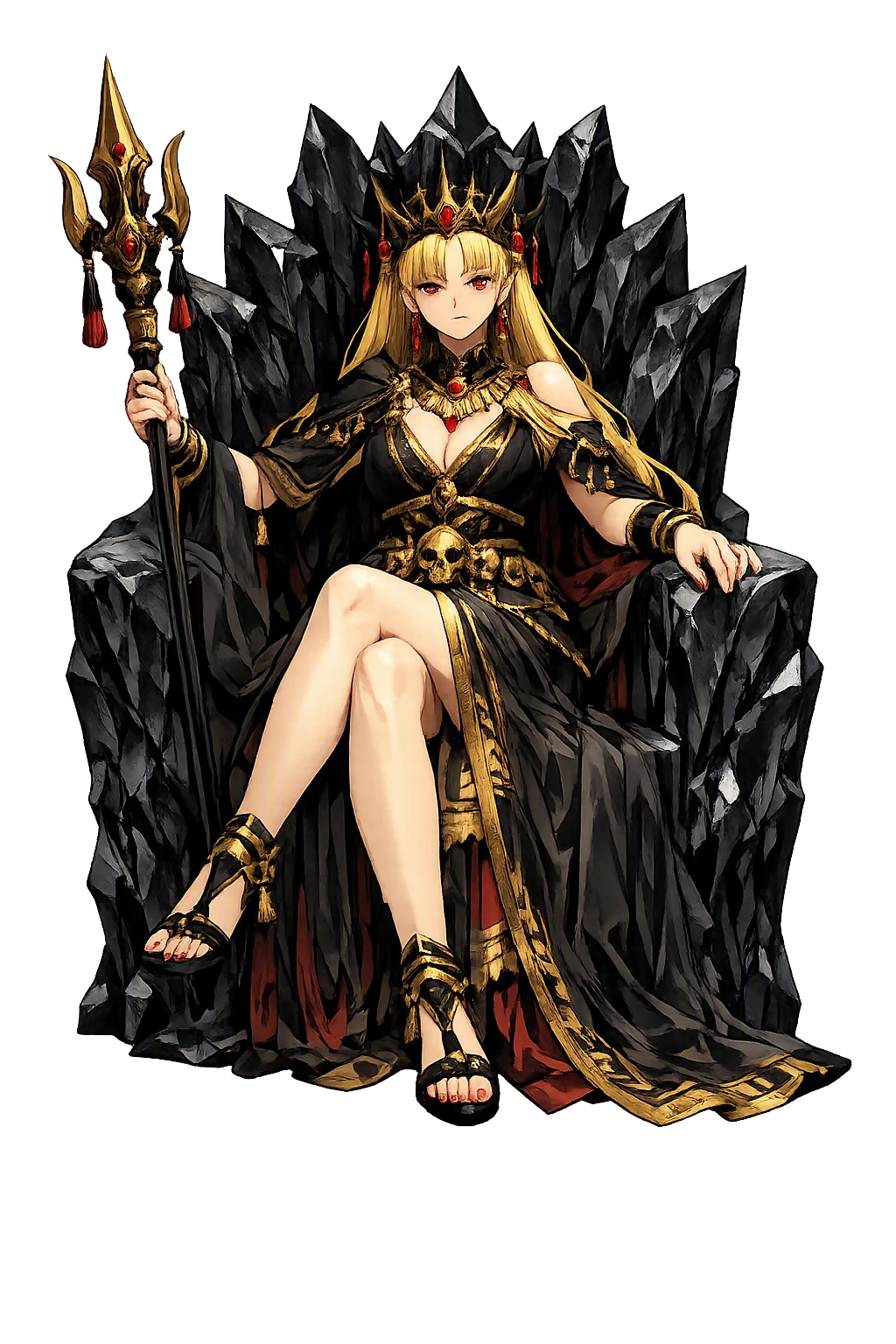
No image of Ereškigal carries her name, yet one masterpiece is always in the room: the so-called Queen of the Night, a large Old Babylonian baked-clay relief in the British Museum, shows a nude, winged goddess with bird's talons, flanked by owls, crowned and holding the rod-and-ring of authority. Owls and the underworld have persuaded many scholars that this is Ereškigal enthroned; others argue for Inanna or the demon Lilitu, and the debate is honest on both sides. Beyond her, the portrait is textual: the queen on the netherworld throne, sceptre in hand, her palace behind seven gates, the dead arriving as feathered birds. The image that survives is made of words — the Descent's stripping at the gates, the dream of dust in the Gilgamesh epic — which is appropriate for a goddess whose kingdom was always elsewhere.

06

Reception & Transformation

The name after its own age — transmission, translation, survival

Afterlives

Ereškigal's journey ran through the earth and back out of it in clay. Her Sumerian Descent poem was copied at Nippur and Ur in the Old Babylonian period; Akkadian scribes remade it as the Descent of Ishtar, and in the fourteenth century BCE the myth of Nergal and Ereškigal travelled to Egypt itself on the Amarna tablet now called EA 357. The god-list An = Anum preserved her titles; first-millennium exorcists kept her name alive at the sickbed. Then silence, until the nineteenth century: the great libraries excavated at Nineveh and the cities of Sumer returned her to the light, and the first translations of the Descent, published within decades of the decipherment, let Europe read the queen of the dead in her own words. Assyriology made her scholarly furniture — the Inanna complex has an immovable second half — and the editions and studies since Sladek's 1974 reconstruction of the Sumerian poem have fixed her text. The comparisons began at once, with Persephone and Orpheus and every later descent, and they continue: for a goddess with no temple, being argued over is what survival means.

Identifications Across Traditions

The Greeks had no exact equivalent for a sovereign queen of the dead — Persephonē shares the realm but shares the throne — and later antiquity mapped Ereškigal mostly through her sister: to Hekate and to Persephonē, the paired mistresses of a chthonic house. The Greek Magical Papyri make the identification explicit, invoking 'Ereškigal' among the names of the underworld queen in the syncretistic spells of Roman Egypt. In the Gnostic and Hermetic currents that fed on such material, her name became one of the passwords of the descending soul. Modern comparative scholarship pairs her with the Norse Hel — a daughter who rules, not a captive who shares — and with the Anatolian and Iranian chthonic goddesses of the dead. Her most faithful modern heirs are fictional: the underworld queens of fantasy literature descend in an unbroken line from her seven gates.

Modern Legacy

Ereškigal left no city, no festival calendar, and no certain temple excavated — her cult, so far as the evidence goes, was woven into the great netherworld theology rather than anchored in a shrine of her own. Her legacy is textual and archetypal. The Descent cycle she anchors became one of the most influential narratives of the ancient world, echoing through later katabasis literature from Orpheus to the harrowings of medieval legend. In Assyriology her name designates the grim half of the Inanna complex, and in modern reception she has been reclaimed — in scholarship, poetry, and fantasy — as the sovereign feminine power the upper world prefers to forget: the sister who rules where everyone must eventually visit. The name still means: the law of the last door.

07

The Meditation

What Ereškigal means — beyond the dictionary

Ereškigal is the sister who stayed. The mythic imagination gave Inanna everything — the sky, the morning star, the kingship of Uruk — and gave Ereškigal the room beneath the world, and then dared to ask which sister was stronger. The Descent answers without hesitation: Inanna arrives with the full regalia of heaven and leaves as meat on a hook; her return is not a victory but a ransom.

What Ereškigal governs is not evil but necessity — the one province no god, king, or lover can exempt. Her seven gates strip away everything that was lent to us: crown, beads, robe, ring. What passes all seven is only what we are. In this she is the most honest deity in the pantheon, and the most patient: everything comes to her eventually, and she keeps flawless accounts.

08

Frequently Asked Questions

Common questions about Ereškigal, Queen of the Underworld, and Unicode restoration

01How do you pronounce Ereškigal?

In reconstructed pronunciation, Ereškigal is /eˌreʃ.ki.ˈɡal/ — approximately 'eh-resh-KEE-gal' — stress the third syllable; š sounds like the sh in 'ship'.

02What does Ereškigal mean?

Ereškigal means Lady of the great earth in the mesopotamian tradition.

03What are the symbols of Ereškigal?

Ereškigal is associated with The throne of the dead (Her seat in the netherworld hall, where Inanna stands stripped and is tried — the one throne in the cosmos no suppliant dares approach.), The seven gates (The porters of her city, each demanding a piece of the traveler's identity: crown, beads, robe, ring, staff — sovereignty paid item by item.), The peg of the dead (The hook on which Inanna's corpse hangs for three days — in Ereškigal's realm even the Queen of Heaven is an object on storage.), The gala-tura and kur-tura (The two sexless beings Enki fashions to slip past her throne — the only couriers her grief does not bar (Descent of Inanna).), Dust and silence (The ration of the dead — 'dust is their sustenance, clay their food' — served by her porter Namtar, the plague-demon who is also her vizier.).

04Why restore Ereškigal in Unicode?

Plain ASCII ereshkigal strips the stress, length, and script that make the name specific. Unicode restoration returns the name to its original written dignity.

05What is the most important myth about Ereškigal?

“The Sister on the Throne of the Dead” — the The Descent story that anchors the mythology of Ereškigal, told in full on the lore page.

09

Scholarly Sources

The philological foundations of this restoration

Every claim on this page is grounded in established scholarship. The orthographic restorations follow disciplinary convention. The etymological chain follows the best available reference works. This is not invention — it is resurrection through scholarship.

◈

Lexicography & Philology

  • ETCSL
  • Black-Green
◎

Primary Texts

◉

Archaeology & Art History

  • Material evidence — iconography, inscriptions, and temple archaeology — for Ereškigal and related cults.
✦

Religious Studies

  • Descent of Inanna, ETCSL 1.4.1; Descent of Ishtar (Akkadian)
  • Nergal and Ereškigal (Amarna tablet EA 357; Middle Assyrian recension)
  • Exorcistic incantation series invoking Ereškigal (first-millennium BCE)
  • An = Anum god list (her titles and genealogy)
  • Black & Green, Gods, Demons and Symbols of Ancient Mesopotamia
Return

The Surface Awaits

You have traced the name from its earliest attestation to its Unicode restoration. Now return to the myth. The story is where the name lives.

Back to Lore
Ereškigal mascot