PuniCodex

Extended Lore

𒀭𒂗𒆤 Enlīl

Etymology · Orthography · Cult · Iconography · Reception · Sources

Tier 1 Enlīl.com
Enlīl — Phonological Reconstruction, Wind, Air, Storms, Kingship
01

Quick Facts

Essential information about Enlīl, Phonological Reconstruction, Wind, Air, Storms, Kingship

Original Script𒀭𒂗𒆤
Unicode RestorationEnlīl
Reconstructed Pronunciation/enˈliːl/
PantheonMesopotamian
DomainPhonological Reconstruction, Wind, Air, Storms, Kingship
MeaningReconstruction node for the Sumerian/Akkadian deity Enlil: the macron marks a discussable vowel length, not a canonical spelling claim.
ClassificationTier 1
Primary DomainEnlīl.com
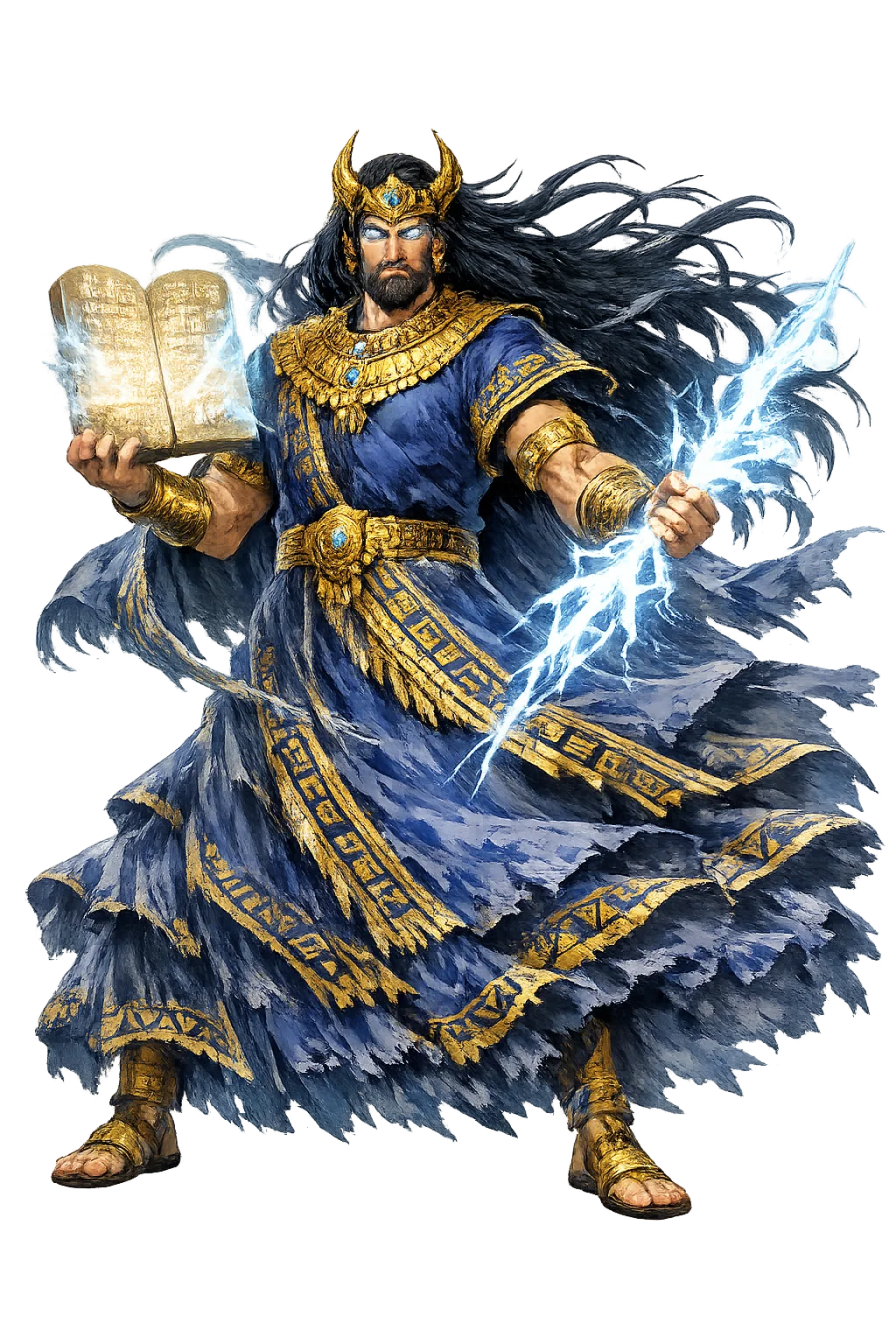
Sacred SymbolsHorned crown, Storm winds, Mountain, Bull, Scepter and crook
02

Etymology & Word Family

From original script to Unicode restoration

Isolate EN.LIL lord of the wind / air
Original Script 𒀭𒂗𒆤 Enlīl — "Reconstruction node for the Sumerian/Akkadian deity Enlil: the macron marks a discussable vowel length, not a canonical spelling claim."
Unicode Restoration Enlīl Restored stress, length, and script
Modern ASCII enlil Plain-ASCII fallback

Standard Assyriology transliterates the god as Enlil (𒀭𒂗𒇸). The Sumerian signs EN.LIL mean 'lord wind/air,' and the Akkadian rendering is Ellil. The length of the second vowel is reconstructed from comparative and orthographic evidence, not explicitly encoded in the cuneiform; the macron on Enlīl is a pedagogical mark that makes that open question visible, not a claim of canonical spelling.

03

Unicode Character Breakdown

Character-by-character philological analysis

CharacterUnicodeNameBlockPhonetic Role
EU+0045Latin Capital Letter EBasic LatinSame, capitalized
nU+006ELatin Small Letter NBasic LatinSame
lU+006CLatin Small Letter LBasic LatinSame
īU+012BLatin Small Letter I with MacronLatin Extended-AMacron: a visible question mark — the length of Enlil's second vowel is discussable, not certain
lU+006CLatin Small Letter LBasic LatinSame

The Tier 1 classification reflects how much of the original phonology this restoration preserves — stress and vowel length for Greek names, distinctive letters and diacritics for every other tradition.

04

Cult & Worship

How the sacred was kept — rites, sanctuaries, remains

The Cult

Enlīl's cult was the cult of legitimacy itself, and its seat was the Ekur — the 'Mountain House' at Nippur, a mud-brick ziggurat-temple whose foundations the Sumerians imagined rooted in the netherworld. Excavated by the University of Pennsylvania from 1889 and later by Iraqi teams, the sanctuary and its tablet houses yielded thousands of hymns and royal inscriptions — the excavated heart of his worship. Kingship was the temple's business: no city ruled without Enlīl's mandate, pronounced at Nippur and recorded in the Sumerian King List, and rulers from Ur-Namma onward rebuilt the Ekur and styled themselves the god's stewards. His chief priest, the sanga of Enlīl, stood at the summit of the Sumerian cultic hierarchy. Votive witness runs from Old Akkadian seals naming servants of Enlīl to first-millennium offerings; the temple's prestige outlasted every dynasty that served it.

In the Earth

The Ekur sanctuary at Nippur — excavated by the University of Pennsylvania (1889–1900) and later Iraqi teams — remains the central archaeological witness to Enlīl's cult. Its mud-brick ziggurat, temple platform, and surrounding tablet houses yielded thousands of Sumerian hymns, royal inscriptions, and school texts invoking Enlīl as king of the gods; the Pennsylvania expedition shipped some thirty thousand tablets from the scribal quarter alone. Votive statuettes and foundation figurines from the site name him as grantor of kingship to Ur-Nammu, Shulgi, and later rulers, while Old Babylonian copies of Enlīl and Ninlil and the Anzu epic found at Nippur fix his mythology in datable manuscripts.

05

Iconography

How Enlīl was imaged across the ages

The Image

Enlīl's own face is surprisingly hard to find: the king of the gods preferred the crown to the portrait. His mark is the multi-horned tiara — the supreme pair of horns among divine crowns — and from the second millennium onward the horned cap alone can stand for him, carved in symbol-rows on Babylonian boundary stones (kudurru), where each god condenses to an attribute: Anu's throne, Enlīl's crown. In Neo-Assyrian reliefs the horned cap hovers emblem-like above the sacred tree as one of the dynasty's guarded symbols. When anthropomorphic, he is the enthroned father in the horned cap, receiving suppliants and bestowing the sceptre. The number fifty — his station in the learned count of the gods — followed him into god-lists and scholastic texts. The image froze early and stayed frozen: the invisible god remained visibly crowned for two thousand years.

06

Reception & Transformation

The name after its own age — transmission, translation, survival

Afterlives

Enlīl's transmission is the biography of a throne changing hands. Through the Sumerian centuries he ruled unchallenged; but when Babylon rose, its scribes wrote the transfer into scripture — the Enūma eliš closes with the decree of Enlīl's authority handed to Marduk and the assembly hailing the new king. The old god did not vanish: his sign outlived his supremacy, for scribes of Anatolia borrowed the logogram EN.LÍL for their own storm-gods, and his name remained a title inside the writing system after the worship thinned. After cuneiform died he slept under the earth at Nippur until the Pennsylvania excavations of 1889–1900 dragged the Ekur's tablet-hoards back into the light and made him legible again. Twentieth-century scholarship gave the reading depth: Jacobsen's Treasures of Darkness and the great hymn editions framed him as the theological engine of Mesopotamian kingship. Assyriology still debates his very name — whether Sumerian knew the long vowel our macron writes — so the god of the commanding word survives as a question about how words sound. That is a fitting afterlife.

Identifications Across Traditions

The Unicode form Enlīl is a reconstruction node: standard Assyriology writes Enlil, while the macron makes visible the open question of vowel length. The Akkadians called him Ellil and continued to venerate him as king of the gods well into the first millennium BCE. The Assyrians identified their national god Aššur with Enlīl, so that the king of Assyria ruled by Enlīl-Aššur's mandate. In Hittite and Hurrian sources, Enlīl's functions were distributed among Taru, Kumarbi, and Teššub. Later Greek and Roman writers had no direct equivalent: Zeus/Jupiter overlaps in sovereignty, but Enlīl's specific association with wind, air, and the mountain temple has no precise Mediterranean counterpart.

Modern Legacy

Enlīl's legacy is the idea of legitimate kingship as a sacred mandate. The doctrine that the ruler derives authority from the chief god of the pantheon influenced Israelite, Persian, and later Christian theories of monarchy. The Ekur at Nippur remained a symbolic center long after political power shifted to Babylon and Assyria. In modern fantasy, Enlīl often appears as the storm-king, the patriarchal sky-father whose breath is the wind. PuniCodex keeps the macron not as a settled fact but as an invitation: every visitor is invited into the philological conversation. The name still means: the authority that fills the air.

07

The Meditation

What Enlīl means — beyond the dictionary

Enlīl is the god of atmosphere in its political sense: the medium through which command travels. A king's proclamation is heard because the air carries it; a storm arrives because the lord of the air sends it. This is not metaphor but Mesopotamian metaphysics: power is a physical force, and the god who rules the air rules the channel through which all other powers flow.

To name Enlīl is to remember that sovereignty is never merely human. It is atmospheric — a condition of the shared medium in which we breathe, speak, and obey. The Ekur, his mountain temple, was built not to dominate the landscape but to concentrate it: to make the invisible wind visible as authority. Every throne room is, in its way, a small Ekur. The macron on the second i is a small philological compass: it points to the distance between what the cuneiform records and what the voice once said, and it asks us to keep that distance open.

08

Frequently Asked Questions

Common questions about Enlīl, Phonological Reconstruction, Wind, Air, Storms, Kingship, and Unicode restoration

01How do you pronounce Enlīl?

In reconstructed pronunciation, Enlīl is /enˈliːl/ — approximately 'en-LEEL' — the second syllable is drawn out, like a sustained breath across the plain.

02What does Enlīl mean?

Enlīl means Reconstruction node for the Sumerian/Akkadian deity Enlil: the macron marks a discussable vowel length, not a canonical spelling claim. in the mesopotamian tradition.

03What are the symbols of Enlīl?

Enlīl is associated with Horned crown (The multi-horned tiara (agû) of divine rank — the number of horn-pairs marks a god's station, and Enlīl's is the supreme pair of all.), Storm winds (The seven winds (im-hul) released at his word — the hurricane that flattens rebels and the breeze that carries every royal proclamation.), Mountain (The Ekur at Nippur — his 'Mountain House,' rooted in the netherworld and peaked in heaven, the physical tether of cosmic order.), Bull (The wild bull whose bellow is thunder: the procreative, irresistible strength of the king of the gods.), Scepter and crook (The shepherd's crook and scepter of legitimate rule — the insignia handed to kings at Nippur and returned when a dynasty fell.).

04Why are there different spellings of Enlīl?

Each form is a historically attested restoration rather than a mistake: enlīl is the owned form (Lowercase owned domain form); Ellil is the alt form (Akkadian variant reflecting late pronunciation). PUNICODEX registers the full set so the tradition is preserved under every defensible spelling.

05Why restore Enlīl in Unicode?

Plain ASCII enlil strips the stress, length, and script that make the name specific. Unicode restoration returns the name to its original written dignity.

06What is the most important myth about Enlīl?

“Enlīl and Ninlil” — the The Sacred Marriage story that anchors the mythology of Enlīl, told in full on the lore page.

09

Scholarly Sources

The philological foundations of this restoration

Every claim on this page is grounded in established scholarship. The orthographic restorations follow disciplinary convention. The etymological chain follows the best available reference works. This is not invention — it is resurrection through scholarship.

◈

Lexicography & Philology

  • CAD
  • AHw
  • Kramer
  • Jacobsen
◎

Primary Texts

  • Atrahasis, tablets I–III (the deluge decreed by Enlīl)
  • Enuma Elish, tablets VI–VII (Enlil's decree transferred to Marduk)
  • Anzu Epic (Old Babylonian and Standard Babylonian versions)
◉

Archaeology & Art History

  • Material evidence — iconography, inscriptions, and temple archaeology — for Enlīl and related cults.
✦

Religious Studies

  • ETCSL — Enlīl and Ninlil (1.2.1); Enlil in the Ekur (4.05.01)
  • Black & Green, Gods, Demons and Symbols of Ancient Mesopotamia
  • Jacobsen, The Treasures of Darkness
Return

The Surface Awaits

You have traced the name from its earliest attestation to its Unicode restoration. Now return to the myth. The story is where the name lives.

Back to Lore
Enlīl mascot