
The Cult
No temples to Duryodhana in orthodox India — the victors’ orthodoxy forbade it. But the epic’s own ambivalence is his cult: he is the character every Mahābhārata retelling must rescue from simplicity.
Extended Lore
Etymology · Orthography · Cult · Iconography · Reception · Sources
Essential information about Duryodhana, Ambition, Rivalry, War
From original script to Unicode restoration
The name Duryodhana reaches the modern world through scholarly transliteration of the sanskrit tradition. Because the conventional spelling uses only Latin letters, its Unicode and ASCII forms coincide — the tradition it carries is in the name itself, not in diacritics.
Character-by-character philological analysis
| Character | Unicode | Name | Block | Phonetic Role |
|---|---|---|---|---|
| D | U+0044 | Latin Capital Letter D | Basic Latin | Same |
| u | U+0075 | Latin Small Letter U | Basic Latin | Short /u/ |
| r | U+0072 | Latin Small Letter R | Basic Latin | Same |
| y | U+0079 | Latin Small Letter Y | Basic Latin | Same |
| o | U+006F | Latin Small Letter O | Basic Latin | Same |
| d | U+0064 | Latin Small Letter D | Basic Latin | Same |
| h | U+0068 | Latin Small Letter H | Basic Latin | Same: aspirate /dʱ/ |
| a | U+0061 | Latin Small Letter A | Basic Latin | Short /a/ |
| n | U+006E | Latin Small Letter N | Basic Latin | Same |
| a | U+0061 | Latin Small Letter A | Basic Latin | Short /a/ |
This restoration reflects fidelity to the attested tradition, not recovered diacritics: every character of Duryodhana already survives in ASCII. What the restoration preserves is the canonical spelling itself — the form scholarship standardised.
How the sacred was kept — rites, sanctuaries, remains
No temples to Duryodhana in orthodox India — the victors’ orthodoxy forbade it. But the epic’s own ambivalence is his cult: he is the character every Mahābhārata retelling must rescue from simplicity.
Duryodhana’s monuments are performance: the Kutiyattam and Kathakali stages of Kerala keep the dice-game and the embassies in living repertory; and the Indonesian wayang kulit shadow-theatre’s Duryudana puppets are museum-pieces of the epic’s longest journey.
How Duryodhana was imaged across the ages
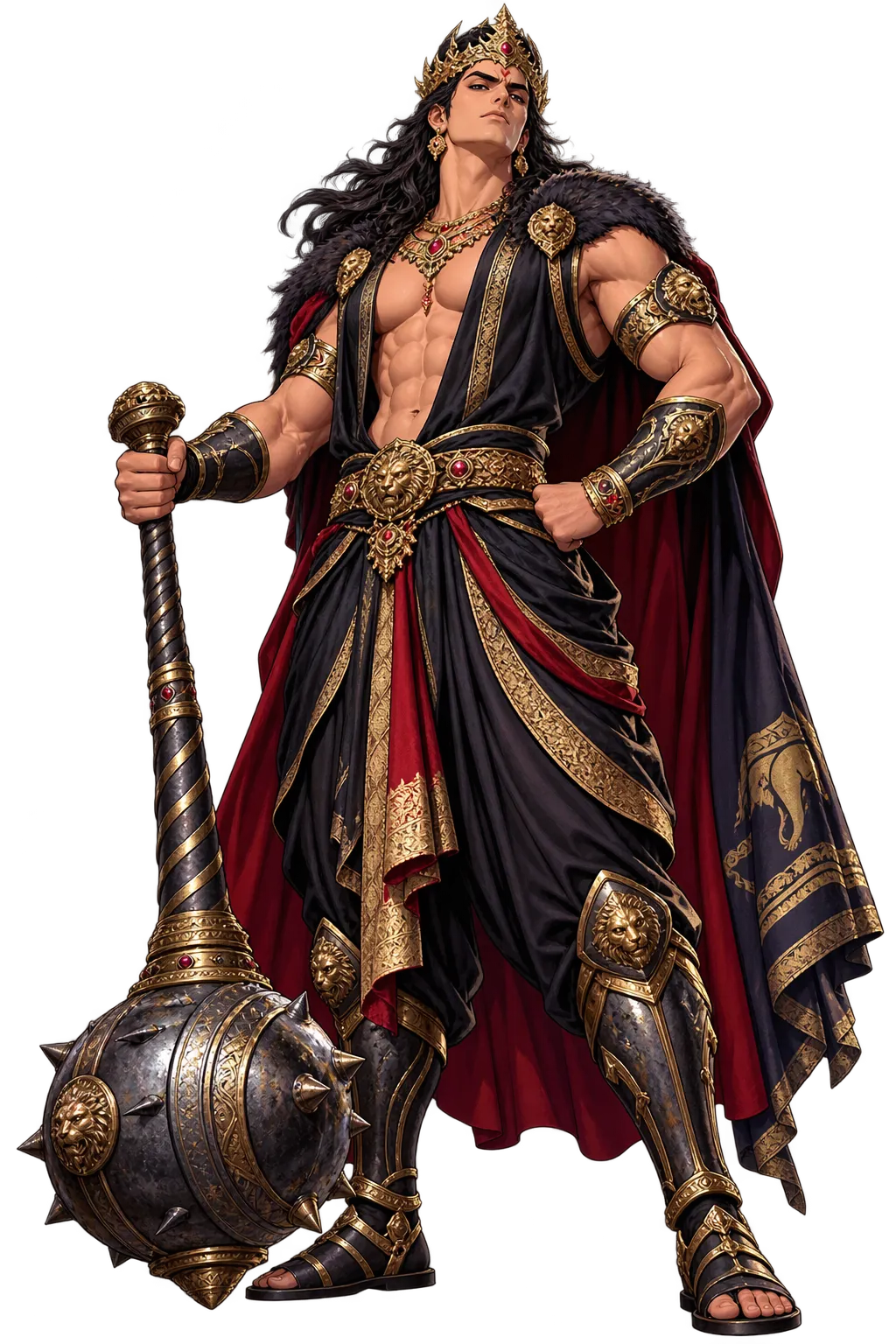
The mace-fighter in royal dress, often with Karṇa beside him; in Indonesian wayang, the strong rounded form of the amUK-king. His icon is the clenched fist — the epic’s most repeated gesture of refusal.
The name after its own age — transmission, translation, survival
Comparative literature sets him beside Achilles and Turnus as the enemy the epic loves; postcolonial readings (Bhyrappa’s Parva, the Indonesian tellings) made his cause the honest one. He remains the great test of the Mahābhārata’s fairness: the reader who hates him has read half the book.
Duryodhana is the epic’s dark mirror of the dharmarāja Yudhiṣṭhira: where the eldest Pāṇḍava keeps the letter and loses the spirit, Duryodhana keeps the pride and loses everything. Later tradition made him a byword for envy, but the critical readings — from the Bhārata’s own ambivalence to modern novelists — keep restoring the man the epic refused to flatten.
His name is the subcontinent’s standing word for ruinous obstinacy; his friendship with Karṇa, for loyalty across caste. The dice-game is staged as dance-drama across South and Southeast Asia; and in Indonesian wayang, where the Mahābhārata became a national epic, Duryodhana (Duryudana) is among the most beloved characters — the loser the culture refuses to disown.
What Duryodhana means — beyond the dictionary
Duryodhana: a name that means “hard to conquer”, worn by the man history conquered most completely. Restored plainly, it keeps its double edge — the boast and the epitaph in four syllables, the epic’s whole tragedy compressed into one who would not yield a needle’s point.
Common questions about Duryodhana, Ambition, Rivalry, War, and Unicode restoration
In reconstructed pronunciation, Duryodhana is /dʊrjˈoːdʰənə/ — approximately “door-YO-dhun-uh”.
Duryodhana means 'Hard to Conquer in Battle' (dur- 'hard' + yodhana 'fighting') — the eldest Kaurava, rival of the Pāṇḍavas whose refusal to yield their share of the kingdom brings about the Kurukṣetra war in the sanskrit tradition.
Duryodhana is associated with The Hundredth Son (Born of Gandhārī’s split pregnancy as a ball of flesh, divided into a hundred sons by Vyāsa’s grace.), Mace-Master (The equal of Bhīma with the gadā; his duel with Bhīma closes the war’s eighteenth day.), Friend of Karṇa (The epic’s one unbreakable friendship: the outcast-sūta king he crowned against all caste law.), The Dice Refusal (“Not a needle’s point of land” — the sentence that made the Kurukṣetra war inevitable.).
Duryodhana is written entirely in ASCII letters, so its restoration is about canonical fidelity rather than recovered diacritics: the temple fixes the name in its scholarly standard spelling, attested in the source tradition, instead of leaving it to drift.
“The Ball of Flesh” — the Ādi Parvan story that anchors the mythology of Duryodhana, told in full on the lore page.
The philological foundations of this restoration
Every claim on this page is grounded in established scholarship. The orthographic restorations follow disciplinary convention. The etymological chain follows the best available reference works. This is not invention — it is resurrection through scholarship.
You have traced the name from its earliest attestation to its Unicode restoration. Now return to the myth. The story is where the name lives.
Back to Lore