PuniCodex

Extended Lore

Δελφοί Delphoí

Etymology · Orthography · Cultural Legacy · Reception · Primary Sources

Tier 1 Delphoí.com
Delphoí — Oracle of Apollo
01

Quick Facts

Essential information about Delphoí, Oracle of Apollo

Original ScriptΔελφοί
Unicode RestorationDelphoí
Reconstructed Pronunciation/del.pʰoˈi/
PantheonGreek Location
DomainOracle of Apollo
MeaningWomb (from δελφύς)
ClassificationTier 1
Primary DomainDelphoí.com
Sacred SymbolsOmphalos stone, Tripod of Pythia, Laurel wreath, Dolphin, Sacred way with treasuries
02

Etymology & Word Family

From original script to Unicode restoration

Proto-indo-european *gʷelbʰ- womb, swell
Original Script Δελφοί Delphoí — "Womb (from δελφύς)"
Unicode Restoration Delphoí Restored stress, length, and script
Modern ASCII delphoi Plain-ASCII fallback

Usually connected with Greek δελφύς 'womb' and a Proto-Indo-European root *gʷelbʰ- 'womb, swell', though Beekes considers a pre-Greek origin equally possible.

03

Unicode Character Breakdown

Character-by-character philological analysis

CharacterUnicodeNameBlockPhonetic Role
DU+0044Latin Capital Letter DBasic LatinDelta
eU+0065Latin Small Letter EBasic LatinShort epsilon
lU+006CLatin Small Letter LBasic LatinLambda
pU+0070Latin Small Letter PBasic LatinPi
hU+0068Latin Small Letter HBasic LatinPhi
oU+006FLatin Small Letter OBasic LatinShort omicron
íU+00EDLatin Small Letter I with AcuteLatin-1 SupplementAcute on iota

The Tier 1 classification reflects how much of the original phonology this restoration preserves — stress and vowel length for Greek names, distinctive letters and diacritics for every other tradition.

04

Cultural Significance

From ancient cult to modern memory

Delphoí in Later Traditions

Under Rome, Delphoi kept its prestige without its power: emperors consulted the oracle and Greek cities still sent embassies, but the Pythia's answers grew rarer as the eastern oracles of Claros and Didyma rose. Christians read the sanctuary's decline providentially — according to late tradition, the emperor Julian's consultation of Delphoi in 362 CE drew the god's bleak reply that his spring had failed and his tripod stilled — and within two generations the oracle fell silent under Theodosius' closure of the temples. The site then passed through a Byzantine village to Frankish lordship; its stones went into the houses of Kastri until the French Archaeological School bought the village in 1891 and excavated beneath it. Rome, Christendom, and modernity each preserved Delphoi differently — as monument, as cautionary tale, and as dig.

Modern Legacy

Delphoi never really ended. The excavations of the French School (from 1892) revealed the sanctuary that had slept under Kastri, and modern Delphi — a UNESCO World Heritage site — receives visitors on the same Sacred Way their ancestors walked. In European speech 'Delphic' became a permanent adjective for oracular ambiguity: every equivocal utterance of a central bank or a politician is 'Delphic' still. The two inscribed hymns to Apóllōn found on the sanctuary wall have been transcribed into modern notation and performed — arguably the oldest notated melody anyone has heard. And the maxim 'Know thyself' (gnōthi seauton), cut into the temple's pronaos, migrated from stone to Socratic philosophy to modern self-help without losing a syllable. Every four years a flame is still kindled at Delphi for international relays — a secular survival of the sacred fire that once burned above the chasm.

In the Earth

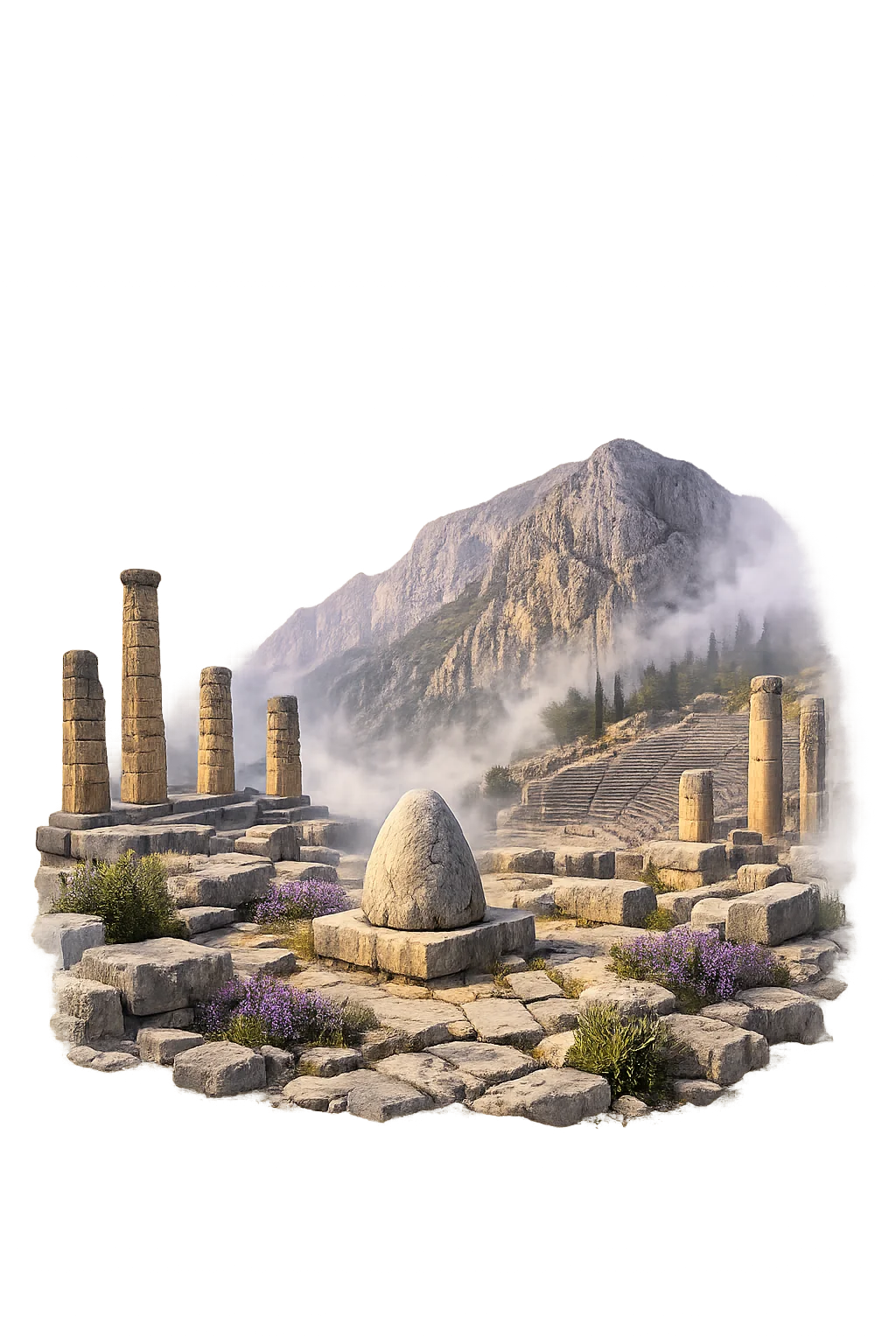
The sanctuary's material record spans the Mycenaean age to late antiquity. A Mycenaean cult deposit with bronze figurines under the temple terrace attests worship from the Late Bronze Age. The fourth-century BCE temple of Apóllōn — the fourth on the site, funded by the Alcmaeonid family with a Parian marble façade — stands in reconstructed form on its excavated foundations. The Athenian treasury (c. 490 BCE), rebuilt in place, carried the inscriptions of the Delphic hymns; the omphalos (a Hellenistic marble copy in the Delphi museum), the Castalian spring, the theater seating five thousand, and the stadium where the Pythian footraces ran complete the complex. Excavations by the French School since 1892 also revealed the Marmaria sanctuary of Athena Pronaia with its celebrated fourth-century tholos.

05

The Meditation

What Delphoí means — beyond the dictionary

Delphoi is the ancient world arguing with itself about certainty. Every famous consultation — Croesus counting on a god who counted better, Oedipus outrunning a sentence that ran faster, Socrates made wise by a god who would not explain — ends at the same insight: the oracle never lies, but it never simplifies. 'Know thyself' over the door was not a greeting but a warning; the god's first demand was that the questioner know the limits of the question.

The restoration Delphoí belongs to that same honesty. English 'Delphi' has lost the aspirated phi, the final diphthong, and the accent that marked the word as a Greek plural — a name, perhaps, for the twin peaks above it. To write Delphoí is to keep the breath and the glide, the sound of a place where mortals once climbed to hear a sentence they would spend their lives interpreting.

06

Frequently Asked Questions

Common questions about Delphoí, Oracle of Apollo, and Unicode restoration

01How do you pronounce Delphoí?

In reconstructed pronunciation, Delphoí is /del.pʰoˈi/ — approximately 'del-PHOY-ee' — the middle syllable has a puffed 'p' and a diphthong like 'boy'; the final syllable is lightly stressed.

02What does Delphoí mean?

Delphoí means Womb (from δελφύς) in the greek-location tradition.

03What are the symbols of Delphoí?

Delphoí is associated with Omphalos stone (The 'navel' of the earth marking Delphi as the centre of the Greek world), Tripod of Pythia (The seat from which Apollo's priestess delivered oracular responses), Laurel wreath (Apollo's sacred plant and the prize of the Pythian Games), Dolphin (The creature said to have brought Apollo's priesthood to Delphi in the form of Cretan sailors), Sacred way with treasuries (The processional route lined by city-state dedications).

04Why are there different spellings of Delphoí?

Each form is a historically attested restoration rather than a mistake: Delphí is the alt form (Alternate English accentuation of Δελφοί; the temple uses Delphoí.). PUNICODEX registers the full set so the tradition is preserved under every defensible spelling.

05Why restore Delphoí in Unicode?

Plain ASCII delphoi strips the stress, length, and script that make the name specific. Unicode restoration returns the name to its original written dignity.

06What is the most important myth about Delphoí?

“Apollo Slays Python” — Delphoí sits on the southern slope of Mount Parnassos above the Gulf of Corinth, but in Greek myth it is the axis of the world. Its name was said to come from delphys, 'womb,' because the sanctuary marked the place where Earth gave birth to her greatest oracle. Before Apollo, the site belonged to Earth and the serpent Python; after Apollo, it became the voice through which kings, colonists, and philosophers heard the will of heaven. For centuries Delphi mediated between Greek cities and the divine. Tyrants and democrats alike sought Apollo's guidance; colonies were founded on oracles delivered from the Pythia's tripod. The sanctuary's prestige peaked in the sixth and fifth centuries BCE, when its influence extended from Sicily to the Black Sea, making Delphoi a panhellenic center of law, religion, and diplomacy. The full telling lives on the lore page.

07

Scholarly Sources

The philological foundations of this restoration

Every claim on this page is grounded in established scholarship. The orthographic restorations follow disciplinary convention. The etymological chain follows the best available reference works. This is not invention — it is resurrection through scholarship.

Lexicography & Philology

  • Pape, W., & Benseler, G. E. Wörterbuch der griechischen Eigennamen. Braunschweig: Vieweg, 1884.
  • Barrington

Primary Texts

  • Homeric Hymn to Apollo (3) — the foundation myth of the oracle
  • Pausanias, Description of Greece 10.5–24 — the Phocian book on Delphi

Archaeology & Art History

  • Herodotus 1.46–49 — Croesus at Delphi
  • Parke & Wormell, The Delphic Oracle, 2 vols. (Oxford, 1956)
  • Fontenrose, The Delphic Oracle (University of California Press, 1978)
  • Scott, Michael, Delphi: A History of the Center of the Ancient World (Princeton, 2014)

Religious Studies

  • Comparative studies of greek-location religion and the place of Delphoí within it.
Return

The Surface Awaits

You have traced the name from its earliest attestation to its Unicode restoration. Now return to the myth. The story is where the name lives.

Back to Lore
Delphoí mascot