PuniCodex

Extended Lore

דָּוִד Dāwîḏ

Etymology · Orthography · Cult · Iconography · Reception · Sources

Tier 1 Dāwîḏ.com
Dāwîḏ — King, Psalmist
01

Quick Facts

Essential information about Dāwîḏ, King, Psalmist

Original Scriptדָּוִד
Unicode RestorationDāwîḏ
Reconstructed Pronunciation/dɔːˈwiːð/
PantheonCanaanite
DomainKing, Psalmist
MeaningSecond king of Israel
ClassificationTier 1
Primary DomainDāwîḏ.com
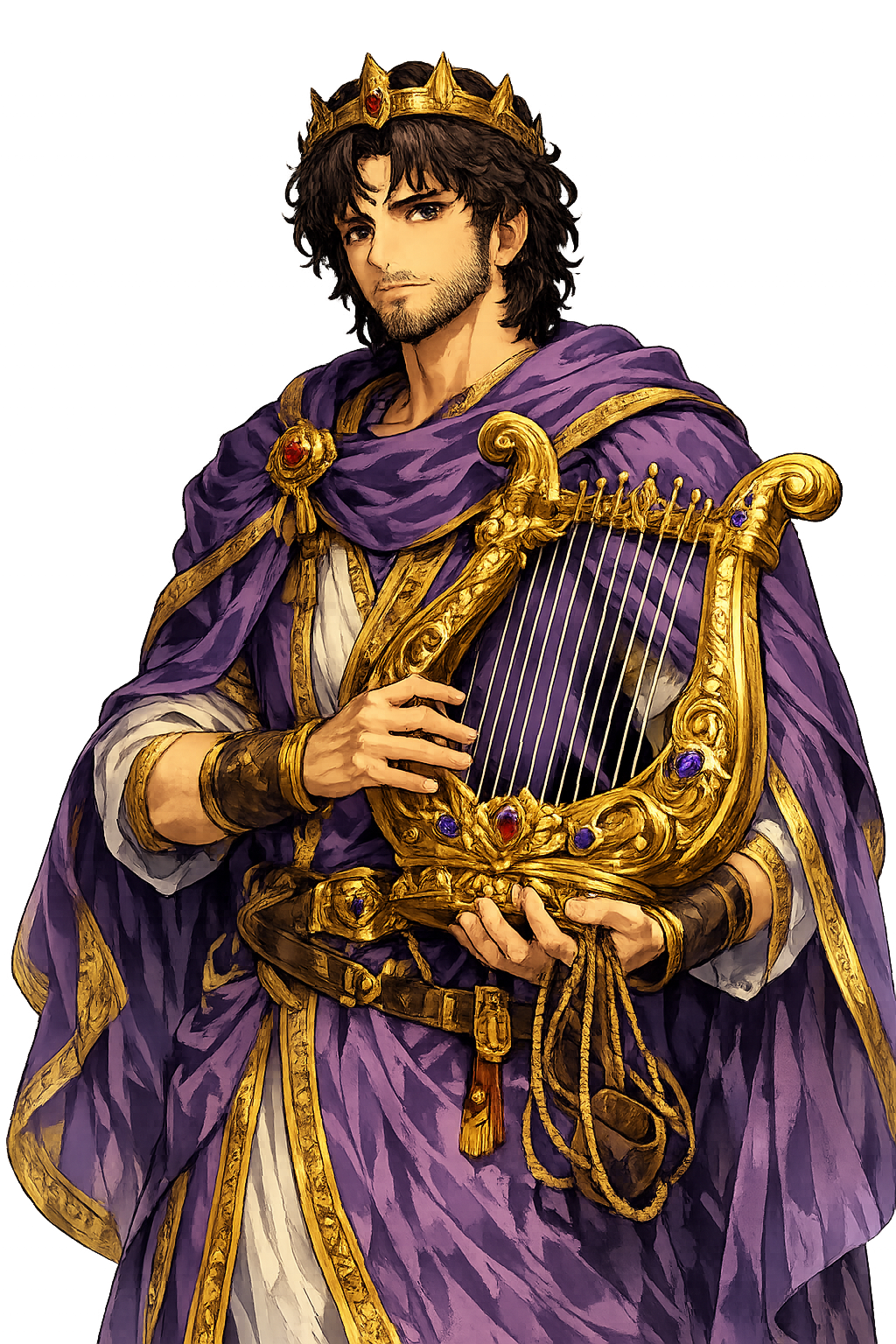
Sacred SymbolsLyre / kinnor, Sling and stone, Crown, Ark of the Covenant, Star of David (later emblem)
02

Etymology & Word Family

From original script to Unicode restoration

Original Script דָּוִד Dāwîḏ — "Second king of Israel"
Unicode Restoration Dāwîḏ Restored stress, length, and script
Modern ASCII david Plain-ASCII fallback

The name Dāwîḏ carries the orthographic signature of the canaanite tradition: דָּוִד. Unicode restoration recovers what ASCII flattens.

03

Unicode Character Breakdown

Character-by-character philological analysis

CharacterUnicodeNameBlockPhonetic Role
DU+0044Latin Capital Letter DBasic LatinSame, capitalized
āU+0101Latin Small Letter A with MacronLatin Extended-AMacron: long vowel
wU+0077Latin Small Letter WBasic LatinWaw w
îU+00EELatin Small Letter I with CircumflexLatin-1 SupplementCircumflex: long vowel
ḏU+1E0FLatin Small Letter D with Line BelowUnknownDalet with line below

The Tier 1 classification reflects how much of the original phonology this restoration preserves — stress and vowel length for Greek names, distinctive letters and diacritics for every other tradition.

04

Cult & Worship

How the sacred was kept — rites, sanctuaries, remains

The Cult

David was never a god, but few dead men have been prayed by so many for so long. His cult is the Psalter itself: the synagogue chants his Psalms daily — the Ashrei of Psalm 145 anchors the morning service — and the Christian office was built on his book, Benedict's Rule distributing the entire Psalter across every monastic week, a rhythm still kept in monasteries. Pilgrimage gave him geography: by the fourth century Christian travelers were shown the house of David on Mount Zion — the Bordeaux pilgrim of 333 CE already marks the spot — and the tomb of David on Zion became one of Jerusalem's holiest stations, venerated by Jews and noted by medieval travelers of every confession. Islam counts him a prophet. There is no altar smoke and no festival day: instead three liturgies and a tomb, and a kingship remembered less for its conquests than for the songs that outlived them.

In the Earth

The Tel Dan Stele (ninth century BCE) contains the phrase bytdwd, 'House of David,' the earliest extra-biblical reference to the Davidic dynasty. The Mesha Stele may also allude to the 'House of David,' though the reading is disputed. Excavations in the City of David have uncovered Iron Age fortifications, the Siloam Tunnel, and residential quarters, but the scale of David's united kingdom remains contested between 'high chronology' and 'low chronology' interpretations. Khirbet Qeiyafa, a fortified site on the Judah-Philistia border, has been proposed by some as evidence of an early tenth-century Judahite state, though this is debated.

05

Iconography

How Dāwîḏ was imaged across the ages

The Image

David is among the earliest biblical figures painted: the third-century synagogue at Dura-Europos shows Samuel anointing him and the duel with Goliath — the shepherd's victory already canonical image. Byzantium made him splendid: the seventh-century silver David Plates from Cyprus, found at Karavas, hammer his combat with Goliath into a cycle of repoussé scenes now divided between the British Museum and Nicosia. The tenth-century Paris Psalter (BnF, Grec 139) shows him as Orpheus' heir, seated with his lyre beside the personification of Melody — the antique soul of the psalmist reborn on purple vellum. Medieval art added the genealogy: David heads the long ancestor line climbing to Christ in every church's scheme. The Renaissance crowned the set — Donatello's bronze boy (Bargello) and Michelangelo's marble giant-slayer (Galleria dell'Accademia, 1504) turned the sling-bearer into the emblem of measured, watchful power. Recognition is simple wherever he appears: lyre, sling, star, crown.

06

Reception & Transformation

The name after its own age — transmission, translation, survival

Afterlives

David's book traveled farther than David's kingdom. The Great Psalms Scroll from Qumran (11Q5) already calls him the composer of 4,050 songs given 'by prophecy' — the first Davidic canon. The Greek Psalter carried him into Christian worship; Jerome's Latin versions made him the prayerbook of the West. The medieval Psalter became Europe's most illuminated book — the St Albans Psalter, England's first great Romanesque picture cycle, is in essence a life of David in paint. The Reformation turned him into metrical song: the Geneva Psalter (1562) gave Calvinist Europe his words in singable verse, and Sternhold and Hopkins did the same for England's parish churches. Modern scholarship then rewrote the authorship question: de Wette's early nineteenth-century essays first pried the Psalms from David's hand, and Gunkel's form criticism with Mowinckel's cultic readings explained the book as the temple's and the people's poetry — David its collector and mask rather than its writer. Through every stage the voice stayed his: lament, thanksgiving, and a king's trust addressed to a God who lets him confess.

Identifications Across Traditions

In Islam, David is Dāwūd, a prophet-king who received the Zabūr (Psalms), could soften iron, and was granted a wise judgment. Christianity reads David as the ancestor of Jesus and the model of the messianic king; the Gospels open with his genealogy and the Psalms with his voice. Jewish tradition makes him the sweet singer of Israel and the founder of the liturgical year. Armenian, Ethiopian, and Samaritan traditions all claim aspects of his legacy. Across these traditions, David remains the same complex figure: beloved, flawed, and foundational.

Modern Legacy

Dāwîḏ gave the West one of its most enduring books of prayer and poetry. The Psalms have been recited in temples, churches, and mosques for millennia; their language of lament, thanksgiving, and royal trust shaped later liturgy and literature. The 'David and Goliath' narrative became shorthand for any victory of the weak over the strong, while the Star of David became the emblem of Judaism and later the state of Israel. Michelangelo's marble David, Renaissance Florence's civic ideal, reimagines the shepherd boy as the concentrated power of republican virtue. In popular culture, David is king, poet, sinner, and hero all at once.

07

The Meditation

What Dāwîḏ means — beyond the dictionary

Dāwîḏ is the king who never stops being a poet. Even when he holds a crown, he reaches for a lyre; even when he holds power, he is undone by desire and restored by lament. His greatness lies not in moral perfection but in the capacity to be named and to name himself — to hear Nathan's parable and say, 'I have sinned against the LORD.'

Modern politics rarely tolerates such public contrition, yet David's story suggests that legitimacy depends on it. The poet-king is the ruler who remembers that power is borrowed and that the song outlasts the sword. To meditate on Dāwîḏ is to meditate on the possibility that art and authority, violence and vulnerability, can inhabit a single life without being reconciled.

08

Frequently Asked Questions

Common questions about Dāwîḏ, King, Psalmist, and Unicode restoration

01How do you pronounce Dāwîḏ?

In reconstructed pronunciation, Dāwîḏ is /dɔːˈwiːð/ — approximately 'daw-EEDH' — draw out the first 'aw' like 'dawn'; the middle sound is 'wee' with a glide; the final consonant is a soft 'th' as in 'this'.

02What does Dāwîḏ mean?

Dāwîḏ means Second king of Israel in the canaanite tradition.

03What are the symbols of Dāwîḏ?

Dāwîḏ is associated with Lyre / kinnor (The instrument of the Psalms and the sound that calms an afflicted king), Sling and stone (The weapons of the underdog; the defeat of Goliath by faith and skill), Crown (Kingship over Judah and Israel, and later the symbol of the Davidic line), Ark of the Covenant (The sacred chest David brings to Jerusalem, making the city a religious as well as political capital), Star of David (later emblem) (A medieval and modern symbol that claims descent from and allegiance to the house of David).

04Why restore Dāwîḏ in Unicode?

Plain ASCII david strips the stress, length, and script that make the name specific. Unicode restoration returns the name to its original written dignity.

05What is the most important myth about Dāwîḏ?

“Anointed in Secret” — the 1 Samuel 16 story that anchors the mythology of Dāwîḏ, told in full on the lore page.

09

Scholarly Sources

The philological foundations of this restoration

Every claim on this page is grounded in established scholarship. The orthographic restorations follow disciplinary convention. The etymological chain follows the best available reference works. This is not invention — it is resurrection through scholarship.

◈

Lexicography & Philology

  • Abraham
◎

Primary Texts

  • The Ugaritic Baal Cycle; ritual texts from Ugarit and Phoenician inscriptions.
◉

Archaeology & Art History

  • Material evidence — iconography, inscriptions, and temple archaeology — for Dāwîḏ and related cults.
✦

Religious Studies

  • HALOT s.v. דָּוִד
  • TDOT s.v. David
  • 1–2 Samuel
  • Psalms
  • McCarter, 1 Samuel / 2 Samuel (Anchor Bible)
  • Halpern, David's Secret Demons
  • Baden, The Historical David
Return

The Surface Awaits

You have traced the name from its earliest attestation to its Unicode restoration. Now return to the myth. The story is where the name lives.

Back to Lore
Dāwîḏ mascot