PuniCodex

Extended Lore

Dagda

Etymology · Phonology · Orthography · Cultural Legacy · Primary Sources

Tier 2 Dagda
Dagda — Abundance, Strength, Magic
01

Quick Facts

Essential information about Dagda, Abundance, Strength, Magic

Scholarly TransliterationDagda
Unicode RestorationDagda
Reconstructed Pronunciation/ˈdaɣ.ða/
PantheonCeltic
DomainAbundance, Strength, Magic
MeaningThe Good God (from Old Irish Dagde)
ClassificationTier 2
Primary DomainDagda
Sacred SymbolsThe great club, The cauldron of Murias, The harp and its three strains, The porridge pit, Brú na Bóinne
02

Etymology & Word Family

From original script to Unicode restoration

Scholarly Transliteration Dagda Dagda — "The Good God (from Old Irish Dagde)"
Unicode Restoration Dagda Restored stress, length, and script
Modern ASCII dagda Plain-ASCII fallback

Dagda is Tier 2 by the mechanical rule: the normalized Old Irish form is already plain ASCII — there is no diacritic and no distinctive letter for the ASCII alphabet to lose. The capital alone distinguishes the temple form from the input; the god's standing in the tradition is beside the point.

03

Unicode Character Breakdown

Character-by-character philological analysis

CharacterUnicodeNameBlockPhonetic Role
DU+0044Latin Capital Letter DBasic LatinSame
aU+0061Latin Small Letter ABasic LatinSame
gU+0067Latin Small Letter GBasic LatinSame
dU+0064Latin Small Letter DBasic LatinSame
aU+0061Latin Small Letter ABasic LatinSame

The Tier 2 classification reflects how much of the original phonology this restoration preserves — stress and vowel length for Greek names, distinctive letters and diacritics for every other tradition.

04

Cultural Significance

From ancient cult to modern Unicode

Ancient Domain

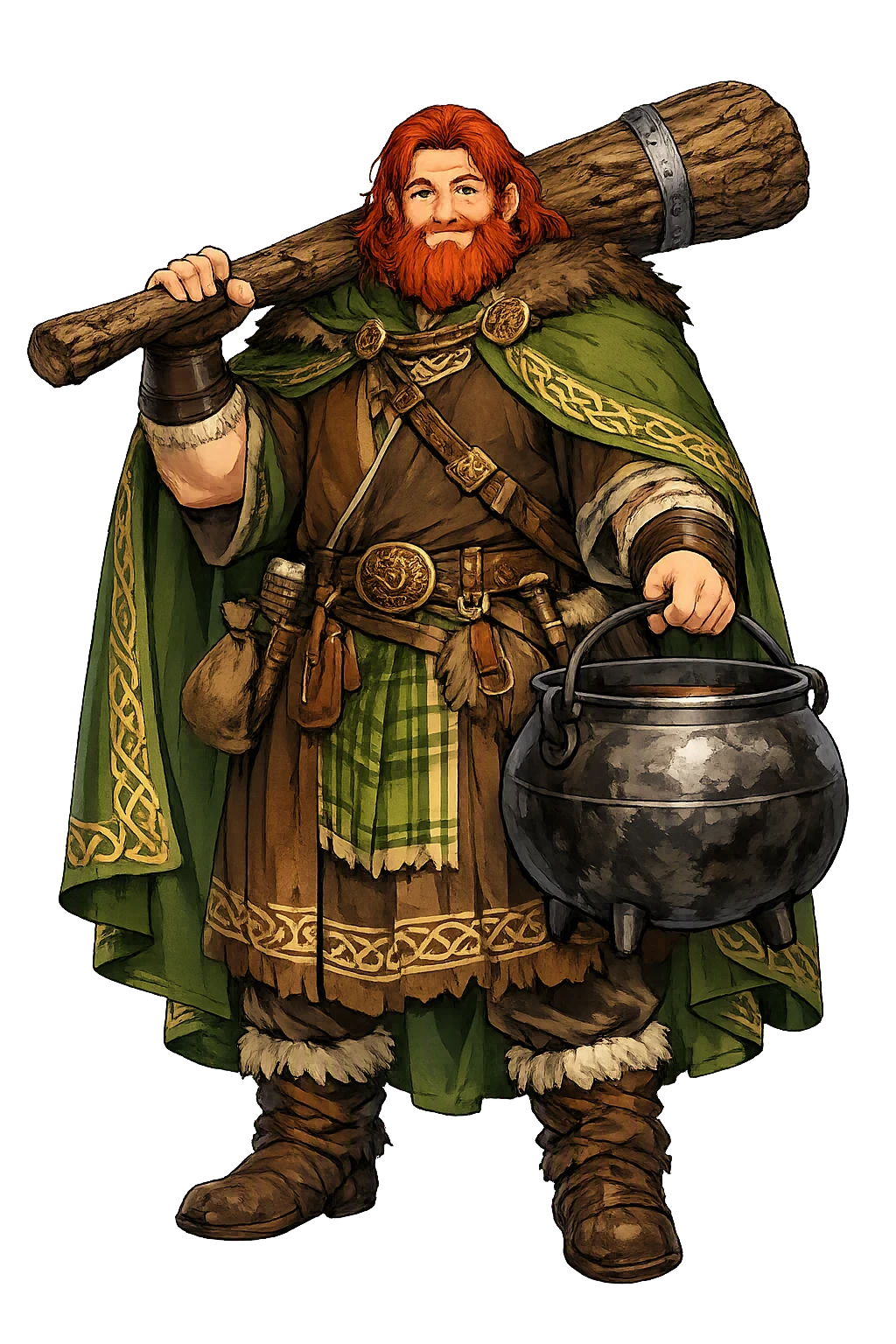
The Dagda — Eochu Ollathir, the All-Father — is the great father-figure of the Túatha Dé Danann: their king for eighty years, master of every art, and owner of three wonders no other Irish god can match — the club whose one end kills nine men at a blow while the other restores them, the cauldron from which no company ever went away unsatisfied, and the harp that leaps to his hand from the enemy's wall and plays the world to tears, to laughter, and to sleep.

Dagda in Later Traditions

The Dagda's clearest cross-border witness is not Welsh but Gaulish. The Mabinogion and the whole Welsh corpus know no counterpart of him — the Brythonic silence is total, and no scholar has repaired it convincingly. The comparison the handbooks prefer runs to Gaul: the god Sucellos, 'the Good Striker', shown on altars with his long-shafted mallet in one hand and a pot in the other, often beside his consort Nantosuelta. Sjoestedt and Mac Cana both set Sucellos beside the Dagda — the good god with the enormous club and the vessel of plenty — as two regional faces of one Celtic figure-type: the all-providing father whose tool serves both ends of life. The Christian scribes who preserved him euhemerized him in their own way, demoting the god to an ancient king mighty in magic and druidry; the medieval glossaries kept his name's meaning anyway, and Cormac's Glossary was already printing 'good god' around the year 900.

Modern Legacy

The Dagda rode the Celtic revival better than almost any Irish god. Lady Gregory's Gods and Fighting Men (1904) carried Cath Maige Tuired into English — porridge pit, ford, and harp complete — and made him the genial giant of a generation's reading, the counterweight to Yeats's more ethereal Sidhe. Twentieth-century scholarship gave him his modern standing: Mac Cana's Celtic Mythology made him the type-case of the Celtic all-skilled father, and the Sucellos comparison fixed him in the pan-Celtic frame. Modern Druidry and Celtic pagan practice honor him as god of plenty, craft, and fatherhood; and Brú na Bóinne — Newgrange, the most visited prehistoric monument in Ireland — keeps his mythic address, the Brug of the Dagda that his son won for a day and a night. In Irish itself the name never went anywhere: an Dagda has meant the same large, shrewd, inexhaustible father of the gods for twelve hundred years of the written language.

Unicode Restoration as Cultural Act

Restoring Dagda in a domain name is more than orthographic accuracy. It is a statement that the internet should recognize the full range of human writing — not only the ASCII keyboard.

05

Frequently Asked Questions

Common questions about Dagda, Abundance, Strength, Magic, and Unicode restoration

01How do you pronounce Dagda?

In reconstructed pronunciation, Dagda is /ˈdaɣ.ða/ — approximately 'DAH-ghah' — stress the first syllable; let the g melt into a voiced gargle and the d into the soft 'th' of 'this'. Modern Irish 'an Dagda' keeps the same shape..

02What does Dagda mean?

Dagda means The Good God (from Old Irish Dagde) in the celtic tradition.

03What are the symbols of Dagda?

Dagda is associated with The great club (Life and death hung on opposite ends of one tool — power that answers for both), The cauldron of Murias (Plenty that no company can exhaust — abundance as a standing fact, not a lucky day), The harp and its three strains (Weeping, laughing, sleeping — the whole register of feeling under a master's hand), The porridge pit (The Fomorians' mock-feast swallowed whole — insult converted into endurance), Brú na Bóinne (The Brug on the Boyne, his Otherworld house — the mound his son Óengus won for a day and a night).

04Why restore Dagda in Unicode?

Plain ASCII dagda strips the stress, length, and script that make the name specific. Unicode restoration returns the name to its original written dignity.

05What is the most important myth about Dagda?

When the Túatha Dé Danann came to Ireland, the tradition says, they came from four cities of the north of the world — Falias, Gorias, Finias, and Murias — and each city yielded a treasure. From Murias came the Dagda's cauldron, and the poem of the four jewels fixes its fame in one line: no company ever went away from it unthankful.The Lebor Gabála Érenn, Ireland's medieval book of invasions, then gives him the longest reign of the divine kings: Eochu Ollathir, that is the Dagda, held the kingship for eighty years — and it records his death at the Brug, his mound on the Boyne, from the wound that Cethlenn, Balor's wife, had dealt him at Mag Tuired.

06

Scholarly Sources

The philological foundations of this restoration

Every claim on this page is grounded in established scholarship. The orthographic restorations follow disciplinary convention. The etymological chain follows the best available reference works. This is not invention — it is resurrection through scholarship.

Lexicography & Philology

  • Vendryes

Primary Texts

  • The Immram Brain (Voyage of Bran); Tochmarc Étaíne; Cóir Anmann; medieval Irish saga literature.

Archaeology & Art History

  • Material evidence — iconography, inscriptions, and temple archaeology — for Dagda and related cults.
  • The Dagda is a textual god: no ogham stone names him, no votive inscription invokes him, and Irish paganism generally left literature rather than dedications. His manuscript witnesses are exact — Cath Maige Tuired survives uniquely in the sixteenth-century British Library MS Harley 5280, which is the basis of Gray's edition, while Lebor Gabála Érenn is preserved in the Book of Leinster and its sister codices. His mythic address, by contrast, is one of the most famous pieces of architecture in Europe: Brú na Bóinne, the Bend of the Boyne, where the passage tomb of Newgrange (c. 3200 BCE) has stood for five thousand years on the site the tales call the Dagda's Brug and Óengus's síd. The nearest material kin of his iconography is Gaulish: the altar from Sarrebourg showing Sucellos with his mallet and pot beside Nantosuelta is the standard comparison for the good god with the club and the vessel — comparative evidence, never identification.

Religious Studies

  • Cath Maige Tuired (The Second Battle of Mag Tuired), ed. and trans. Elizabeth A. Gray — Bres' forts, the porridge pit, the ford of the Unius, the harp on the wall
  • Lebor Gabála Érenn, ed. and trans. R. A. S. Macalister — the eighty-year kingship; his death at the Brug from Cethlenn's wound
  • Tochmarc Étaíne (The Wooing of Étaín), ed. Bergin and Best — the birth of Óengus; the day the sun stood still
  • De Gabáil in t-Sída (The Taking of the Síd) — Óengus's day-and-night winning of Brú na Bóinne
  • Sanas Cormaic (Cormac's Glossary), s.v. Dagda — dago-dēwo-s, 'good god'
  • Vendryes, Lexique étymologique de l'irlandais ancien, s.v. dagdae, dag — the etymology and the sense of 'good'
  • Mac Cana, Celtic Mythology — the all-skilled father; the Sucellos comparison
  • Sjoestedt, Gods and Heroes of the Celts — the Gaulish Sucellos and the Celtic dispenser type
  • Koch, ed., Celtic Culture: A Historical Encyclopedia, s.v. Dagda
Return

The Surface Awaits

You have traced the name from its earliest attestation to its Unicode restoration. Now return to the myth. The story is where the name lives.

Back to Lore
Dagda mascot