PuniCodex

Extended Lore

Δαίδαλος Daídalos

Etymology · Orthography · Cult · Iconography · Reception · Sources

Tier 1 Daídalos
Daídalos — Craftsman, Inventor, Wings
01

Quick Facts

Essential information about Daídalos, Craftsman, Inventor, Wings

Original ScriptΔαίδαλος
Unicode RestorationDaídalos
Reconstructed Pronunciation/dai̯.da.los/
PantheonGreek
DomainCraftsman, Inventor, Wings
MeaningCunningly wrought
ClassificationTier 1
Primary DomainDaídalos
Sacred SymbolsWings, Wax, Labyrinth, Tools, The thread
02

Etymology & Word Family

From original script to Unicode restoration

Original Script Δαίδαλος Daídalos — "Cunningly wrought"
Unicode Restoration Daídalos Restored stress, length, and script
Modern ASCII daedalus Plain-ASCII fallback

The name Daídalos carries the orthographic signature of the greek tradition: Δαίδαλος. Unicode restoration recovers what ASCII flattens.

03

Unicode Character Breakdown

Character-by-character philological analysis

CharacterUnicodeNameBlockPhonetic Role
DU+0044Latin Capital Letter DBasic LatinSame
aU+0061Latin Small Letter ABasic LatinSame
íU+00EDLatin Small Letter I with AcuteLatin-1 SupplementIota
dU+0064Latin Small Letter DBasic LatinSame
aU+0061Latin Small Letter ABasic LatinSame
lU+006CLatin Small Letter LBasic LatinSame
oU+006FLatin Small Letter OBasic LatinOmicron
sU+0073Latin Small Letter SBasic LatinSame

The Tier 1 classification reflects how much of the original phonology this restoration preserves — stress and vowel length for Greek names, distinctive letters and diacritics for every other tradition.

04

Cult & Worship

How the sacred was kept — rites, sanctuaries, remains

The Cult

No ancient cult of Daedalus is attested. He was remembered as a culture hero and master craftsman, not as a recipient of sacrifice or priesthood. His mythic footprint is archaeological rather than ritual: Bronze Age Knossos, where the palace's maze-like plan and bull imagery later fed the labyrinth story, and Athens, where the murder of his nephew Perdix was localized on the Acropolis. The absence of a cult matches his role as a legendary inventor whose value lay in tales of techne, not in worship.

In the Earth

Homer anchors Daedalus in Bronze Age Knossos a thousand years before the classical city-states told his story, and Arthur Evans' excavations (1900-1905) gave the myth a landscape: the palace's corridors, bull-imagery, and wall paintings let moderns walk his labyrinth. Ancient Athens claimed him too — the murder of Perdix was set on the Acropolis — and classical authors (Pliny, Natural History 36.13) credited him with the first true sculpture, 'opening the eyes and separating the limbs.' The Archaic sculptural style of the seventh century BCE is still called 'Daedalic' after him. No secure artifact is his; like the labyrinth, his archaeology is a structure of plausible paths.

05

Iconography

How Daídalos was imaged across the ages

The Image

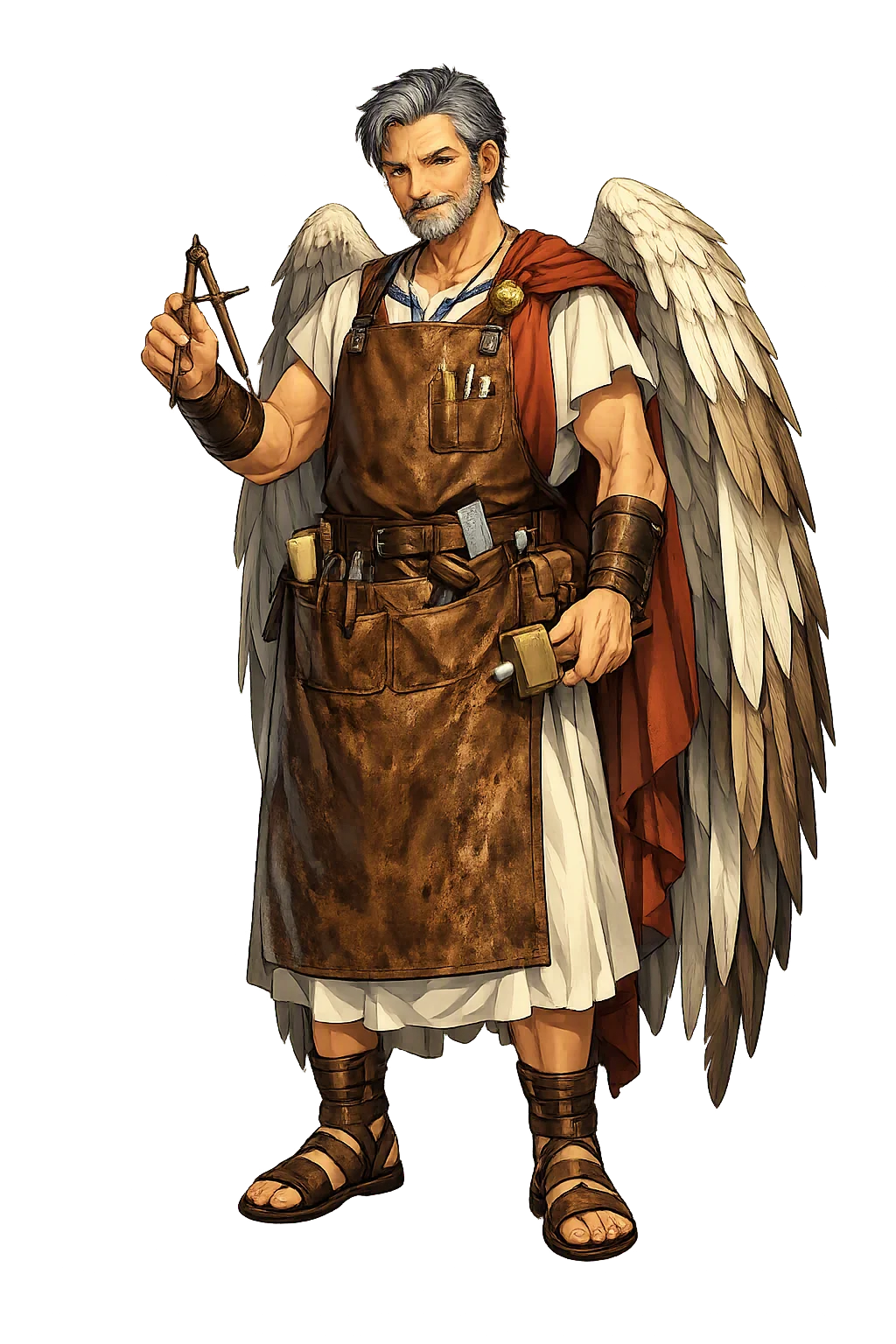
Daedalus appears most famously as the inventor of wings, a scene painted on Attic vases from the sixth century BCE onward: the craftsman and his son Icarus take flight, often with Icarus already falling into the sea. Statues and dedications credited to him—such as the archaic xoanon of Heracles at Samos and the Cretan dancing-floor pattern described by Homer—made his name a byword for cunning artifice. Roman sarcophagi, gem engravings, and later European painting kept the winged flight as his defining image.

06

Reception & Transformation

The name after its own age — transmission, translation, survival

Afterlives

Daedalus moved from Bronze Age legend to classical emblem of human ingenuity and its limits. Plato linked him to the philosophical puzzle of self-moving statues; Aristophanes and later satirists mocked daidala as over-clever contrivances. Roman writers such as Ovid and Virgil made the Cretan labyrinth and Icarian Sea household references across the Latin world. In the Renaissance, the name became a badge for artists and engineers—most famously when Joyce gave Stephen Dedalus the name as a symbol of the artificer. Modern scholarship has read him as a mythic memory of Minoan palace culture, while psychoanalytic and space-age interpretation have recycled the Icarus fall as a caution about technological hubris. The word passed into English as Daedalian, meaning intricately wrought, and his workshop remains a shorthand for any creator who risks too much in pursuit of flight.

Identifications Across Traditions

The Romans absorbed him as Daedalus, and Ovid's Metamorphoses book 8 — the wings, the fall, the nephew — fixed his canonical Latin form; Virgil alludes to the Cretan maze (Aeneid 5.588-591: 'the Cretan labyrinth... Daedalus, pouring his genius into the craft'). The Renaissance made him the emblem of the artist-engineer, from Vasari's lives to the emblem-books; in the twentieth century James Joyce rebuilt him as Stephen Dedalus, the young artist escaping the nets of family, religion, and nation — wings that also melt. Modern engineering borrowed his name without irony (Project Daedalus, the British Interplanetary Society's interstellar probe study). He remains the myth's permanent consultant on invention: every story about technology outrunning its maker is his story retold.

Modern Legacy

Daedalus is the archetype of the inventor and the artist in one figure — the engineer whose creations work too well. The labyrinth gave European languages its word for any designed confusion; the wings fathered every myth of flight from Icarus to the space program; the moving statues made him the patron, millennia early, of robotics and AI. Modern debates about autonomous systems, from Frankenstein to lethal drones, are his debate: can a maker foresee what his making will do? Homer already knew the answer the tradition keeps giving — the dancing-floor is beautiful, the maze is brilliant, and both outlive the hand that made them.

07

The Meditation

What Daídalos means — beyond the dictionary

Daidalos is the first Western portrait of the inventor as tragic hero. His gifts are extraordinary; his judgment is not. He kills his nephew from envy, builds a prison for a monster, and loses his son to the very technology that saved him. Each invention solves one problem and creates another, and the pattern is so consistent that the Greeks made his name an adjective for any cunningly wrought thing.

To meditate on Daidalos is to meditate on the double edge of human making. We are the species that makes wings, and we are the species whose children fly too high. The question the myth hands us is not whether to invent — he will invent, that is what he is — but whether we can learn to give warnings that outlast the wax. The name Daidalos still means 'cunningly wrought'; it still sounds, in Greek, like a compliment and a diagnosis.

08

Frequently Asked Questions

Common questions about Daídalos, Craftsman, Inventor, Wings, and Unicode restoration

01How do you pronounce Daídalos?

In reconstructed pronunciation, Daídalos is /dai̯.da.los/ — approximately 'DIE-dah-los' — the first syllable is long and carries the ancient pitch rise; the remaining syllables are short and light.

02What does Daídalos mean?

Daídalos means Cunningly wrought in the greek tradition.

03What are the symbols of Daídalos?

Daídalos is associated with Wings (The instruments of escape and the boundary between human and divine — held together by wax, held up by obedience), Wax (The material that holds the wings together and melts when the warning fails — technology as a perishable interface between instruction and desire), Labyrinth (The architectural puzzle that embodies his cunning and its dangerous consequences — a mind built in stone), Tools (The axe, file, and compass of the craftsman who can make anything except a safe life), The thread (The clue Ariadne unrolled through the maze — in Hyginus' telling (Fabulae 43) Daedalus' own stratagem — the one invention designed to be undone).

04Why restore Daídalos in Unicode?

Plain ASCII daedalus strips the stress, length, and script that make the name specific. Unicode restoration returns the name to its original written dignity.

05What is the most important myth about Daídalos?

“The Nephew He Killed” — the Athens story that anchors the mythology of Daídalos, told in full on the lore page.

09

Scholarly Sources

The philological foundations of this restoration

Every claim on this page is grounded in established scholarship. The orthographic restorations follow disciplinary convention. The etymological chain follows the best available reference works. This is not invention — it is resurrection through scholarship.

◈

Lexicography & Philology

  • Liddell, H. G., Scott, R., & Jones, H. S. A Greek-English Lexicon. Oxford: Clarendon Press, 9th ed. 1996.
  • Pape, W., & Benseler, G. E. Wörterbuch der griechischen Eigennamen. Braunschweig: Vieweg, 1884.
  • Beekes, R. S. P. Etymological Dictionary of Greek. Leiden: Brill, 2010.
◎

Primary Texts

  • Homer, Iliad 18.590-592 (the dancing-floor of Knossos)
  • Apollodorus, Library 3.15.8; Epitome 1.7-15
  • Ovid, Metamorphoses 8.152-262
  • Diodorus Siculus 4.76-80
  • Hyginus, Fabulae 39-43; Plato, Meno 97d
◉

Archaeology & Art History

  • Material evidence — iconography, inscriptions, and temple archaeology — for Daídalos and related cults.
✦

Religious Studies

  • Morris, Daidalos and the Origins of Greek Art (1992)
Return

The Surface Awaits

You have traced the name from its earliest attestation to its Unicode restoration. Now return to the myth. The story is where the name lives.

Back to Lore
Daídalos mascot