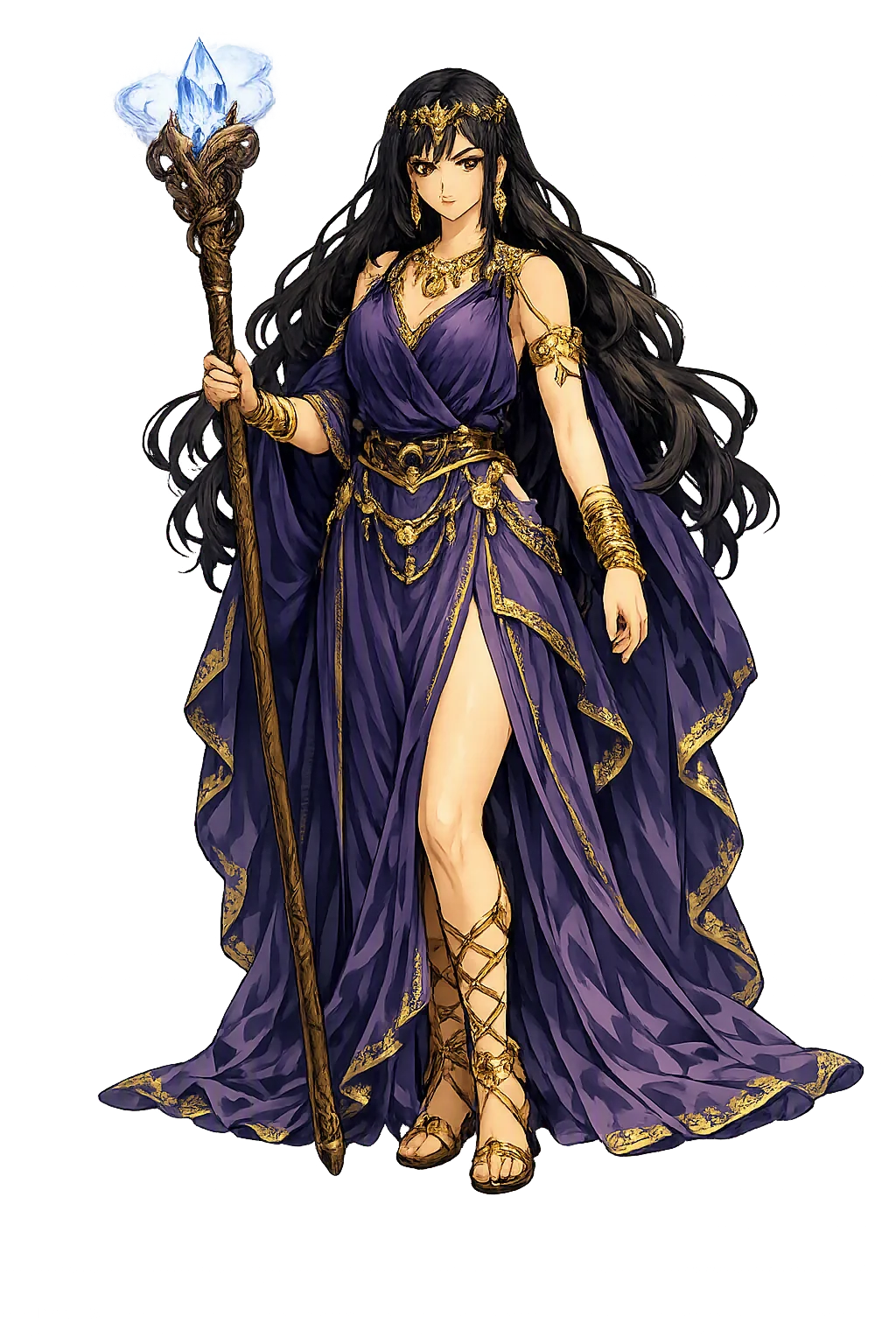
PuniCodex

Extended Lore

Κίρκη Kírkē

Etymology · Orthography · Cult · Iconography · Reception · Sources

Tier 1 Kírkē.com
Kírkē — Sorceress, Aeaea, Transformations
01

Quick Facts

Essential information about Kírkē, Sorceress, Aeaea, Transformations

Original ScriptΚίρκη
Unicode RestorationKírkē
Reconstructed Pronunciation/kír.kɛː/
PantheonGreek
DomainSorceress, Aeaea, Transformations
MeaningFalcon, bird of prey
ClassificationTier 1
Primary DomainKírkē.com
Sacred SymbolsThe wand (rhábdos), The cup, Swine, The loom, Moly
02

Etymology & Word Family

From original script to Unicode restoration

Original Script Κίρκη Kírkē — "Falcon, bird of prey"
Unicode Restoration Kírkē Restored stress, length, and script
Modern ASCII circe Plain-ASCII fallback

The name Kírkē carries the orthographic signature of the greek tradition: Κίρκη. Unicode restoration recovers what ASCII flattens.

03

Unicode Character Breakdown

Character-by-character philological analysis

CharacterUnicodeNameBlockPhonetic Role
KU+004BLatin Capital Letter KBasic LatinKappa
íU+00EDLatin Small Letter I with AcuteLatin-1 SupplementAcute on iota
rU+0072Latin Small Letter RBasic LatinRho
kU+006BLatin Small Letter KBasic LatinKappa
ēU+0113Latin Small Letter E with MacronLatin Extended-AEta: long epsilon

The Tier 1 classification reflects how much of the original phonology this restoration preserves — stress and vowel length for Greek names, distinctive letters and diacritics for every other tradition.

04

Cult & Worship

How the sacred was kept — rites, sanctuaries, remains

The Cult

No Greek city ever kept a priestess for Kírkē, and that absence is itself the datum. Homer calls her a dread goddess endowed with speech, yet no polis calendar, festival day, or votive deposit attests her worship in the Greek world: her 'cult' was the recitation of the Odyssey — the schoolroom text par excellence, where generations of boys met her drugs and her moly. The only sanctuary ancient writers actually point to is Italian. Strabo (5.3.6) reports a temple of Circe on the promontory of Circeii, where legend had moored her island, and Roman travellers were shown the spot; no certain remains of the building have ever been excavated. What the evidence gives is not a cult but a congregation — schoolboys construing Odyssey 10, symposiasts singing the encounter, painters selling the scene to Etruscan and Roman buyers. She was worshipped the way literature is worshipped: by repetition.

In the Earth

No excavated sanctuary of Kírkē herself survives; her cult was Roman and coastal. Strabo (5.3.6) reports that the promontory of Circeii — modern Monte Circeo in Lazio — was believed to have once been an island, as Homer's Aiaia was, and that a temple of Circe was pointed out there; the marshy plain behind the cape still shows how the 'island' silted into the mainland. Archaic art took her up earlier than almost any other Homeric episode: Boeotian black-figure vases of the sixth century BCE paint Odysseus drawing his sword on her amid men already bristling into beasts, and an archaic painter is named 'the Circe Painter' for the scene.

05

Iconography

How Kírkē was imaged across the ages

The Image

Vase painters fell on the scene almost before the ink was dry. The earliest surviving images are Boeotian and Attic black-figure of the sixth century BCE, and they fix her iconography for good: a woman standing at loom or mixing bowl, wand raised, while sailors sprout bristling animal heads on human bodies. A kylix of about 550 BCE attributed to the Painter of the Boston Polyphemos (Museum of Fine Arts, Boston) states the whole grammar — the potion, the fleeing Eurylochus, Odysseus barging in sword first. The classical reformulation, an Attic red-figure calyx-krater of about 440 BCE attributed to the Persephone Painter (Metropolitan Museum of Art), sets cup and wand between her and the hero, the companions already half-beast. From there the image barely moves: medieval and Renaissance artists keep the cup, the wand, the circling animals. Dosso Dossi's Circe and her Lovers in a Landscape (c. 1515, National Gallery of Art, Washington) is the High Renaissance's definitive version — the enchantress calm at the centre of her menagerie.

06

Reception & Transformation

The name after its own age — transmission, translation, survival

Afterlives

Kírkē's transmission is the Odyssey's own. Eugammon of Cyrene's lost Telegony gave her a second act — the son Telegonus who would kill his own father without knowing him — and Proclus's summary kept that ending alive for scholarship. Rome read her in Greek classrooms and rewrote her at home; through late antiquity the episode anchored moralizing readings, and Byzantine scholarship kept the text whole — Eustathius of Thessalonica's twelfth-century commentary parses her scene line by line. The West recovered her twice: first in Boccaccio's De mulieribus claris, where she stands among famous women as a natural philosopher of herbs, and then in Christine de Pizan's Book of the City of Ladies, which reads her 'magic' as the pharmacological science of women, slandered by poets — the first great feminist rehabilitation of a mythological witch. The Greek text itself returned with the émigré scholars after 1453; the Aldine Homer of 1508 put her back on Europe's desk, and painting immediately restaged her. From the sixteenth century she becomes a vernacular institution — an operatic subject, an emblem of dangerous eloquence, the ancestor of every enchantress with a recipe — while philology quietly reached its verdict: her name, restored as Kírkē, carries the acute and the long vowel that Homer's verse demands.

Identifications Across Traditions

Rome did not need to invent a Latin Kírkē; it simply moved her in. Hesiod had already posted her sons to the Tyrrhenian coast, and Virgil's Aeneas skirts 'the shores of Circe's land,' where the daughter of the Sun sings ceaselessly in her groves while the groans of her transformed men roll out across the water (Aeneid 7.10–24). The promontory of Circeii claimed her temple (Strabo 5.3.6), and Horace calls Tusculum 'the hills of Telegonus the parricide' (Odes 3.29.8) — her son naturalized as a founder of Latin towns. From there she passes into the European imagination as the archetype of the enchantress: the witch with a pedigree, a loom, and a cup.

Modern Legacy

English keeps her as an adjective: Circean — bewitching, dangerously seductive, charming in the way that unmakes a man. Cape Circeo still bears her name on the Tyrrhenian coast, and if the old derivation of her name from kírkos ('ring; hawk') holds, she shares a root with Latin circus — and so with English circle and circus. The nineteenth century painted her endlessly — Waterhouse's Circe Offering the Cup to Ulysses (1891) and Circe Invidiosa (1892) are the icons — and every island sorceress with a wand and a potion since is her descendant. Restoring Kírkē restores the falcon in the enchantress's name.

07

The Meditation

What Kírkē means — beyond the dictionary

The Greeks never decided whether Kírkē was danger or salvation, and Homer refuses to help. He calls her a dread goddess, then lets her feed the hero for a year, arm him against the Sirens and Scylla, and draw him the only map of the underworld Greek epic possesses. She is the poem's most accomplished divinity after Athēnâ — and the only one whose power is chemical. Pharmaka, not thunderbolts: the Greeks suspected that transformation, like poisons and potions, was women's work, and Kírkē is that suspicion deified and stranded on an island where no husband can check her.

Her deepest moment is a piece of grammar: the swine keep their noos, their mind, 'firm as before' (Odyssey 10.240) — what is a person, Homer asks, if the body can be unmade around it? Even her geography is a riddle: he moors Aiaia 'where are the dancing-floors of Dawn and the risings of the sun' (Odyssey 12.3–4), the far east, while Rome dragged her west to the Tyrrhenian cape. The honest answer is that Aiaia lies wherever the charted world ends — and Kírkē is what waits there: the intelligence of the wild, articulate, patient, and not to be trifled with.

08

Screen & Culture

Where Kírkē echoes through film, television, and games — and how

09

Frequently Asked Questions

Common questions about Kírkē, Sorceress, Aeaea, Transformations, and Unicode restoration

01How do you pronounce Kírkē?

In reconstructed pronunciation, Kírkē is /kír.kɛː/ — approximately 'KEER-keh' — high pitch on the first syllable, a trilled rho, and a long open final vowel; English 'SUR-see' has wandered far from the falcon's name.

02What does Kírkē mean?

Kírkē means Falcon, bird of prey in the greek tradition.

03What are the symbols of Kírkē?

Kírkē is associated with The wand (rhábdos) (With a single stroke she pens the crew in the sties — the original witch's wand of European literature (Odyssey 10.238)), The cup (Barley, cheese, and pale honey in Pramneian wine, with the pharmaka stirred into the food (Odyssey 10.234–235)), Swine (Her transformed company: beast in head, voice, bristle, and shape — 'but the mind remained as before' (Odyssey 10.239–243)), The loom (The sailors first hear her singing at a great immortal web — goddesses' work, delicate and glorious (Odyssey 10.221–223)), Moly (The black-rooted, milk-white-flowered herb Hermes gives against her drugs — hard for mortals to dig (Odyssey 10.302–306)).

04Why restore Kírkē in Unicode?

Plain ASCII circe strips the stress, length, and script that make the name specific. Unicode restoration returns the name to its original written dignity.

05What is the most important myth about Kírkē?

“The Men Made Swine” — the The Wand story that anchors the mythology of Kírkē, told in full on the lore page.

10

Scholarly Sources

The philological foundations of this restoration

Every claim on this page is grounded in established scholarship. The orthographic restorations follow disciplinary convention. The etymological chain follows the best available reference works. This is not invention — it is resurrection through scholarship.

◈

Lexicography & Philology

  • Liddell, H. G., Scott, R., & Jones, H. S. A Greek-English Lexicon. Oxford: Clarendon Press, 9th ed. 1996.
  • Pape, W., & Benseler, G. E. Wörterbuch der griechischen Eigennamen. Braunschweig: Vieweg, 1884.
  • Beekes, R. S. P. Etymological Dictionary of Greek. Leiden: Brill, 2010.
◎

Primary Texts

  • Homer, Odyssey 10–12
  • Hesiod, Theogony 1011–1016
  • Apollodorus, Library
  • Ovid, Metamorphoses 14
  • Virgil, Aeneid 7
◉

Archaeology & Art History

  • Material evidence — iconography, inscriptions, and temple archaeology — for Kírkē and related cults.
✦

Religious Studies

  • Proclus, Chrestomathy
Return

The Surface Awaits

You have traced the name from its earliest attestation to its Unicode restoration. Now return to the myth. The story is where the name lives.

Back to Lore
Kírkē mascot