PuniCodex

Extended Lore

Χίμαιρα Chímaira

Etymology · Orthography · Cult · Iconography · Reception · Sources

Tier 1 Chímaira.com
Chímaira — Fire-Breathing Monster
01

Quick Facts

Essential information about Chímaira, Fire-Breathing Monster

Original ScriptΧίμαιρα
Unicode RestorationChímaira
Reconstructed Pronunciation/kʰí.mai.ra/
PantheonGreek
DomainFire-Breathing Monster
MeaningShe-goat
ClassificationTier 1
Primary DomainChímaira.com
Sacred SymbolsFlame, Lion forepart, She-goat's head, Serpent tail, Pegasos
02

Etymology & Word Family

From original script to Unicode restoration

Original Script Χίμαιρα Chímaira — "She-goat"
Unicode Restoration Chímaira Restored stress, length, and script
Modern ASCII chimaira Plain-ASCII fallback

The name Chímaira carries the orthographic signature of the greek tradition: Χίμαιρα. Unicode restoration recovers what ASCII flattens.

03

Unicode Character Breakdown

Character-by-character philological analysis

CharacterUnicodeNameBlockPhonetic Role
CU+0043Latin Capital Letter CBasic LatinC uppercase
hU+0068Latin Small Letter HBasic Latinh same
íU+00EDLatin Small Letter I with AcuteLatin-1 SupplementAcute on i
mU+006DLatin Small Letter MBasic Latinm same
aU+0061Latin Small Letter ABasic Latina same
iU+0069Latin Small Letter IBasic Latini same
rU+0072Latin Small Letter RBasic Latinr same
aU+0061Latin Small Letter ABasic Latina same

The Tier 1 classification reflects how much of the original phonology this restoration preserves — stress and vowel length for Greek names, distinctive letters and diacritics for every other tradition.

04

Cult & Worship

How the sacred was kept — rites, sanctuaries, remains

The Cult

No cult of the Chímaira is recorded; she is a monster to be destroyed, not a power to be propitiated. Her ritual trace, if any, is topographical rather than devotional: the undying fire of Mount Chimaera near ancient Phaselis in Lycia — the methane-fed flames of Yanartaş — was a sailor's landmark from Ctesias to Pliny, and may have given the myth its local habitation. Ancient travellers certainly noticed the phenomenon, but there is no evidence of priesthood, festival, or votive practice addressed to the beast herself. The site remains a minor tourist destination today, its flames still burning, more a natural curiosity than a place of worship.

In the Earth

She had no sanctuary — monsters seldom do — but her landscape survives: the natural-gas flames of Yanartaş near ancient Phaselis in Lycia have burned without fuel for millennia, and ancient writers from Ctesias to Pliny (Natural History 2.111) knew the undying fire of Mount Chimaera as a landmark for sailors. In art she is among the earliest Greek monsters, attacked by Bellerophôn and Pegasos on Corinthian and Attic vases from the seventh century BC onward, and the Etruscans cast her masterpiece — the bronze Chimaira of Arezzo (c. 400 BC), a lion with the goat's head rising from its back and a serpent for a tail, dedicated to the god Tinia as its inscribed leg (tinścvil) records. Pausanias (2.4.1) still points out the spring Peirene at Corinth, where Bellerophôn was said to have seized the winged horse for the hunt.

05

Iconography

How Chímaira was imaged across the ages

The Image

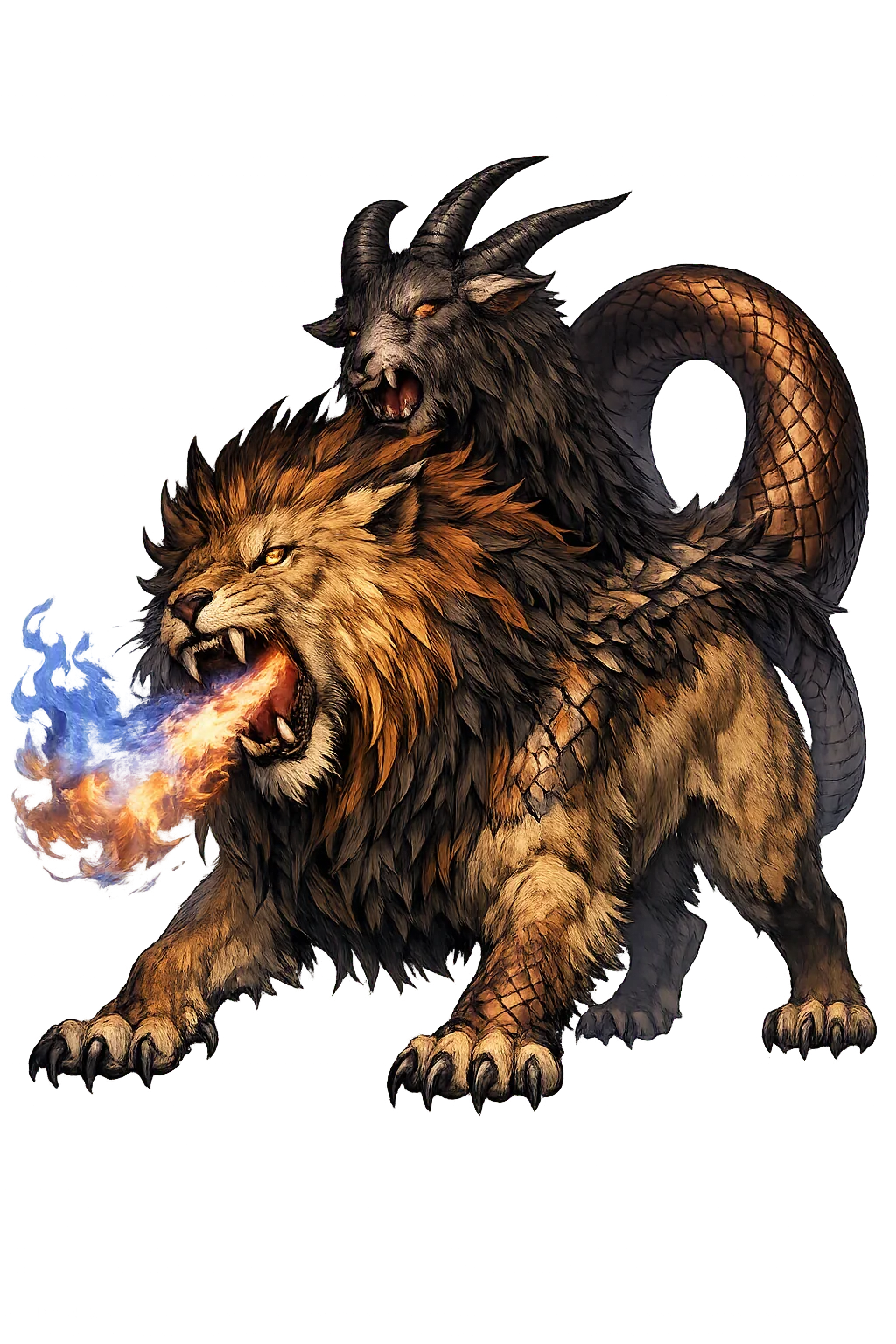
The Chímaira is one of the earliest fully formed Greek monsters in visual art. Corinthian and Attic black-figure vases show her as a lion-bodied creature with a goat's head rising from her back and a serpent for a tail, attacked by Bellerophôn on Pegasos. Lycian coins from Phaselis and neighbouring cities sometimes carry the beast as a civic badge. The canonical three-part anatomy was established by the Archaic period and remained standard through Roman times, when floor mosaics and carved gems repeated the combat scene. Renaissance and later emblem books revived her as a symbol of the impossible or the monstrous female, an image that persists in modern fantasy illustration.

06

Reception & Transformation

The name after its own age — transmission, translation, survival

Afterlives

The Chímaira passed from Greek myth into a general metaphor for the impossible or the hybrid. In classical antiquity she was already proverbial: Hesiod's genealogy made her a daughter of Echidna, and later writers used Chimaera as a byword for vain terrors. The name's scientific afterlife is especially durable: in biology a chimera denotes an organism with cells from two distinct zygotes, and in genetics the term describes transgenic organisms or fused cell lines. Medieval and Renaissance bestiaries copied her triple anatomy, while modern fantasy role-playing games, video games, and film continue to deploy her as a fire-breathing boss monster. Through all these transformations the core idea — a single body compounded of incompatible parts — has remained her defining power.

Identifications Across Traditions

Rome received her without a cult to domesticate: the Latin Chimaera kept the Greek spelling and lost the goat. Virgil arms her with flame and posts her among the Centaurs and double-formed monsters at the gate of the underworld (Aeneid 6.288), Ovid names her among the hybrid creatures in Byblis's reckoning of unnatural things (Metamorphoses 9.646–648), and Hyginus (Fabulae 57) retells Bellerophôn's hunt for Latin schoolrooms. From there the word drifts from beast to idea: by the Renaissance a 'chimera' is any fire-breathing fancy of the mind, and the she-goat of Lycia has become the common name of impossibility itself.

Modern Legacy

English keeps her twice over. As chimera — and the adjective chimerical — she names the impossible hybrid or the vain, wild fantasy, a sense current in English since the seventeenth century. Science then recruited the monster for real composites: in genetics a chimera is an organism built from two distinct cell lineages, and the ghost-sharks of the deep sea, the family Chimaeridae, bear her name for their mismatched bodies. Every 'chimerical scheme' dismissed in a boardroom is, unknowingly, a Lycian she-goat still breathing fire.

07

The Meditation

What Chímaira means — beyond the dictionary

The Greeks built her no altar, and yet Homer calls her θεῖον γένος — 'of divine stock, not of men' (Iliad 6.180): the impossible, they felt, deserves a kind of reverence. Commentators have read Hesiod's triple anatomy as a riddle of the Lycian landscape — lion, goat, and serpent as crag, pasture, and fire-vented cleft — but the poet offers no key; the monster simply refuses to be one thing. There is a dry humour buried in the sources: Iliad 16.328 says a man named Amisodaros 'reared' her, as one rears livestock, to be 'a bane to many men' — the Greeks imagined the ungovernable and then gave it a goatherd. The deepest wordplay is the name itself: the most impossible creature in Greek myth carries the tamest noun in the language, a one-winter she-goat; terror, the grammar insists, is bred in the barnyard.

08

Frequently Asked Questions

Common questions about Chímaira, Fire-Breathing Monster, and Unicode restoration

01How do you pronounce Chímaira?

In reconstructed pronunciation, Chímaira is /kʰí.mai.ra/ — approximately 'KHEE-mye-rah' — begin with a k followed by a sharp breath, let the middle glide like 'eye', and end on a quick tapped r.

02What does Chímaira mean?

Chímaira means She-goat in the greek tradition.

03What are the symbols of Chímaira?

Chímaira is associated with Flame (Her inextinguishable breath of fire — the one feature every source, from Hesiod to Virgil, refuses to omit), Lion forepart (The grim-eyed lion's head in front, emblem of her strength and royal ferocity), She-goat's head (The goat rising from her middle — the body part that carries her very name, χίμαιρα, 'she-goat'), Serpent tail (The dragon (δράκων) behind, her kinship with the earth-born brood of Typhôn made flesh), Pegasos (The winged horse, offspring of Poseidôn and Medousa, without whose height no mortal could reach her).

04Why restore Chímaira in Unicode?

Plain ASCII chimaira strips the stress, length, and script that make the name specific. Unicode restoration returns the name to its original written dignity.

05What is the most important myth about Chímaira?

“Daughter of the Monster-House” — the Birth story that anchors the mythology of Chímaira, told in full on the lore page.

09

Scholarly Sources

The philological foundations of this restoration

Every claim on this page is grounded in established scholarship. The orthographic restorations follow disciplinary convention. The etymological chain follows the best available reference works. This is not invention — it is resurrection through scholarship.

◈

Lexicography & Philology

  • Liddell, H. G., Scott, R., & Jones, H. S. A Greek-English Lexicon. Oxford: Clarendon Press, 9th ed. 1996.
◎

Primary Texts

  • Hesiod
  • Homer, Iliad 6.144–211; 16.328–329 (the letter; Amisodaros’ livestock)
  • Hesiod, Theogony 319–325
  • Pindar, Olympian 13.63–92
  • Apollodorus, Library 2.3.1–2
  • Pausanias 2.4.1 (Peirene); the Chimaira of Arezzo, Museo Archeologico Nazionale, Florence
◉

Archaeology & Art History

  • Material evidence — iconography, inscriptions, and temple archaeology — for Chímaira and related cults.
✦

Religious Studies

  • Beekes, Etymological Dictionary of Greek, s.v. χίμαιρα
Return

The Surface Awaits

You have traced the name from its earliest attestation to its Unicode restoration. Now return to the myth. The story is where the name lives.

Back to Lore
Chímaira mascot