PuniCodex

Extended Lore

Cernunnos

Etymology · Phonology · Orthography · Cultural Legacy · Primary Sources

Tier 2 Cernunnos
Cernunnos — Wilderness, Animals, Fertility
01

Quick Facts

Essential information about Cernunnos, Wilderness, Animals, Fertility

Scholarly TransliterationCernunnos
Unicode RestorationCernunnos
Reconstructed Pronunciation/kerˈnun.nos/
PantheonCeltic
DomainWilderness, Animals, Fertility
MeaningThe Horned One (from Gaulish)
ClassificationTier 2
Primary DomainCernunnos
Sacred SymbolsThe antlers, The torc, The ram-horned serpent, The gathered beasts
02

Etymology & Word Family

From original script to Unicode restoration

Scholarly Transliteration Cernunnos Cernunnos — "The Horned One (from Gaulish)"
Unicode Restoration Cernunnos Restored stress, length, and script
Modern ASCII cernunnos Plain-ASCII fallback

Cernunnos is Tier 2 by the mechanical rule: the attested Gaulish form is already plain Latin letters — ERNVNNOS in the capitals of the Paris inscription — with no diacritic and no distinctive letter for ASCII to lose. The restoration differs from the lowercase entry only by the capital. The etymology 'the horned one' is the standard reading (Delamarre, Matasović), though the details of the suffix formation remain debated and the connection with Conall Cernach is conjecture, not consensus.

03

Unicode Character Breakdown

Character-by-character philological analysis

CharacterUnicodeNameBlockPhonetic Role
CU+0043Latin Capital Letter CBasic LatinSame
eU+0065Latin Small Letter EBasic LatinSame
rU+0072Latin Small Letter RBasic LatinSame
nU+006ELatin Small Letter NBasic LatinSame
uU+0075Latin Small Letter UBasic LatinSame
nU+006ELatin Small Letter NBasic LatinSame
oU+006FLatin Small Letter OBasic LatinSame
sU+0073Latin Small Letter SBasic LatinSame

The Tier 2 classification reflects how much of the original phonology this restoration preserves — stress and vowel length for Greek names, distinctive letters and diacritics for every other tradition.

04

Cultural Significance

From ancient cult to modern Unicode

Ancient Domain

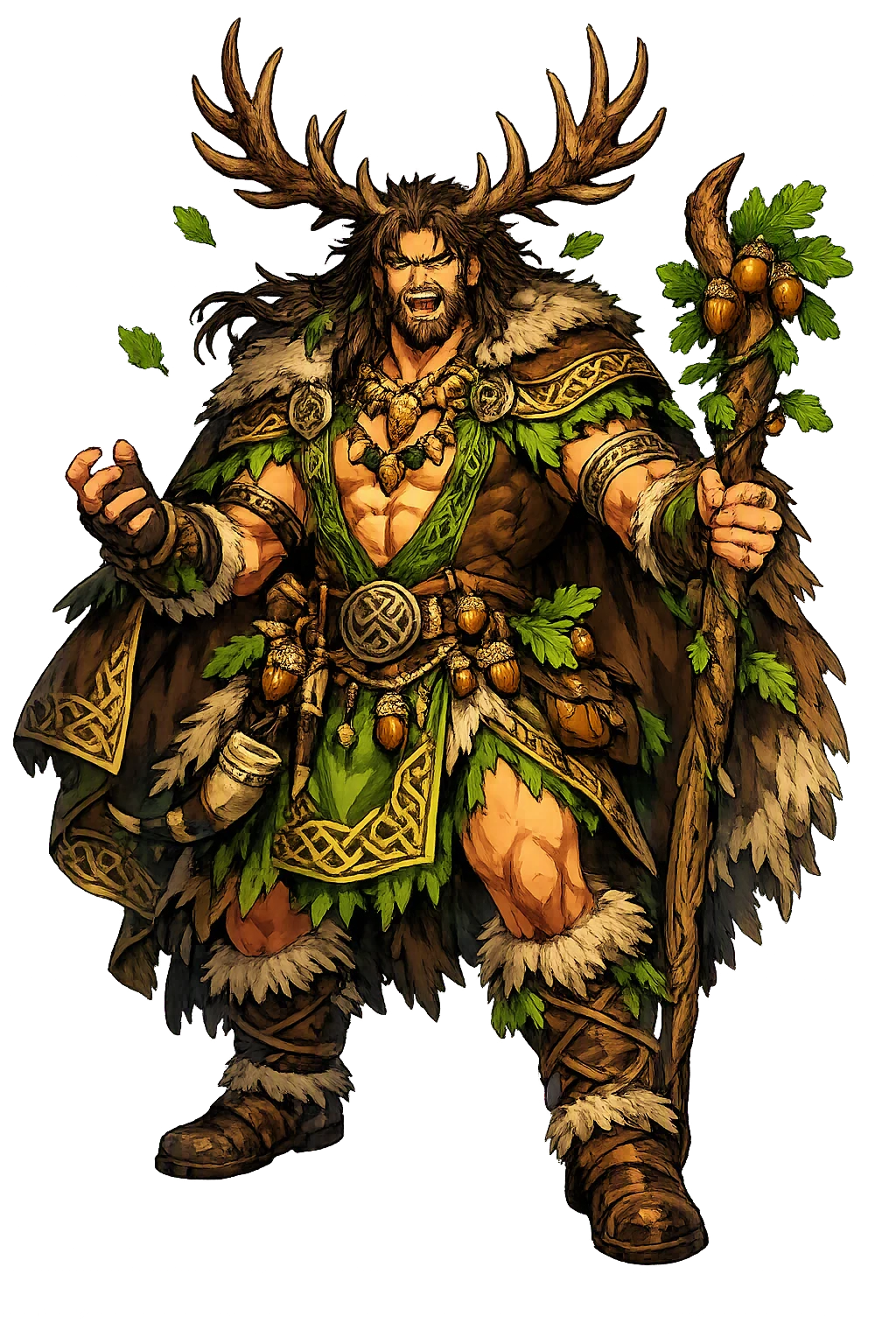
Cernunnos is the horned god of Gaul: named once in stone at Paris, pictured across the Celtic world as the cross-legged, antlered lord who holds the torc of rank in one hand and the ram-horned serpent of the underworld in the other, with the beasts of the wild gathered at his back.

Cernunnos in Later Traditions

Rome met the horned god the way Rome met every god: by pairing him with her own. The Reims altar seats the antlered figure between Apollo and Mercury — a Roman frame built round a native centre — and the Pillar of the Boatmen itself is dedicated to Jupiter, with the Gaulish gods carved in attendance. The deepest Roman comparison is inferential: Caesar reports (De Bello Gallico 6.18) that all the Gauls claim descent from Dis Pater, father of the underworld, and since the nineteenth century scholars have wondered whether the antlered lord with his serpent and his cross-legged stillness is the god Caesar's informants meant. The identification is suggestive, never provable, and the best handbooks — Mac Cana, Green, Koch — keep it filed under hypothesis. His closest kin inside the lexicon are the other lords of the Celtic otherworld: [[arawn|Arawn]] of [[annwn|Annwn]], who hunts with white red-eared hounds, and [[dagda|the Dagda]], the good god whose cauldron never empties.

Modern Legacy

Cernunnos has the strangest afterlife in the lexicon: a god named once in antiquity who became, two millennia later, the most famous horned figure in modern religion. Margaret Murray's The God of the Witches (1931) made him the prime exhibit of her pan-European witch-cult — a thesis academic history has since dismantled (Ronald Hutton's The Triumph of the Moon is the standard autopsy) — but the image outlived the theory. Gerald Gardner placed the Horned God at the centre of modern Wicca, and 'Cernunnos' became his conventional name in contemporary pagan practice worldwide. The Gundestrup plate did the visual work: that cross-legged, antlered silhouette is now one of the most reproduced images of the ancient world, from album covers to fantasy games. A god with no surviving myth became the emblem of every wild thing that refuses to be tamed.

Unicode Restoration as Cultural Act

Restoring Cernunnos in a domain name is more than orthographic accuracy. It is a statement that the internet should recognize the full range of human writing — not only the ASCII keyboard.

05

Frequently Asked Questions

Common questions about Cernunnos, Wilderness, Animals, Fertility, and Unicode restoration

01How do you pronounce Cernunnos?

In reconstructed pronunciation, Cernunnos is /kerˈnun.nos/ — approximately 'ker-NOON-nos' — every c is hard, the double nn is fully sounded, and the final -os is crisp, not anglicized to '-us'..

02What does Cernunnos mean?

Cernunnos means The Horned One (from Gaulish) in the celtic tradition.

03What are the symbols of Cernunnos?

Cernunnos is associated with The antlers (Sovereignty over the wild, written into the name itself — the horn made godhead), The torc (Rank and offering at once: the wealth the lord of beasts holds, wears, and dispenses), The ram-horned serpent (The underworld's animal, held bare-handed — the chthonic power no other Gaulish figure touches so calmly), The gathered beasts (Stag, boar, and the beasts of the deep wood: the retinue that answers to him and to no one else).

04Why restore Cernunnos in Unicode?

Plain ASCII cernunnos strips the stress, length, and script that make the name specific. Unicode restoration returns the name to its original written dignity.

05What is the most important myth about Cernunnos?

Under the choir of Notre-Dame, in 1711, workmen uncovered the monument the boatmen's guild of the Parisii — the nautae Parisiaci — had raised to Jupiter in the reign of Tiberius, early in the first century CE. Among its carved gods, one block shows a balding, bearded head wearing antlers, with a torc hanging from each antler, and above the figure runs the inscription [C]ERNVNNOS. The first letter is lost and restored by convention, but the reading has held for three centuries of scholarship: this is the only text in the world that names the horned god. Everything else called Cernunnos is an identification argued from this single stone.

06

Scholarly Sources

The philological foundations of this restoration

Every claim on this page is grounded in established scholarship. The orthographic restorations follow disciplinary convention. The etymological chain follows the best available reference works. This is not invention — it is resurrection through scholarship.

Lexicography & Philology

  • Vendryes

Primary Texts

  • The Immram Brain (Voyage of Bran); Tochmarc Étaíne; Cóir Anmann; medieval Irish saga literature.

Archaeology & Art History

  • Material evidence — iconography, inscriptions, and temple archaeology — for Cernunnos and related cults.
  • Cernunnos is the most materially grounded name in the Celtic lexicon and the most textually impoverished: his entire attestation is archaeological. The Pillar of the Boatmen, raised by the boatmen's guild of the Parisii under Tiberius (14–37 CE) and rediscovered beneath Notre-Dame in 1711, carries the name's only inscription, [C]ERNVNNOS, above the antlered head with torcs; it stands today in the Musée national du Moyen Âge, Paris. The Gundestrup cauldron, cut from the peat at Rævemosen, Jutland, in 1891 and dated to around the first century BCE or CE, shows the cross-legged antlered figure with torc and ram-horned serpent on its most famous interior plate; it is the treasure of the National Museum of Denmark. The supporting gallery is wide: the Reims altar with its antlered figure between Apollo and Mercury, the cross-legged relief from Saintes, the horned figure with serpents from Cirencester in Roman Britain, and the fourth-century BCE antlered carving of Val Camonica — the oldest horned image in the Celtic world.

Religious Studies

  • Pillar of the Boatmen (CIL XIII 3026), dedicated by the nautae Parisiaci under Tiberius; Musée national du Moyen Âge, Paris
  • The Gundestrup Cauldron, found 1891 in the Rævemosen bog, Jutland; National Museum of Denmark, Copenhagen
  • Caesar, De Bello Gallico 6.13–18 (Gaulish religion; the descent from Dis Pater)
  • Vendryes, Lexique étymologique de l'irlandais ancien — the lexicon's cited authority for the entry
  • Delamarre, Dictionnaire de la langue gauloise, s.v. carno- 'horn', Cernunnos
  • Matasović, Etymological Dictionary of Proto-Celtic, s.v. *karnon 'horn'
  • Mac Cana, Celtic Mythology (the horned god; Conall Cernach; counsel of caution)
  • Koch (ed.), Celtic Culture: A Historical Encyclopedia, s.v. Cernunnos, Gundestrup cauldron
  • Green, The Gods of the Celts; Animals in Celtic Life and Myth (iconography of the antlered god and the ram-horned serpent)
Return

The Surface Awaits

You have traced the name from its earliest attestation to its Unicode restoration. Now return to the myth. The story is where the name lives.

Back to Lore
Cernunnos mascot