PuniCodex

Extended Lore

財神 Cáishén

Etymology · Orthography · Cult · Iconography · Reception · Sources

Tier 1 Cáishén.com
Cáishén — Wealth, Prosperity, New Year
01

Quick Facts

Essential information about Cáishén, Wealth, Prosperity, New Year

Original Script財神
Unicode RestorationCáishén
Reconstructed Pronunciation/caishen/
PantheonChinese
DomainWealth, Prosperity, New Year
MeaningGod of wealth
ClassificationTier 1
Primary DomainCáishén.com
Sacred SymbolsThe gold ingot (yuanbao), The black tiger, The iron whip, The ruyi scepter, The account book
02

Etymology & Word Family

From original script to Unicode restoration

Original Script 財神 Cáishén — "God of wealth"
Unicode Restoration Cáishén Restored stress, length, and script
Modern ASCII caishen Plain-ASCII fallback

Cái (財) 'wealth, riches'; Shén (神) 'god, spirit' — the popular deity of prosperity worshipped at New Year.

03

Unicode Character Breakdown

Character-by-character philological analysis

CharacterUnicodeNameBlockPhonetic Role
CU+0043Latin Capital Letter CBasic LatinSame, capitalized
áU+00E1Latin Small Letter A with AcuteLatin-1 SupplementAcute tone mark
iU+0069Latin Small Letter IBasic LatinSame
sU+0073Latin Small Letter SBasic LatinSame
hU+0068Latin Small Letter HBasic LatinSame
éU+00E9Latin Small Letter E with AcuteLatin-1 SupplementAcute tone mark
nU+006ELatin Small Letter NBasic LatinSame

The Tier 1 classification reflects how much of the original phonology this restoration preserves — stress and vowel length for Greek names, distinctive letters and diacritics for every other tradition.

04

Cult & Worship

How the sacred was kept — rites, sanctuaries, remains

The Cult

Cáishén keeps shop hours: his whole liturgical year is one night at the door. No wealth-god temple is attested before the Song commercial revolution; what grew then, and swelled through the Ming and Qing, was a practice without a priesthood — the fifth-day reception at New Year, the altar above the shop counter or beside the family stove, incense, fruit, and wine set before the red-faced image, the year's first incense contested between rival businesses. Daoist temples admitted him with a wealth-god hall; guild halls enthroned him at the head of the meeting room; temple fairs kept his birthdays with opera and procession. The votive record is deliberately disposable — an icon pasted up at New Year and burned to speed the god on his way — devotion renewed annually rather than endowed forever. His votaries were merchants, and their ledger was the liturgy.

In the Earth

The material record of Cáishén is popular, mass-produced, and deliberately ephemeral — which is itself testimony. Late-imperial woodblock New Year prints (nianhua) from Yangliuqing (Tianjin), Taohuawu (Suzhou), and Mianzhu (Sichuan) turned out hundreds of thousands of red-and-gold god-images each winter, to be pasted above doorways and burned in the fourth-night send-off. The Yuan–Ming god-compendium Santjiao soushen daquan reached households in cheap woodblock editions that carried the mythology to the non-literate. Wealth-god shrines stand in guild halls and temples across the Sinosphere, usually flanked by his assistants with the tiger at his feet; paper and porcelain icons still sit on shop altars everywhere, replaced annually — wealth itself made a renewable rite.

05

Iconography

How Cáishén was imaged across the ages

The Image

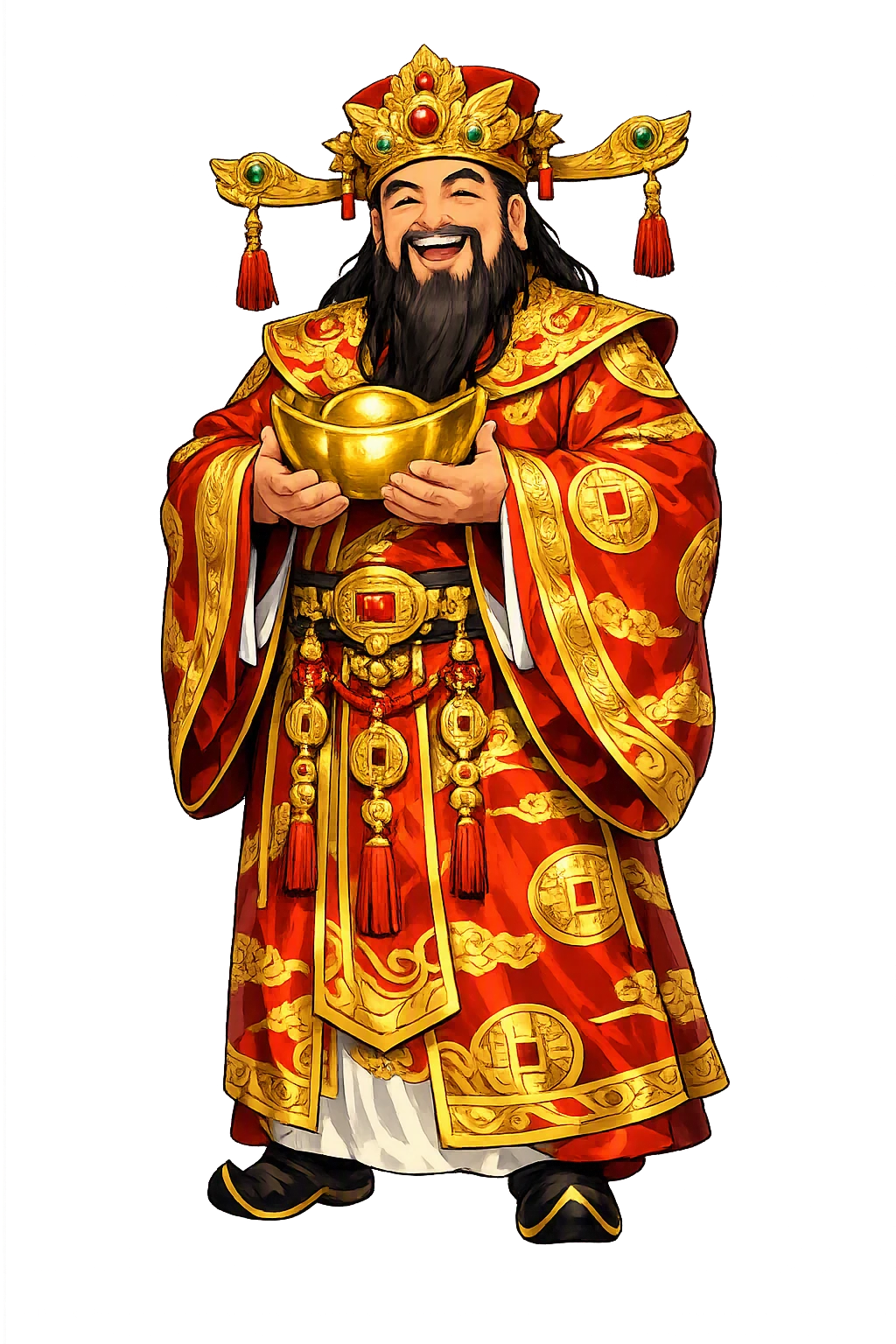
Every Cáishén is a portrait of the office. The canon set in the Ming: Marshal Zhào in armor or official dress, face red as lacquer, iron whip across the wrist, black tiger at his feet, flanked by his four assistants — Xiāo Shēng who summons treasure, Cáo Bǎo who gathers the precious, Chén Jiǔgōng the envoy of wealth, Yáo Shàosī the officer of fair profit; opposite him the civil form, Bǐ Gàn or Fàn Lǐ, white-bearded in a minister's robe with ruyi scepter and scroll. The boat-shaped gold ingot is never far from any hand. No ancient icon survives — the image is the work of print culture, standardized in Qing woodblock workshops and modeled in porcelain by the thousand for home altars and export. A god you can paste above a door and burn when the year turns: the iconography of a deity who is, above all, portable wealth.

06

Reception & Transformation

The name after its own age — transmission, translation, survival

Afterlives

The office of wealth was assembled from old parts and shipped new. Its raw material is Sima Qian: Bǐ Gàn's heartless martyrdom and Fàn Lǐ's three fortunes, both in the Shiji of the first century BCE, supplied the civil faces. A thousand years on, the Song commercial revolution made wealth worth praying to; the Yuan–Ming compendium Santjiao soushen daquan filed the growing pantheon, and the Ming novel Fengshen Yanyi canonized the marshal in the scene every reader remembers — Jiāng Zǐyá's investiture of the dead, commissioning Zhào Gōngmíng over the dragon-tiger altar. The Qing turned the cast into print: almanacs and New Year pictures carried the god to households that owned few other images, and Western residents were puzzling over him early — S. Wells Williams describes the rites of the God of Wealth in The Middle Kingdom (1848). Henri Doré's Researches into Chinese Superstitions and E. T. C. Werner's Dictionary of Chinese Mythology (1932) fixed the Western catalogue of the avatars; modern scholarship reads the god as the theology of a market revolution. Two characters — 'wealth deity' — did the rest: a title anyone could fill, and everyone did.

Identifications Across Traditions

Cáishén was assembled by borrowing. The novel's machinery of canonization is Daoist — Jiang Ziya's investiture lists are pure Daoist pantheon-building, and temple practice couches the god in Daoist liturgy. From Buddhism came wealth-deities the Tang already naturalized: Vaiśravaṇa (Bishamonten), the northern king and treasure-guardian, and Jambhala in the Tibetan and Mongolian lands. The closest foreign counterpart is Japan's Daikokuten — Mahākāla turned money-god, often fused with Ōkuninushi — one of the Seven Gods of Fortune. Vietnam keeps Thần Tài beside the earth-god Ông Địa on every family altar, and Hong Kong's banks host the lion dance at New Year. Across the Sinosphere, wealth was the one god every household kept — and each culture built its own face for him.

Modern Legacy

At Lunar New Year, Cáishén is the busiest god alive. The fifth-day welcome, the firecrackers, the reopened shops, the paper icons, and the greeting Gong Xi Fa Cai — 'wishing you prosperity' — all run on his calendar, from Harbin to Singapore to San Francisco. Hong Kong's markets watch the god's day; diaspora restaurants keep his altar by the register, oranges and gold ingots before the red-faced image. The digital age has not displaced him but multiplied his mediums: apps send red envelopes, and his portrait rides phone wallpapers through the New Year. A god minted by Song-dynasty commerce now banks the hopes of two billion people a year — the largest recurring act of popular worship on earth.

07

The Meditation

What Cáishén means — beyond the dictionary

Cáishén is a mirror. A civilization's wealth-god shows what that civilization thinks wealth is: the Greeks had Ploutos, a blind boy; Rome had Fortuna, a wheel; China built a bureaucracy. Marshal Zhao on his tiger says wealth has teeth; Bi Gan's missing heart says wealth corrupts; Fan Li's three fortunes say wealth is a craft; the four assistants — welcome treasure, gather valuables, invite wealth, profit the market — say it is, above all, an office with paperwork.

There is wisdom in the composite. No single story could carry the whole moral weight of money, so the tradition carries it by committee and lets each petitioner choose the face that fits. And the New Year custom keeps the deepest truth: fortune circulates. The god who arrives at midnight, received with noise and incense by whoever stays at the door, is a theology of readiness — prosperity favors the one awake to welcome it. That is not superstition. It is a culture's entire theory of prosperity, printed on red paper and burned, year after year, to send it on its rounds.

08

Screen & Culture

Where Cáishén echoes through film, television, and games — and how

09

Frequently Asked Questions

Common questions about Cáishén, Wealth, Prosperity, New Year, and Unicode restoration

01How do you pronounce Cáishén?

In reconstructed pronunciation, Cáishén is /caishen/ — approximately 'CAISHEN' — pronounce the restored form with attention to the preserved diacritics and length.

02What does Cáishén mean?

Cáishén means God of wealth in the chinese tradition.

03What are the symbols of Cáishén?

Cáishén is associated with The gold ingot (yuanbao) (The boat-shaped silver-gold ingot held by every avatar of Cáishén — wealth made visible and graspable.), The black tiger (Marshal Zhao's mount; the tiger that can carry wealth away as easily as it brings it.), The iron whip (Zhao Gongming's weapon, disciplining the pursuit of riches — wealth taken unjustly is wealth reclaimed.), The ruyi scepter ('As you wish' — the wish-granting wand of the Civil God of Wealth.), The account book (The ledger in which the god's office records each household's fortune for the coming year.).

04Why restore Cáishén in Unicode?

Plain ASCII caishen strips the stress, length, and script that make the name specific. Unicode restoration returns the name to its original written dignity.

05What is the most important myth about Cáishén?

“One Office, Many Gods” — the The Title story that anchors the mythology of Cáishén, told in full on the lore page.

10

Scholarly Sources

The philological foundations of this restoration

Every claim on this page is grounded in established scholarship. The orthographic restorations follow disciplinary convention. The etymological chain follows the best available reference works. This is not invention — it is resurrection through scholarship.

◈

Lexicography & Philology

  • Chinese folk religion
  • Chinese folklore
  • Fengshen Yanyi
◎

Primary Texts

  • Primary sources in the chinese tradition for Cáishén.
◉

Archaeology & Art History

  • Material evidence — iconography, inscriptions, and temple archaeology — for Cáishén and related cults.
✦

Religious Studies

  • Fengshen Yanyi (Investiture of the Gods, Ming)
  • Santjiao soushen daquan (Yuan–Ming compendium)
  • Sima Qian, Shiji 3 (Yin ben ji)
  • Doré, Researches into Chinese Superstitions
  • Werner, Dictionary of Chinese Mythology (1932)
Return

The Surface Awaits

You have traced the name from its earliest attestation to its Unicode restoration. Now return to the myth. The story is where the name lives.

Back to Lore
Cáishén mascot