PuniCodex

Extended Lore

ᛒᚱᛅᚴᛁ Bragi

Etymology · Orthography · Cult · Iconography · Reception · Sources

Tier 2 Bragi
Bragi — Poetry, Eloquence
01

Quick Facts

Essential information about Bragi, Poetry, Eloquence

Original Scriptᛒᚱᛅᚴᛁ
Unicode RestorationBragi
Reconstructed Pronunciation/ˈbrɑ.ɣi/
PantheonNorse
DomainPoetry, Eloquence
MeaningPoet, first
ClassificationTier 2
Primary DomainBragi
Sacred SymbolsThe mead of poetry, The bragarfull, The long beard, The bench in Ægir's hall, The greeting of dead kings
02

Etymology & Word Family

From original script to Unicode restoration

Original Script ᛒᚱᛅᚴᛁ Bragi — "Poet, first"
Unicode Restoration Bragi Canonical scholarly spelling — ASCII-identical
Modern ASCII bragi Plain-ASCII fallback

The name Bragi reaches the modern world through scholarly transliteration of the norse tradition. Because the conventional spelling uses only Latin letters, its Unicode and ASCII forms coincide — the tradition it carries is in the name itself, not in diacritics.

03

Unicode Character Breakdown

Character-by-character philological analysis

CharacterUnicodeNameBlockPhonetic Role
BU+0042Latin Capital Letter BBasic LatinSame, capitalized
rU+0072Latin Small Letter RBasic LatinSame
aU+0061Latin Small Letter ABasic LatinSame
gU+0067Latin Small Letter GBasic LatinSame
iU+0069Latin Small Letter IBasic LatinSame

The Tier 2 classification here reflects fidelity to the attested tradition, not recovered diacritics: every character of Bragi already survives in ASCII. What the restoration preserves is the canonical spelling itself — the form scholarship standardised.

04

Cult & Worship

How the sacred was kept — rites, sanctuaries, remains

The Cult

No cult of Bragi is attested, and the evidence that would ground one — sanctuaries, votives, theophoric place-names — is exactly where the record falls silent. What the sources give instead is one custom his name never left: the bragarfull, the 'foremost cup' of the vow-toast, which Ynglinga saga sets at the great inheritance feasts, where a son swears his oaths over the cup before the assembled kin — the one rite in the corpus where a god's name is the rite itself. The skaldic profession that clustered around him is the social reality the god personifies: court poets praising kings, the poem as the contract between a ruler and his fame. It left no altars because it needed none; its monument is the verse that survives. The welcome he speaks over dead kings in the court poems is the theology of that world — eloquence as the reception committee of the afterlife. Modern heathen sumbel, which still hails Bragi before the boasting rounds, revives the toast rather than any temple tradition.

In the Earth

Bragi is a textual god: no runestone invokes him, no votive deposit names him, and the place-name record offers no secure theophoric site — the silence that leads Simek and Lindow to weigh him as a late literary personification rather than an old cult figure. The runic corpus does know the name, but only as an ordinary human anthroponym: Bragi is well attested as a Viking-Age man's name in Scandinavian inscriptions, which is precisely the problem for cult-hunters, since none of the carvings can be tied to the god. The witnesses are therefore the manuscripts. Lokasenna and Grímnismál survive in the thirteenth-century Codex Regius of the Poetic Edda; Gylfaginning and the Skáldskaparmál frame in the Codex Regius and sister manuscripts of the Prose Edda, with Skáldatal in the Uppsala codex; Hákonarmál rides inside the Heimskringla tradition and Eiríksmál inside Fagrskinna. The famous image of Bragi as an old harper belongs to nineteenth-century art, not to the material record: no medieval carving, pendant, or picture stone shows him.

05

Iconography

How Bragi was imaged across the ages

The Image

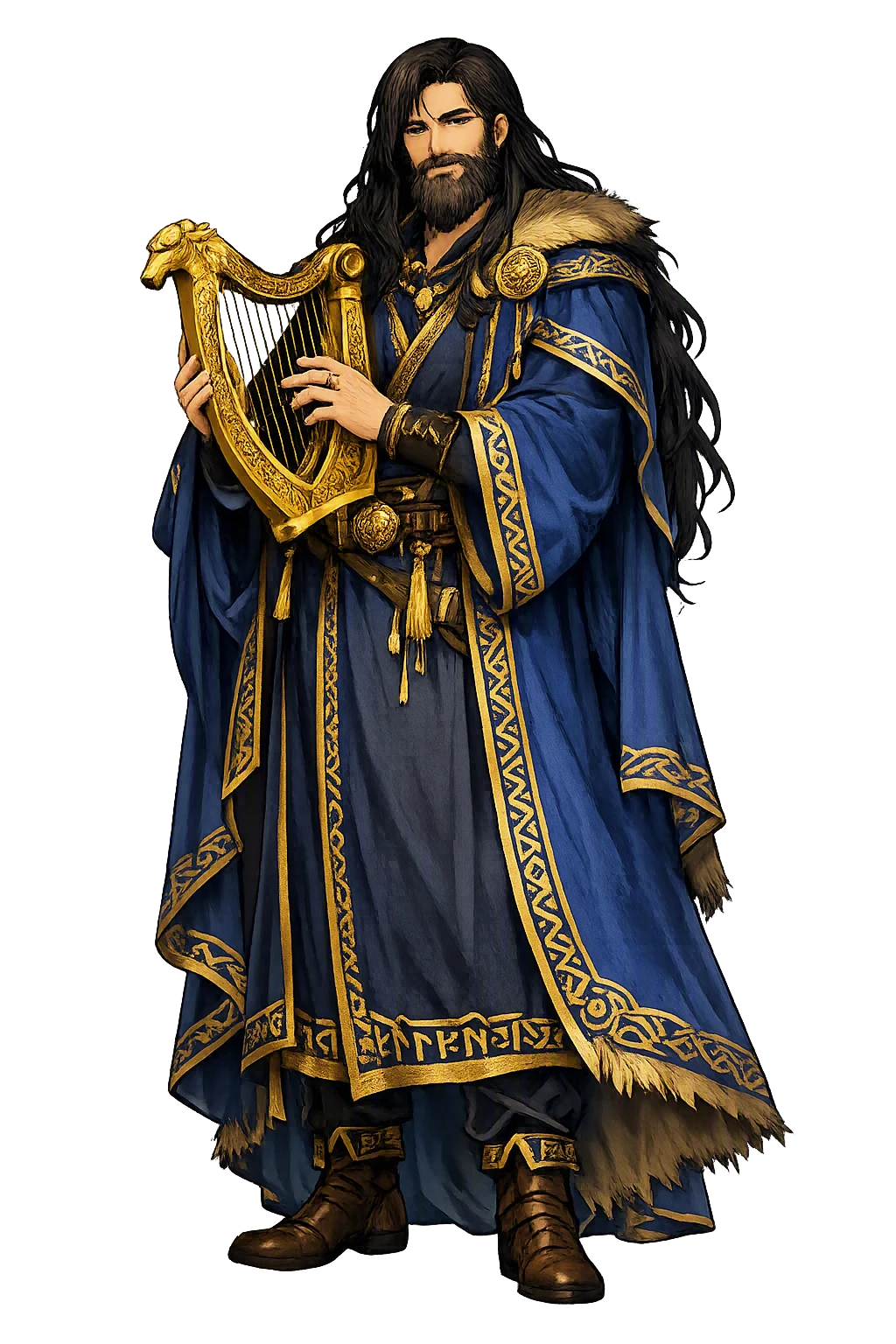
Bragi has almost no visual history at all, which suits a god whose attribute was the voice. The texts give him exactly three marks: the beard of the elder, the bench at Ægir's feast, and the cup from which vows are sworn. Snorri's portrait is a description, not a picture, and no Viking-Age stone or amulet carries him. His first portraits are embarrassingly late: eighteenth-century Icelandic antiquarian manuscripts drew the gods as a learned genealogy project and gave Bragi the beard and the bench straight from the prose. The harp is younger still — a nineteenth-century Romantic addition for which the Eddas offer no warrant; before that invention he is a mouth, not a musician. Modern Ásatrú iconography, when it depicts him at all, follows the eighteenth-century formula. The honest summary is the one his mythology insists on: the god of eloquence left eloquence as his only likeness.

06

Reception & Transformation

The name after its own age — transmission, translation, survival

Afterlives

Bragi's afterlife is the transmission of the word rather than the god. Bragr — poetry, the foremost — ran through the language: Snorri derived the noun from the god, modern etymologists have argued the direction ever since, and the argument itself has kept his name in every history of Old Norse literature. The verse he was made from was rescued by quotation: the Prose Edda's pages preserve Bragi Boddason's Ragnarsdrápa, the ninth-century shield-poem whose description of a myth-painted shield is the single most important ekphrasis for the lost art of the Viking Age — without those quoted stanzas we would not know how the myths looked on wood. The court poems that made Bragi the greeter of kings — Hákonarmál, Eiríksmál — rode inside Heimskringla and Fagrskinna into the modern editions. Finnur Jónsson's great Skjaldedigtning (1912–1915) fixed the skaldic corpus in print, and twentieth-century scholarship has largely settled his case: not an ancient cult god but the North's own reflection on its poets, surviving wherever skaldic verse is read — and still answering, every time a Scandinavian prize for literature takes his name, to the second sense of bragr: foremost.

Identifications Across Traditions

Bragi invites comparisons, and the honest ones are typological, not genealogical. The Irish Ogma of the Tuatha Dé Danann — champion of eloquence, credited with the Ogham script — is his closest structural kin in the neighbouring tradition: two Indo-European cultures that each enthroned the well-spoken word among their gods, with no borrowing argued or needed. The Greek comparison is weaker: Bragi is no Apollo, for he neither leads a choir nor prophesies, and the North already gave the mead of poetry's conquest to Óðinn. What Bragi has that the Greeks never made into a god is the skald's office itself — praise as a profession, memory as a wage, the poem as the contract between a king and his fame. The deepest syncretic question is internal: whether Bragi is a personification of bragr raised to godhood, or the euhemerized Bragi Boddason absorbed into his own subject matter. Either way, he is the most Germanic of answers to the question of where poetry lives: it lives at the feast, with a name that means 'foremost'.

Modern Legacy

Bragi never left the North's language. Bragr remained the Old Norse word for poetry itself; the bragr-maðr and bragr-kona — the man or woman of surpassing eloquence — kept his name in everyday compliment; and the bragarfull, the foremost cup of the vow-toast that Ynglinga saga sets at the great inheritance feasts, carried the word into the drinking customs of medieval Scandinavia and, revived, into the sumbel of modern Heathen practice, where Bragi is still hailed as the patron of poets before the boasting rounds begin. The name lives on as a Scandinavian given name — Bragi in Iceland, Brage in Norway and Sweden — and Norway's premier literary award, the Brage Prize, has borne it since 1992. The white-bearded Bragi with a harp who appears in nineteenth-century Scandinavian painting and sculpture is a Romantic addition: the Eddas give him no instrument, only the voice — which was, of course, the whole point.

07

The Meditation

What Bragi means — beyond the dictionary

Bragi is the god a culture of oral memory had to invent. In a world without archives, the skald was the archive: the king's deeds, the clan's honour, the boundary between being remembered and being nothing all ran through one trained voice at the feast. The North looked at that voice and saw a god in it — and then, characteristically, put the god to work at the door of the dead, because the only immortality the Edda truly promises is the welcome spoken over you when you arrive. Óðinn wins the mead; Bragi pours it. That division of labour is the deepest thing the tradition says about poetry: inspiration is theft and ordeal, but eloquence is hospitality — the craft of receiving greatness and giving it words. The god whose name means 'foremost' is the one who stands where the living greet the dead and finds the sentence both can bear.

08

Frequently Asked Questions

Common questions about Bragi, Poetry, Eloquence, and Unicode restoration

01How do you pronounce Bragi?

In reconstructed pronunciation, Bragi is /ˈbrɑ.ɣi/ — approximately BRAH-ghi — a short open 'ah', and the g softening between vowels to a light voiced fricative, like a gentle 'gh'; stress falls on the first syllable.

02What does Bragi mean?

Bragi means Poet, first in the norse tradition.

03What are the symbols of Bragi?

Bragi is associated with The mead of poetry (Poetry as a liquid that can be brewed, stolen, and shared — inspiration made drinkable), The bragarfull (The foremost cup of the vow-toast — the spoken word made binding over drink), The long beard (Snorri's kenning for the god — age, memory, and the skald's authority worn on the face), The bench in Ægir's hall (The storyteller's seat at the feast — eloquence as a hospitality the gods themselves require), The greeting of dead kings (The word that meets greatness at death's door — praise as the North's answer to mortality).

04Why restore Bragi in Unicode?

Bragi is written entirely in ASCII letters, so its restoration is about canonical fidelity rather than recovered diacritics: the temple fixes the name in its scholarly standard spelling, attested in the source tradition, instead of leaving it to drift.

05What is the most important myth about Bragi?

“The Best of Skalds” — the Gylfaginning 26 story that anchors the mythology of Bragi, told in full on the lore page.

09

Scholarly Sources

The philological foundations of this restoration

Every claim on this page is grounded in established scholarship. The orthographic restorations follow disciplinary convention. The etymological chain follows the best available reference works. This is not invention — it is resurrection through scholarship.

◈

Lexicography & Philology

  • Cleasby-Vigfusson
◎

Primary Texts

  • Poetic Edda
  • Poetic Edda: Lokasenna 11–18 (Bragi bars Loki from the feast; Iðunn's intervention); Grímnismál 44 (Bragi best of skalds, in the litany of the best)
  • Snorri Sturluson, Prose Edda: Gylfaginning 26 (the catalogue portrait: eloquence, bragr from his name, husband of Iðunn); Skáldskaparmál (the frame with Ægir; the mead of poetry; the abduction of Iðunn; kennings for Bragi; quotations of Bragi Boddason's Ragnarsdrápa)
  • Snorri Sturluson, Heimskringla: Ynglinga saga (the bragarfull, the foremost cup of the vow-toast); Skáldatal (Bragi Boddason among the skalds of Ragnarr loðbrók)
◉

Archaeology & Art History

  • Material evidence — iconography, inscriptions, and temple archaeology — for Bragi and related cults.
✦

Religious Studies

  • Eyvindr Finnsson skáldaspillir, Hákonarmál (Bragi and Hermóðr sent to greet King Hákon), preserved in Snorri Sturluson, Heimskringla, Hákonar saga góða; and the anonymous Eiríksmál (Bragi questions Óðinn on Eiríkr Bloodaxe), preserved in Fagrskinna
  • Cleasby–Vigfusson, An Icelandic-English Dictionary, s.v. Bragi, bragr, bragarfull; Zoëga, A Concise Dictionary of Old Icelandic, s.v. Bragi, bragr
  • Simek, Dictionary of Northern Mythology; Orchard, Dictionary of Norse Myth and Legend; Lindow, Norse Mythology: A Guide — s.v. Bragi (the personification and Bragi Boddason debates)
Return

The Surface Awaits

You have traced the name from its earliest attestation to its Unicode restoration. Now return to the myth. The story is where the name lives.

Back to Lore
Bragi mascot