PuniCodex

Extended Lore

Blodeuwedd

Etymology · Orthography · Cult · Iconography · Reception · Sources

Tier 2 Blodeuwedd
Blodeuwedd — Flower Bride, Betrayal
01

Quick Facts

Essential information about Blodeuwedd, Flower Bride, Betrayal

Scholarly TransliterationBlodeuwedd
Unicode RestorationBlodeuwedd
Reconstructed Pronunciation/blɔˈdɛu̯.wɛð/
PantheonCeltic
DomainFlower Bride, Betrayal
MeaningFlower face
ClassificationTier 2
Primary DomainBlodeuwedd
Sacred SymbolsOak, broom, and meadowsweet, The spear a year in the forging, The cauldron and the billy-goat, The owl, Llyn y Morwynion
02

Etymology & Word Family

From original script to Unicode restoration

Scholarly Transliteration Blodeuwedd Blodeuwedd — "Flower face"
Unicode Restoration Blodeuwedd Canonical scholarly spelling — ASCII-identical
Modern ASCII blodeuwedd Plain-ASCII fallback

The name Blodeuwedd reaches the modern world through scholarly transliteration of the celtic tradition. Because the conventional spelling uses only Latin letters, its Unicode and ASCII forms coincide — the tradition it carries is in the name itself, not in diacritics.

03

Unicode Character Breakdown

Character-by-character philological analysis

CharacterUnicodeNameBlockPhonetic Role
BU+0042Latin Capital Letter BBasic LatinSame, capitalized
lU+006CLatin Small Letter LBasic LatinSame
oU+006FLatin Small Letter OBasic LatinSame
dU+0064Latin Small Letter DBasic LatinSame
eU+0065Latin Small Letter EBasic LatinSame
uU+0075Latin Small Letter UBasic LatinSame
wU+0077Latin Small Letter WBasic LatinSame
eU+0065Latin Small Letter EBasic LatinSame
dU+0064Latin Small Letter DBasic LatinSame

The Tier 2 classification here reflects fidelity to the attested tradition, not recovered diacritics: every character of Blodeuwedd already survives in ASCII. What the restoration preserves is the canonical spelling itself — the form scholarship standardised.

04

Cult & Worship

How the sacred was kept — rites, sanctuaries, remains

The Cult

No one ever built Blodeuwedd a shrine, and the Fourth Branch never shows anyone praying to her: she is a made woman in a single tale, not a goddess with a cult, and the medieval record offers no festival, priesthood, or votive that is hers. The only observance the tradition preserves is linguistic — the folk-etymology installed by the tale's ending, which made her name the Welsh word for owl, so that every Welsh speaker who names the bird performs a small act of memory. Modern pagan circles, especially at May, have adopted her as a flower-goddess and built seasonal observances around oak, broom, and meadowsweet; that devotion is modern, sincere, and unevidenced, and should be honored as revival rather than quoted as survival.

In the Earth

Blodeuwedd is a literary figure with no material cult record: no inscription, image, or votive object names her, and her witnesses are the two Mabinogion codices — the White Book of Rhydderch (Aberystwyth, NLW Peniarth 4–5, c. 1350) and the Red Book of Hergest (Oxford, Jesus College MS 111, c. 1400). What she has instead of temples is topography, and the Fourth Branch's map is still walkable. Mur Castell, her bridal court, is traditionally placed at Tomen y Mur in Ardudwy, beside the Roman fort; Llyn y Morwynion, the Lake of the Maidens where her retinue drowned, is pointed out above Ffestiniog; and on the bank of the river Cynfael stands a holed stone locally called Llech Ronw, 'Gronw's stone', the slab Lleu's spear pierced. These are local identifications rather than proof, but they show how early and how firmly the tale was staked into the landscape of Gwynedd — medieval hearers, like modern walkers, could be taken to the places where it happens.

05

Iconography

How Blodeuwedd was imaged across the ages

The Image

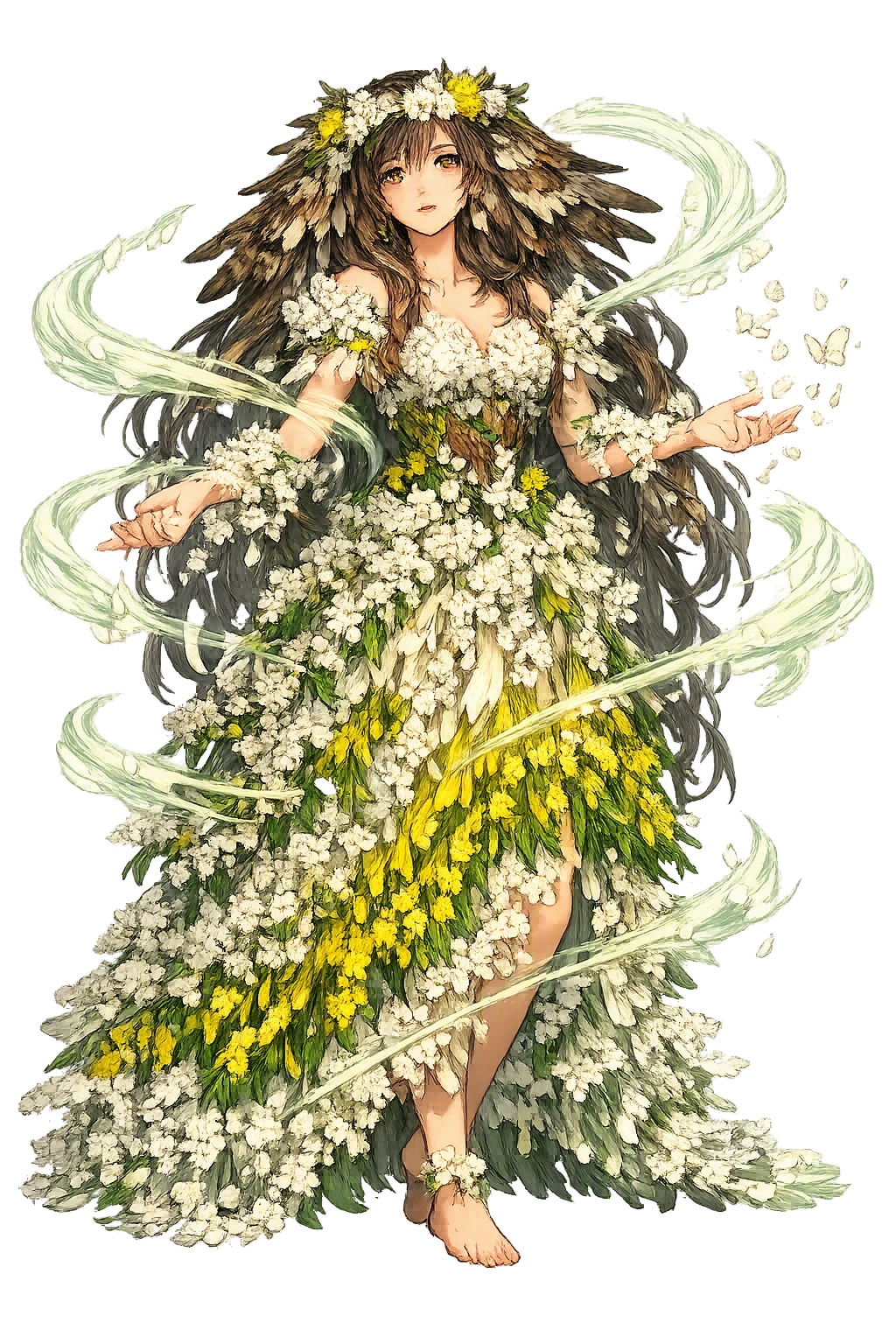
The manuscripts never drew her: no illumination of the White Book or the Red Book gives the flower-bride a face, and for six centuries her iconography remained purely verbal — a woman made from oak blossom, broom, and meadowsweet, beauty assembled as a legal argument against Arianrhod's destiny. Her image in the world is a sentence: Gwydion's decree that she wear the shape of the night-bird forever. The visual afterlife is modern, and Welsh art claimed it early. Christopher Williams's Blodeuwedd; Flower Face (c. 1925–30, Newport Museum and Art Gallery) gave her a somber, monumental body; Alan Lee's paintings for the 1982 Dragon's Dream Mabinogion carried the conjured bride to an international readership in the idiom of modern fantasy illustration. In nearly all of it the owl keeps watch at the edge of the frame — the sentence the tale passed on her, and the shape her image can never quite escape.

06

Reception & Transformation

The name after its own age — transmission, translation, survival

Afterlives

Blodeuwedd's transmission is the transmission of the Fourth Branch itself, and it is remarkably narrow: one masterpiece, preserved whole in the White Book of Rhydderch (c. 1350) and the Red Book of Hergest (c. 1400), carried her to modernity. The tale reached its first wide readership in English through Lady Charlotte Guest's Mabinogion (1838–49), which introduced the flower-bride to the Victorian imagination, and the Welsh scholarly establishment then gave the text its modern form — John Rhys lecturing on its mythic substratum in the 1880s, Ifor Williams's edition Pedeir Keinc y Mabinogi (1930) fixing the language on which all later study stands. Robert Graves made her a muse: The White Goddess (1948) built an entire poetics around the made bride and her flowers, and modern Welsh writing has been answering him ever since. The late twentieth century reread her as the literature's great study of a manufactured woman who chooses — and of the sentence passed on female choice — a critical tradition that runs from feminist scholarship into contemporary Welsh fiction. Through every redescription the tale's own monument endures: a word in the Welsh dictionary that is still her name.

Identifications Across Traditions

Blodeuwedd's closest comparative kin is the made bride. Greek tradition offers [[pandora|Pandora]], the woman the gods fashion as a gift that is also a trap — beauty assembled by divine craft and given to a man, with ruin in the giving. The parallel holds at the level of motif, not borrowing: both figures are manufactured women whose makers intend one destiny and whose own desires rewrite it, though Pandora's makers send her as the trap while Blodeuwedd's makers are her undoing's victims. Within Celtic scholarship she has been read in the sovereignty frame — Mac Cana and others note the pattern by which the woman's favour carries the land, since Gronw takes Lleu's rule with his wife — and her triple flowers have drawn the attention of the tree-calendar speculation around Robert Graves, which the handbooks do not accept. The honest verdict is that she belongs to the international faithless-bride and made-woman complexes, with a sentence that is the Mabinogi's own: no other tradition punishes a woman by letting her keep her name forever.

Modern Legacy

Blodeuwedd's afterlife is carried in two forms: a word and a novel. The word is blodeuwedd itself — in modern Welsh simply 'owl', so that every Welsh speaker who names the bird repeats her sentence, a folk-etymology the Fourth Branch deliberately installed. The novel is Alan Garner's The Owl Service (1967), winner of the Carnegie Medal, which takes the Fourth Branch's triangle as a pattern that replays down the generations of a Welsh valley: a dinner service whose painted flowers resolve into owls, and three young people cast again as the flower-bride, the lord, and the hunter. The tale has become a set text of Welsh education and a touchstone of Welsh-language letters — retold for children, staged, and argued over by critics who read her as traitor, as sovereignty figure, or as the literature's first portrait of a made thing demanding a will of its own. In scholarship she holds a fixed place: Ifor Williams's edition, Mac Cana's study of the Mabinogi, and Koch's encyclopedia all treat her episode as the Fourth Branch's tragic heart.

07

The Meditation

What Blodeuwedd means — beyond the dictionary

Blodeuwedd is the Mabinogi's argument about what making means. Math and Gwydion make a woman the way they make illusions — by craft, for a purpose, to defeat a destiny — and the Fourth Branch's quiet question is what a made thing owes its makers. She has no mother, no father, no childhood, no choice in her marriage; she is given beauty, a name, a husband, and a court, and the tale watches, without comment, as the one thing she chooses for herself is a man and a murder. Gwydion's sentence is exact in its cruelty: not death, which would end her, but the kept name — Flower-face worn forever on the face of the night-bird every other bird hates. The punishment preserves her even as it damns her. Seven centuries later the word for owl in Welsh is still her name: the flowers never stopped blooming in it, and the shame never left it either.

08

Frequently Asked Questions

Common questions about Blodeuwedd, Flower Bride, Betrayal, and Unicode restoration

01How do you pronounce Blodeuwedd?

In reconstructed pronunciation, Blodeuwedd is /blɔˈdɛu̯.wɛð/ — approximately 'blo-DEH-weth' — three syllables with the weight on the middle one; the final dd is the soft th of 'this', and the eu slides like the vowel of 'say' pulled toward a rounded close.

02What does Blodeuwedd mean?

Blodeuwedd means Flower face in the celtic tradition.

03What are the symbols of Blodeuwedd?

Blodeuwedd is associated with Oak, broom, and meadowsweet (The three flowers of her making — beauty assembled by enchantment, with no childhood and no kin), The spear a year in the forging (Worked only during Mass on Sundays — the weapon shaped by the stolen secret of an impossible death), The cauldron and the billy-goat (The two footings of the fatal stance: one foot on the rim, one on the beast — neither indoors nor out, neither mounted nor afoot), The owl (The shape of the sentence: the face that must not be shown by day, mobbed by every other bird), Llyn y Morwynion (The Lake of the Maidens — the backward glance in the dark that drowned her whole retinue).

04Why restore Blodeuwedd in Unicode?

Blodeuwedd is written entirely in ASCII letters, so its restoration is about canonical fidelity rather than recovered diacritics: the temple fixes the name in its scholarly standard spelling, attested in the source tradition, instead of leaving it to drift.

05What is the most important myth about Blodeuwedd?

“Made of Flowers” — the Math fab Mathonwy story that anchors the mythology of Blodeuwedd, told in full on the lore page.

09

Scholarly Sources

The philological foundations of this restoration

Every claim on this page is grounded in established scholarship. The orthographic restorations follow disciplinary convention. The etymological chain follows the best available reference works. This is not invention — it is resurrection through scholarship.

◈

Lexicography & Philology

  • Mabinogion
  • MacKillop
◎

Primary Texts

  • The Immram Brain (Voyage of Bran); Tochmarc Étaíne; Cóir Anmann; medieval Irish saga literature.
◉

Archaeology & Art History

  • Material evidence — iconography, inscriptions, and temple archaeology — for Blodeuwedd and related cults.
✦

Religious Studies

  • Mabinogion, Fourth Branch (Math uab Mathonwy), trans. Sioned Davies (Oxford University Press, 2007)
  • Ifor Williams, ed., Pedeir Keinc y Mabinogi, 2nd ed. (University of Wales Press, 1951)
  • Proinsias Mac Cana, The Mabinogi, 2nd ed. (University of Wales Press, 1992)
  • John T. Koch, ed., Celtic Culture: A Historical Encyclopedia (ABC-CLIO, 2006), s.v. Blodeuwedd, Mabinogi
  • Geiriadur Prifysgol Cymru / A Dictionary of the Welsh Language, s.v. blodeuwedd
  • Alan Garner, The Owl Service (Collins, 1967)
Return

The Surface Awaits

You have traced the name from its earliest attestation to its Unicode restoration. Now return to the myth. The story is where the name lives.

Back to Lore
Blodeuwedd mascot