PuniCodex

Extended Lore

Bifrǫst

Etymology · Phonology · Orthography · Cultural Legacy · Primary Sources

Tier 1 Bifrǫst.com
Bifrǫst — Rainbow Bridge, Passage, Heimdallr's Watch
01

Quick Facts

Essential information about Bifrǫst, Rainbow Bridge, Passage, Heimdallr's Watch

Scholarly TransliterationBifrǫst
Unicode RestorationBifrǫst
Reconstructed Pronunciation/ˈbif.rɔst/
PantheonNorse
DomainRainbow Bridge, Passage, Heimdallr's Watch
MeaningTrembling pathway (from bifa, to shake, + rǫst, league)
ClassificationTier 1
Primary DomainBifrǫst.com
Sacred SymbolsThe red band, Gjallarhorn, Himinbjǫrg, Urðr's well, The horses of the Æsir
02

Etymology & Word Family

From original script to Unicode restoration

Scholarly Transliteration Bifrǫst Bifrǫst — "Trembling pathway (from bifa, to shake, + rǫst, league)"
Unicode Restoration Bifrǫst Restored stress, length, and script
Modern ASCII bifrost Plain-ASCII fallback

Cleasby–Vigfusson (s.v. bifrǫst) glosses the name 'the trembling way,' from bifa 'to shake, tremble' and rǫst 'a league, a distance to be traversed'; Zoëga (s.v.) gives the same etymology and records the alternate name Ásbrú 'the Æsir-bridge.' The Eddic codex reads Bilrǫst, with bil 'moment, lapse of time,' and editors still debate which compound is original; Snorri's Bifrǫst is the form that prevailed. The o-ogonek ǫ is a distinctive atomic letter that the ASCII form loses, so the restoration is Tier 1 under the mechanical rule.

03

Unicode Character Breakdown

Character-by-character philological analysis

CharacterUnicodeNameBlockPhonetic Role
BU+0042Latin Capital Letter BBasic LatinSame, capitalized
iU+0069Latin Small Letter IBasic LatinSame
fU+0066Latin Small Letter FBasic LatinSame
rU+0072Latin Small Letter RBasic LatinSame
ǫU+01EBLatin Small Letter O with OgonekLatin Extended-BO-hook: short /ɔ/ vowel
sU+0073Latin Small Letter SBasic LatinSame
tU+0074Latin Small Letter TBasic LatinSame

The Tier 1 classification reflects how much of the original phonology this restoration preserves — stress and vowel length for Greek names, distinctive letters and diacritics for every other tradition.

04

Cultural Significance

From ancient cult to modern Unicode

Ancient Domain

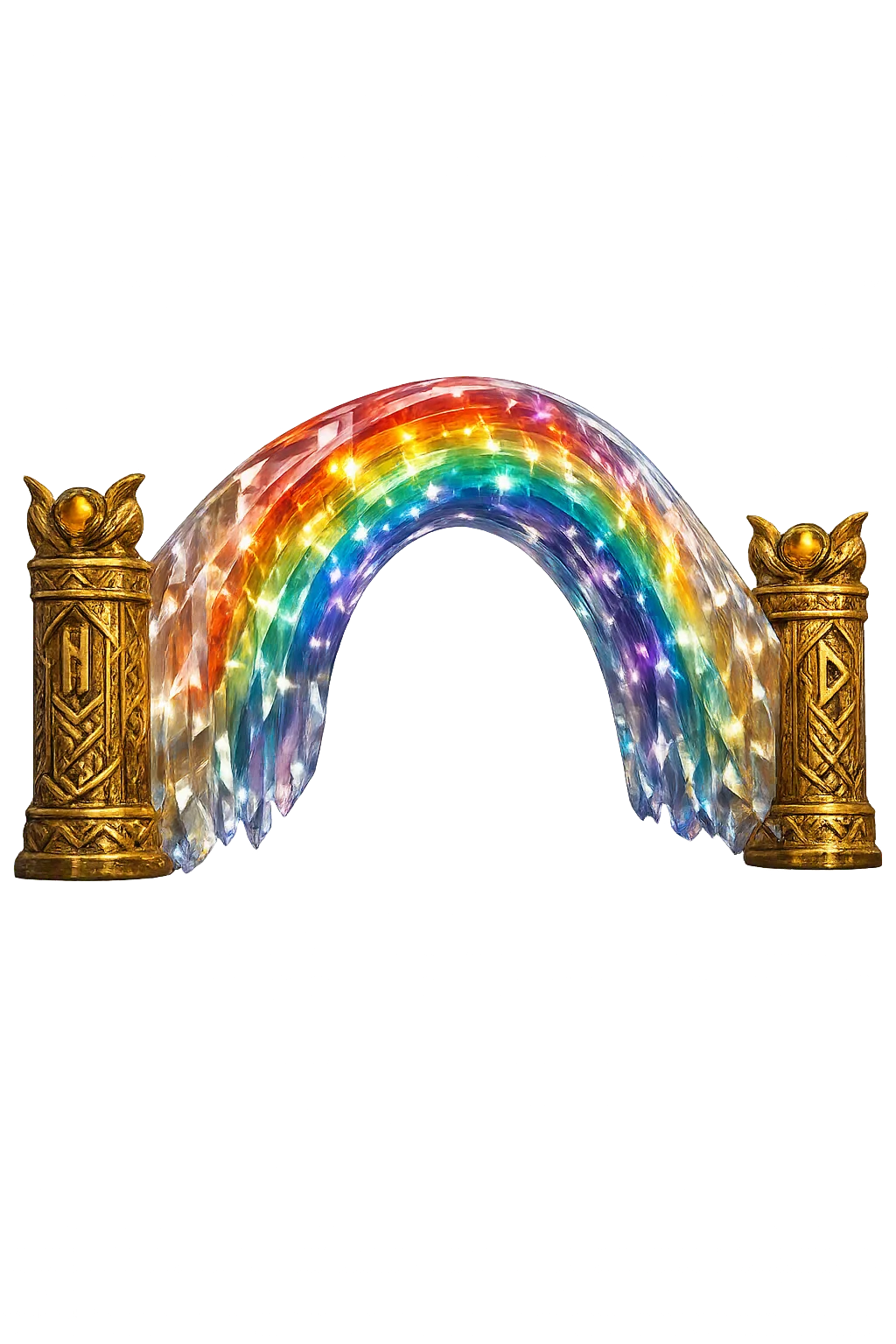
In the norse tradition, Bifrǫst is the burning rainbow that joins Miðgarðr to Ásgarðr — the trembling path, from bifa 'to shake' and rǫst 'a league, a distance to be traversed.' The gods themselves call it Ásbrú, the Æsir-bridge, and ride it daily to hold court beneath Yggdrasill.

The name encodes a structure built to fail: strong beyond any other work, as Snorri insists, yet fated to shake, to burn, and at last to break beneath the sons of Muspell. Between its watchman's horn and its final shattering, the bridge is the measure of the distance between gods and everything else.

Bifrǫst in Later Traditions

The burning rainbow has no attested continental Germanic counterpart — no Old English or Old High German source names the bridge, so Bifrǫst belongs to the Old Norse material alone, and any deeper common-Germanic pedigree is conjecture. Comparanda crowd around it nonetheless. In Greek tradition Iris is the rainbow made person, the messenger who moves between heaven and earth along the arc; in the Rig Veda the rainbow is Indra's bow (Indradhanush), a weapon hung in the sky; and the rainbow covenant of Genesis 9 was familiar to the Christian Icelanders who copied the Eddas, a juxtaposition that colors, though it does not explain, Snorri's red band of fire. In Finnic and Baltic folklore the Milky Way is a road of birds or souls, another shining path overhead. Later European folk belief kept the rainbow as a bridge and a boundary — the treasure at its foot, the impossibility of reaching its end — and modern popular culture, most openly Marvel's Einstein–Rosen 'Bifrost,' has translated the trembling way into a wormhole, which is the same intuition in newer physics: a bridge that burns, shakes, and cannot be trusted to hold.

Modern Legacy

Wagner fixed the bridge in the modern imagination at the close of Das Rheingold: Donner's hammer summons the storm that clears the air, the rainbow appears, Froh names it as the way to the gods' new castle, and the gods process over it into Valhalla while Loge mutters that they are hastening toward their end — a reading of Bifrǫst's built-in doom that Snorri would have recognized. Nineteenth- and twentieth-century book illustration kept the burning arc as the standard emblem of the passage to Ásgarðr. Marvel's comics and films made Bifrost a household word, reimagining it as a wormhole guarded by Heimdall and gate-keeping travel between realms; games from God of War Ragnarök to Assassin's Creed Valhalla render it as the shimmering road between worlds. Modern heathen practice uses the rainbow bridge as a symbol of the live connection between Miðgarðr and the gods, while the unrelated 'Rainbow Bridge' poem of pet bereavement shows how far the idiom of the shining span has travelled from its Old Norse root. Restoring Bifrǫst in Unicode keeps the trembling in the name — the ASCII Bifrost has forgotten that the bridge shakes.

Unicode Restoration as Cultural Act

Restoring Bifrǫst in a domain name is more than orthographic accuracy. It is a statement that the internet should recognize the full range of human writing — not only the ASCII keyboard.

05

Frequently Asked Questions

Common questions about Bifrǫst, Rainbow Bridge, Passage, Heimdallr's Watch, and Unicode restoration

01How do you pronounce Bifrǫst?

In reconstructed pronunciation, Bifrǫst is /ˈbif.rɔst/ — approximately 'BIV-rost' — stress the first syllable; let the f pass as a soft breath between the lips, almost a 'v'; say the ǫ as a short, open 'aw' cut in half, not the long 'oh' of the English Bifrost..

02What does Bifrǫst mean?

Bifrǫst means Trembling pathway (from bifa, to shake, + rǫst, league) in the norse tradition.

03What are the symbols of Bifrǫst?

Bifrǫst is associated with The red band (The stripe of burning fire within the rainbow that bars the giants from heaven), Gjallarhorn (Heimdallr's horn, kept at the bridge and winded to wake the gods at Ragnarǫk), Himinbjǫrg ('Heaven's castle,' Heimdallr's hall at the bridge's head where it touches the sky), Urðr's well (The spring beneath Yggdrasill where the gods ride each day to sit in judgment), The horses of the Æsir (The steeds named in Grímnismál — Glad, Gyllir, Glær, Skeiðbrimir and the rest — that bear the gods over the burning span).

04Why restore Bifrǫst in Unicode?

Plain ASCII bifrost strips the stress, length, and script that make the name specific. Unicode restoration returns the name to its original written dignity.

05What is the most important myth about Bifrǫst?

Gangleri asks how the gods pass from heaven to earth, and Hárr answers that they built Bifrǫst from earth to heaven: a bridge of three colors, very strong, and made with more skill and cunning than any other work. The red in the rainbow, Hárr explains, is burning fire, so that the frost-giants and mountain-giants cannot mount into heaven over the bridge.At the bridge's head, where it reaches the edge of heaven, stands Himinbjǫrg, the hall of Heimdallr, the watchman of the gods. He needs less sleep than a bird, sees a hundred leagues by night as by day, and hears the grass growing on the earth and the wool on the sheep. Beside him waits the Gjallarhorn, whose blast is heard in all worlds.

06

Scholarly Sources

The philological foundations of this restoration

Every claim on this page is grounded in established scholarship. The orthographic restorations follow disciplinary convention. The etymological chain follows the best available reference works. This is not invention — it is resurrection through scholarship.

Lexicography & Philology

  • Poetic Edda
  • Prose Edda
  • Cleasby-Vigfusson

Primary Texts

  • The Prose Edda of Snorri Sturluson, trans. Arthur Gilchrist Brodeur (1916) — Gylfaginning on the building, the red band of fire, and the breaking of Bifröst
  • The Poetic Edda, trans. Henry Adams Bellows (1936) — Grímnismál, Lokasenna, Vafþrúðnismál, Fáfnismál, Grípisspá
  • Gylfaginning — Old Norse text of Snorri's account of Bifrǫst and Himinbjǫrg
  • Grímnismál — Old Norse text: Þórr's wading of Kǫrmt, Ǫrmt, and the Kerlaugar, and the burning Ásbrú
  • Lokasenna — Old Norse text: Loki's taunt of Heimdallr, the watchman of the gods
  • Vafþrúðnismál — Old Norse text of the wisdom-contest poem in the Codex Regius
  • The Story of the Volsungs (Volsunga Saga), with excerpts from the Poetic Edda, trans. Eiríkr Magnússon and William Morris (1870) — Grípisspá's prophecy of the bridge's breaking

Archaeology & Art History

  • Material evidence — iconography, inscriptions, and temple archaeology — for Bifrǫst and related cults.
  • Bifrǫst is a textual figure with no known pictorial or runic attestation: no picture stone, amulet, or runestone names or unambiguously depicts the rainbow bridge, and the riders carved on stones such as Ardre VIII cannot be securely tied to it. Its transmission is manuscriptal. The mythological poems that preserve it — Grímnismál, Fáfnismál, Grípisspá, Lokasenna, Vafþrúðnismál — survive in the Codex Regius of the Poetic Edda (GKS 2365 4to, c. 1270), which reads the name as Bilrǫst. Snorri's extended account in Gylfaginning survives in the Codex Regius of the Prose Edda (GKS 2367 4to, early fourteenth century), the Codex Wormianus (AM 242 fol.), the Codex Upsaliensis (DG 11), and the Codex Trajectinus (Traj 1374), whose divergences editors weigh stanza by stanza.

Religious Studies

  • Encyclopaedia Britannica, 'Bifrost'
Return

The Surface Awaits

You have traced the name from its earliest attestation to its Unicode restoration. Now return to the myth. The story is where the name lives.

Back to Lore
Bifrǫst mascot