
Pronouncing Bifrǫst: a guide for the curious
Saying Bifrǫst aloud is harder than reading it on a screen, and more rewarding. The restored spelling is a compressed pronunciation guide: every accent and macron is an instruction. This post unpacks those instructions — the reconstructed sound, the phoneme-by-phoneme record, the kindred forms in neighboring languages — and then zooms out to the full record around the name: its Runes writing, its mythology, its cult, and its modern life as a Unicode domain. Whether you arrive as a linguist, a reader of myth, or a domainer, you will leave able to say the name the way the evidence suggests it was said — and able to type it the way it was written.
At a Glance
- Restored name: Bifrǫst
- ASCII form: bifrost
- Meaning: "Trembling pathway (from bifa, to shake, + rǫst, league)"
- Domain of influence: Rainbow Bridge, Passage, Heimdallr's Watch
- Pantheon: Norse
- Classification: Tier 1
- Live domain: bifrǫst.com
Overview
Bifrǫst (bifrost) — Rainbow Bridge, Passage, Heimdallr's Watch · Trembling pathway (from bifa, to shake, + rǫst, league) — belongs to the Norse tradition, where it is catalogued under the domain "Rainbow Bridge, Passage, Heimdallr's Watch". The name means "Trembling pathway (from bifa, to shake, + rǫst, league)".
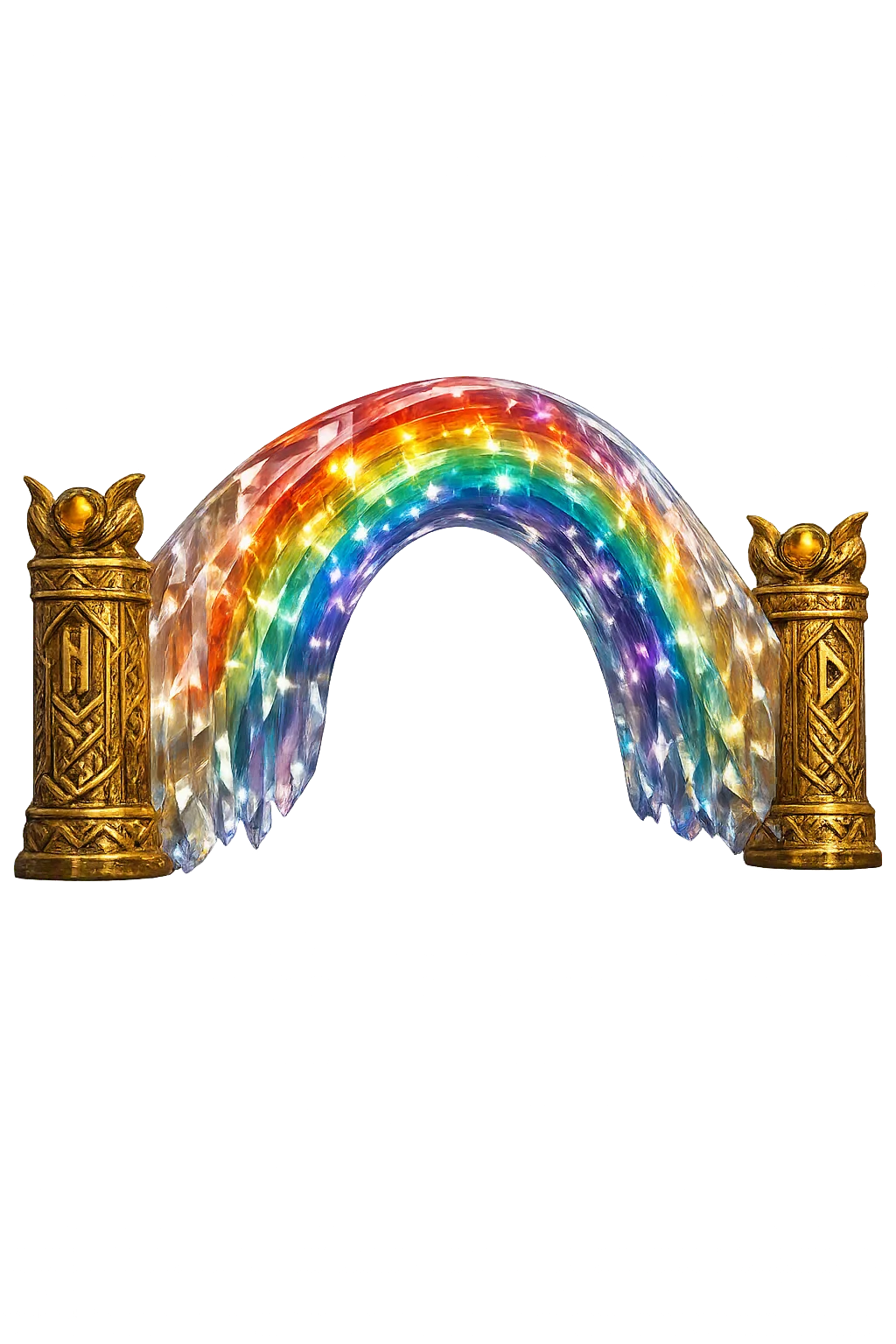
In the norse tradition, Bifrǫst is the burning rainbow that joins Miðgarðr to Ásgarðr — the trembling path, from bifa 'to shake' and rǫst 'a league, a distance to be traversed.' The gods themselves call it Ásbrú, the Æsir-bridge, and ride it daily to hold court beneath Yggdrasill.
The name encodes a structure built to fail: strong beyond any other work, as Snorri insists, yet fated to shake, to burn, and at last to break beneath the sons of Muspell. Between its watchman's horn and its final shattering, the bridge is the measure of the distance between gods and everything else.
PuniCodex restores the name as Bifrǫst and serves its temple at bifrǫst.com. The restoration preserves at least one distinctive feature — a diacritic or a distinctive letter — that the ASCII form loses, and exactly one historically valid Unicode restoration exists, which places the name in Tier 1. The plain ASCII form bifrost survives as a modern convenience imposed by the early domain-name system; the restoration, not the fallback, is the form the project defends as philologically complete.
The Name
No indigenous written attestation survives for this name; Bifrǫst is a scholarly transliteration of the reconstructed spoken form. Etymologically the name means "Trembling pathway (from bifa, to shake, + rǫst, league)".
The ASCII form bifrost survives only because the early domain-name system could not carry diacritics; it is a technological compromise, not an ancient spelling. The Unicode restoration Bifrǫst recovers the full diacritic detail of the scholarly transliteration directly in the address bar. The restoration preserves at least one distinctive feature — a diacritic or a distinctive letter — that the ASCII form loses, and exactly one historically valid Unicode restoration exists, which places the name in Tier 1.
The letter-by-letter transformation runs:
- b → B — Same, capitalized
- i → i — Same
- f → f — Same
- r → r — Same
- o → ǫ — O-hook: short /ɔ/ vowel
- s → s — Same
- t → t — Same
The project holds the domain bifrǫst.com (xn--bifrst-zcc.com) as the canonical home of this name.
The Original Script
The original script for this norse name has not yet been added to PUNICODEX. The form shown is a scholarly transliteration.
The form Bifrǫst is therefore a scholarly transliteration rather than an attested ancient spelling; it encodes the reconstructed sound of the name for modern use, and no mark in it is decorative.
The name is Old Norse Bifrǫst, transmitted in Latin-script codices; no runic inscription preserves it. In a normalized Younger Futhark rendering it would be written ᛒᛁᚠᚱᛅᛋᛏ, with ᛅ for the ǫ. The ǫ is the o-ogonek, the u-umlaut of a — a short open-mid vowel, written ö in Modern Icelandic — and it is the one distinctive feature the ASCII form destroys. The restored registrable form is bifrǫst.com (punycode xn--bifrst-zcc.com); the ASCII fallback bifrost.com flattens the trembling vowel into a plain 'o'.
Pronunciation
The reconstructed pronunciation of the name is /ˈbif.rɔst/ — Old Norse Reconstruction.
Phoneme by phoneme:
- f — A soft bilabial fricative [β] between vowels, made with both lips rather than the teeth; lighter and voiced compared with the English 'f'
- ǫ — Short open-mid back rounded [ɔ], the o-ogonek; it is the u-umlaut of a, written ö in Modern Icelandic, and is never the long vowel
- st — A true final cluster [st]; the r before it is a full alveolar trill and no vowel is inserted between the s and the t
For the modern speaker, the closest approximation is: 'BIV-rost' — stress the first syllable; let the f pass as a soft breath between the lips, almost a 'v'; say the ǫ as a short, open 'aw' cut in half, not the long 'oh' of the English Bifrost.
Kindred and historical forms of the name:
- Old Norse manuscript variant — Bilrǫst, the reading of the Poetic Edda's Codex Regius (Grímnismál, Fáfnismál), with bil 'moment, interval of time' in place of bifa
- Modern Icelandic — Bifröst, with ö continuing the medieval ǫ
- Anglicized — Bifrost, the diacritic-stripped English form
- Alternate name — Ásbrú, 'the Æsir-bridge', the name the gods themselves give it in Grímnismál
Cleasby–Vigfusson (s.v. bifrǫst) glosses the name 'the trembling way,' from bifa 'to shake, tremble' and rǫst 'a league, a distance to be traversed'; Zoëga (s.v.) gives the same etymology and records the alternate name Ásbrú 'the Æsir-bridge.' The Eddic codex reads Bilrǫst, with bil 'moment, lapse of time,' and editors still debate which compound is original; Snorri's Bifrǫst is the form that prevailed. The o-ogonek ǫ is a distinctive atomic letter that the ASCII form loses, so the restoration is Tier 1 under the mechanical rule.
Mythology
Bifrǫst is the one road between the worlds of gods and men, and every story told of it is a story about passage: who may cross, what the crossing costs, and what happens when the road itself gives way. Snorri describes it as the strongest of all constructions and yet builds its destruction into the end of the world. The poems of the Codex Regius, which read the name as Bilrǫst, already know that the bridge will break. Around it gather Heimdallr the watchman, the daily assize at Urðr's well, and the solitary figure of Þórr, who is forbidden the span and wades the rivers instead.
The Bridge of Three Colors (Gylfaginning)
Gangleri asks how the gods pass from heaven to earth, and Hárr answers that they built Bifrǫst from earth to heaven: a bridge of three colors, very strong, and made with more skill and cunning than any other work. The red in the rainbow, Hárr explains, is burning fire, so that the frost-giants and mountain-giants cannot mount into heaven over the bridge.
At the bridge's head, where it reaches the edge of heaven, stands Himinbjǫrg, the hall of Heimdallr, the watchman of the gods. He needs less sleep than a bird, sees a hundred leagues by night as by day, and hears the grass growing on the earth and the wool on the sheep. Beside him waits the Gjallarhorn, whose blast is heard in all worlds.
The Daily Ride to Judgment (Grímnismál)
Every day the Æsir ride up over Ásbrú — the Æsir-bridge — on their named horses, to sit in judgment at the ash Yggdrasill. But Þórr does not ride. Grímnismál says that he must wade the rivers Kǫrmt and Ǫrmt and the two Kerlaugar each day on his way to the doomstead, for the Æsir-bridge stands all aflame and the holy waters seethe.
Snorri gives the same exception a physical cause: the thunder-god's passage, with the heat and weight of his thunder, would break the span. The strongest of the gods is thus the one who walks — the bridge that carries everyone else cannot carry him.
The Shattering at Vígríðr (Ragnarǫk)
When the end comes, Heimdallr stands and winds the Gjallarhorn to wake the gods. Surtr advances from the south with fire, and behind him ride the sons of Muspell toward the field of Vígríðr. They ride over Bifrǫst, and the bridge breaks beneath them.
The poets of the Codex Regius knew it already: Fáfnismál says that Bilrǫst breaks as the hosts ride across, and the horses must swim in the surge, and Grípisspá repeats the prophecy. The road between worlds is the first great work of the gods to fall — the connection is severed before the battle is even joined.
Symbols & Iconography
The iconography associated with Bifrǫst concentrates in a small set of recurring attributes, each a compressed statement about the name:
- The red band — The stripe of burning fire within the rainbow that bars the giants from heaven
- Gjallarhorn — Heimdallr's horn, kept at the bridge and winded to wake the gods at Ragnarǫk
- Himinbjǫrg — 'Heaven's castle,' Heimdallr's hall at the bridge's head where it touches the sky
- Urðr's well — The spring beneath Yggdrasill where the gods ride each day to sit in judgment
- The horses of the Æsir — The steeds named in Grímnismál — Glad, Gyllir, Glær, Skeiðbrimir and the rest — that bear the gods over the burning span
Archaeology & Evidence
Bifrǫst is a textual figure with no known pictorial or runic attestation: no picture stone, amulet, or runestone names or unambiguously depicts the rainbow bridge, and the riders carved on stones such as Ardre VIII cannot be securely tied to it. Its transmission is manuscriptal. The mythological poems that preserve it — Grímnismál, Fáfnismál, Grípisspá, Lokasenna, Vafþrúðnismál — survive in the Codex Regius of the Poetic Edda (GKS 2365 4to, c. 1270), which reads the name as Bilrǫst. Snorri's extended account in Gylfaginning survives in the Codex Regius of the Prose Edda (GKS 2367 4to, early fourteenth century), the Codex Wormianus (AM 242 fol.), the Codex Upsaliensis (DG 11), and the Codex Trajectinus (Traj 1374), whose divergences editors weigh stanza by stanza.
Realm & Domain
In the norse tradition, Bifrǫst is the burning rainbow that joins Miðgarðr to Ásgarðr — the trembling path, from bifa 'to shake' and rǫst 'a league, a distance to be traversed.' The gods themselves call it Ásbrú, the Æsir-bridge, and ride it daily to hold court beneath Yggdrasill.
The name encodes a structure built to fail: strong beyond any other work, as Snorri insists, yet fated to shake, to burn, and at last to break beneath the sons of Muspell. Between its watchman's horn and its final shattering, the bridge is the measure of the distance between gods and everything else.
The Trembling Way
From bifa 'to shake' and rǫst 'league, path': the bridge is a trembling span of three colors, made with more skill and cunning than any other structure.
The Red Band of Fire
Snorri explains the red stripe as burning fire: the bridge is warded in flame so that frost-giants and mountain-giants cannot climb it into heaven.
Heimdallr's Watch
At Himinbjǫrg, where the bridge reaches heaven's edge, Heimdallr keeps guard — hearing the grass grow, seeing a hundred leagues by night, holding the Gjallarhorn.
The Breaking at Ragnarǫk
When the sons of Muspell ride over it toward the field of Vígríðr, the bridge shatters beneath them; the horses of the gods must swim the flood.
Across Cultures
The burning rainbow has no attested continental Germanic counterpart — no Old English or Old High German source names the bridge, so Bifrǫst belongs to the Old Norse material alone, and any deeper common-Germanic pedigree is conjecture. Comparanda crowd around it nonetheless. In Greek tradition Iris is the rainbow made person, the messenger who moves between heaven and earth along the arc; in the Rig Veda the rainbow is Indra's bow (Indradhanush), a weapon hung in the sky; and the rainbow covenant of Genesis 9 was familiar to the Christian Icelanders who copied the Eddas, a juxtaposition that colors, though it does not explain, Snorri's red band of fire. In Finnic and Baltic folklore the Milky Way is a road of birds or souls, another shining path overhead. Later European folk belief kept the rainbow as a bridge and a boundary — the treasure at its foot, the impossibility of reaching its end — and modern popular culture, most openly Marvel's Einstein–Rosen 'Bifrost,' has translated the trembling way into a wormhole, which is the same intuition in newer physics: a bridge that burns, shakes, and cannot be trusted to hold.
Within the Norse tradition, closely related names in the corpus include Álfheimr, Búri, Eggþér, Fáfnir, Helheimr, and Hermóðr.
Cultural Legacy
Wagner fixed the bridge in the modern imagination at the close of Das Rheingold: Donner's hammer summons the storm that clears the air, the rainbow appears, Froh names it as the way to the gods' new castle, and the gods process over it into Valhalla while Loge mutters that they are hastening toward their end — a reading of Bifrǫst's built-in doom that Snorri would have recognized. Nineteenth- and twentieth-century book illustration kept the burning arc as the standard emblem of the passage to Ásgarðr. Marvel's comics and films made Bifrost a household word, reimagining it as a wormhole guarded by Heimdall and gate-keeping travel between realms; games from God of War Ragnarök to Assassin's Creed Valhalla render it as the shimmering road between worlds. Modern heathen practice uses the rainbow bridge as a symbol of the live connection between Miðgarðr and the gods, while the unrelated 'Rainbow Bridge' poem of pet bereavement shows how far the idiom of the shining span has travelled from its Old Norse root. Restoring Bifrǫst in Unicode keeps the trembling in the name — the ASCII Bifrost has forgotten that the bridge shakes.
The Scholarly Record
The account of Bifrǫst given in this edition rests on the witnesses and reference works listed below. Lexica and etymological dictionaries secure the form and meaning of the name; the literary and religious texts supply the narrative evidence.
- The Prose Edda of Snorri Sturluson, trans. Arthur Gilchrist Brodeur (1916) — Gylfaginning on the building, the red band of fire, and the breaking of Bifröst. Full text
- The Poetic Edda, trans. Henry Adams Bellows (1936) — Grímnismál, Lokasenna, Vafþrúðnismál, Fáfnismál, Grípisspá. Full text
- Gylfaginning — Old Norse text of Snorri's account of Bifrǫst and Himinbjǫrg. Full text
- Grímnismál — Old Norse text: Þórr's wading of Kǫrmt, Ǫrmt, and the Kerlaugar, and the burning Ásbrú. Full text
- Lokasenna — Old Norse text: Loki's taunt of Heimdallr, the watchman of the gods. Full text
- Vafþrúðnismál — Old Norse text of the wisdom-contest poem in the Codex Regius. Full text
- The Story of the Volsungs (Volsunga Saga), with excerpts from the Poetic Edda, trans. Eiríkr Magnússon and William Morris (1870) — Grípisspá's prophecy of the bridge's breaking. Full text
- Encyclopaedia Britannica, 'Bifrost'. Full text
A Meditation
Some names are nouns; this one is a verb wearing the shape of a thing. Bifrǫst means the trembling way, and everything the tradition says about it honors that grammar: a bridge of fire and color that the gods trust daily and that is fated, precisely because it connects what must be kept apart, to fail at the last. To name a structure after its shaking is to admit that connection is always provisional — that the distance between heaven and earth is not abolished by the bridge but measured by it. Unicode restoration returns that admission to readable form.
The Unicode Restoration
Bifrǫst is classified as Tier 1: the restoration preserves at least one distinctive feature — a diacritic or a distinctive letter — that the ASCII form loses. The ASCII fallback bifrost still resolves everywhere, but it is the restored form that carries the name's full information. Across the 7 characters of the name, the restoration adjusts 1: 1 further adjustment (ǫ). That is the whole thesis of this temple: the marks are the message.
The Domain Name
The restored name is live as a working domain: bifrǫst.com, which the DNS carries in punycode form as xn--bifrst-zcc.com — an ASCII-compatible encoding that lets a non-ASCII name travel the global network without breaking older infrastructure. The visitor sees Bifrǫst; the machines see the encoding. That duality is the engineering compromise on which the entire restoration rests, and it is why a name written the way its own tradition wrote it in Runes can now be typed into any browser on earth.
Why This Restoration Matters
Pronunciation turns out to be the heart of the matter. The marks in Bifrǫst are instructions for the voice, and a web that strips them is a web that mispronounces the past at scale. The restoration hands the instructions back: say it as the evidence suggests, type it as the tradition wrote it, and let the punycode machinery do the quiet translation in between. That is all the PuniCodex project asks of the infrastructure — and everything it asks of you, the reader, is to use the whole name.
Explore Further
This post is one doorway into the temple. The home page carries the full character breakdown and the ambient canvas; the lore page tells the myths in long form; the Scholarly Edition preserves the sources, pronunciation data, and revision history; and the patron wall supports the restoration directly. For the wider map, browse the Lexicon, explore the Pantheon, or return to the PuniCodex blog.
Related Names
Sources
The full scholarly apparatus — every citation, revision, and review — lives in the Scholarly Edition. Key references for this post:
- The Prose Edda of Snorri Sturluson, trans. Arthur Gilchrist Brodeur (1916) — Gylfaginning on the building, the red band of fire, and the breaking of Bifröst.
- The Poetic Edda, trans. Henry Adams Bellows (1936) — Grímnismál, Lokasenna, Vafþrúðnismál, Fáfnismál, Grípisspá.
- Gylfaginning — Old Norse text of Snorri's account of Bifrǫst and Himinbjǫrg.
- Grímnismál — Old Norse text: Þórr's wading of Kǫrmt, Ǫrmt, and the Kerlaugar, and the burning Ásbrú.
- Lokasenna — Old Norse text: Loki's taunt of Heimdallr, the watchman of the gods.
- Vafþrúðnismál — Old Norse text of the wisdom-contest poem in the Codex Regius.
- Poetic Edda, Grímnismál (the daily riding; Þórr's wading).
- Poetic Edda, Fáfnismál and Grípisspá (the bridge's breaking).
- Poetic Edda, Lokasenna (Heimdallr the watchman).
- Prose Edda, Gylfaginning (the building, the red band of fire, the breaking).
- Lexicon authorities for this entry: Poetic Edda, Prose Edda, Cleasby-Vigfusson.