PuniCodex

Extended Lore

弁財天 Benzaiten

Etymology · Orthography · Cult · Iconography · Reception · Sources

Tier 2 Benzaiten
Benzaiten — Music, Wealth, Eloquence
01

Quick Facts

Essential information about Benzaiten, Music, Wealth, Eloquence

Original Script弁財天
Unicode RestorationBenzaiten
Reconstructed Pronunciation/beɴ.za.i.teɴ/
PantheonJapanese
DomainMusic, Wealth, Eloquence
MeaningArgumentation talent heaven
ClassificationTier 2
Primary DomainBenzaiten
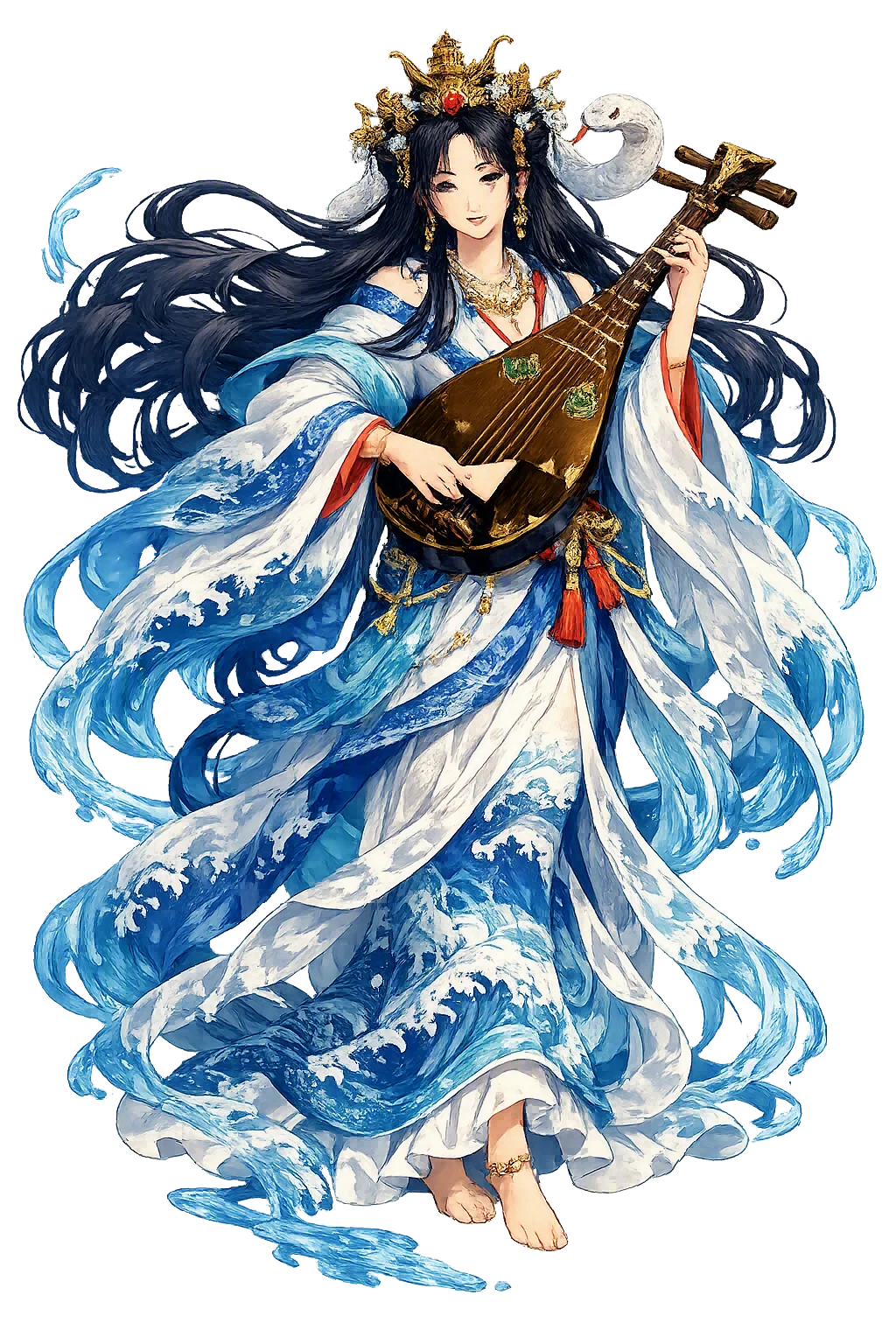
Sacred SymbolsBiwa, Snake or dragon, Jeweled crown, Water and island
02

Etymology & Word Family

From original script to Unicode restoration

Original Script 弁財天 Benzaiten — "Argumentation talent heaven"
Unicode Restoration Benzaiten Canonical scholarly spelling — ASCII-identical
Modern ASCII benzaiten Plain-ASCII fallback

The name Benzaiten reaches the modern world through scholarly transliteration of the japanese tradition. Because the conventional spelling uses only Latin letters, its Unicode and ASCII forms coincide — the tradition it carries is in the name itself, not in diacritics.

03

Unicode Character Breakdown

Character-by-character philological analysis

CharacterUnicodeNameBlockPhonetic Role
BU+0042Latin Capital Letter BBasic LatinSame
eU+0065Latin Small Letter EBasic LatinSame
nU+006ELatin Small Letter NBasic LatinSame
zU+007ALatin Small Letter ZBasic LatinSame
aU+0061Latin Small Letter ABasic LatinSame
iU+0069Latin Small Letter IBasic LatinSame
tU+0074Latin Small Letter TBasic LatinSame
eU+0065Latin Small Letter EBasic LatinSame
nU+006ELatin Small Letter NBasic LatinSame

The Tier 2 classification here reflects fidelity to the attested tradition, not recovered diacritics: every character of Benzaiten already survives in ASCII. What the restoration preserves is the canonical spelling itself — the form scholarship standardised.

04

Cult & Worship

How the sacred was kept — rites, sanctuaries, remains

The Cult

Benzaiten's cult is alive, wealthy, and precise about its addresses. The tradition ranks three sanctuaries first — Enoshima in Sagami Bay, Chikubushima's Hōgonji on its rock in Lake Biwa, and the island shrine of Itsukushima in Aki — and each keeps its own practice: the cave-womb pilgrimage of Enoshima's Iwaya, the hidden image of Chikubushima, the sea-stage rites of Miyajima. The medieval Enoshima engi (1321) preserves the dragon legend that binds the goddess to the island. Her most characteristic rite belongs to Kamakura: at Zeniarai Benten — the money-washing shrine whose founding tradition dates to 1185 and a dream of Minamoto no Yoritomo — worshippers scrub banknotes in the cave spring so the capital will multiply. Around these centers runs a domestic devotion of astonishing reach: musicians, calligraphers, and merchants keep her as personal patron, households hang her among the Seven Gods of Fortune at New Year, and in most Japanese cities the shichifukujin circuit is a Benten tour by another name.

In the Earth

Benzaiten's principal sanctuaries are her own archaeology. At Enoshima, the Hetsunomiya and Okutsunomiya shrines preserve Edo-period structures above a cave-cult that is older than any of them; the Enoshima engi scroll itself is a primary document of the medieval cult. Chikubushima's Hōgonji, on its sheer rock in Lake Biwa, preserves temple buildings and statuary from the Muromachi period onward. Itsukushima's great torii and sea-stage (12th–13th centuries, periodically rebuilt) mark the Aki shrine where her Munakata identity is worshipped. And the portable arts document her widest diffusion: countless Edo-period woodblock prints, netsuke, and temple statues show Benten with her biwa and coiled serpent — the material record of a fortune-cult that reached into every pocket.

05

Iconography

How Benzaiten was imaged across the ages

The Image

The image was settled by the medieval period and has barely moved since: Benzaiten sits, a beautiful woman in court dress, a biwa across her knee, and at her feet a white snake coiled like a signature. The instrument records her Indian ancestry — Sarasvatī's vīṇa becoming the Chinese pipa and then the Japanese lute — and the snake records her marriage to the islands, the water-kami Ichikishimahime and the dragon she subdued at Enoshima. In her esoteric form she grows eight arms, the happi Benzaiten, carrying bow, sword, wheel, and jewel among her implements; in her fortune-guise she holds the wish-granting jewel and a scroll of scripture. The earliest Japanese images are Nara-period masterpieces — the dry-lacquer Benzaiten of Tōdai-ji's Sangatsu-dō among the hall's ten National Treasures — and her great medieval sanctuaries guarded hidden images pilgrims registered rather than saw. From the Edo period onward the woodblock print did the widest work: Hiroshige's Enoshima views and the lucky-god prints carried the lute-and-serpent type into every shop.

06

Reception & Transformation

The name after its own age — transmission, translation, survival

Afterlives

Benzaiten's journey to Japan ran along the great avenue of Buddhist scripture. In India the river-goddess Sarasvatī had already been folded into Buddhism when the Suvarṇaprabhāsasūtra — the Sutra of Golden Light — made her one of its protecting goddesses; translated into Chinese from the early fifth century, that text is the vehicle that carried her east, and the early Japanese court's lecturing of the Golden Light for state protection brought her name into the Nara aristocracy. The eighth-century dry-lacquer Benzaiten of Tōdai-ji's Sangatsu-dō shows how quickly the image naturalized: an Indian goddess, a Chinese instrument, a Japanese face. The medieval centuries localized her — the Enoshima engi of 1321 rewrote her as the island's dragon-subduing guardian, and poets such as Saigyō made the Enoshima crossing a staple of literary travel — while the Muromachi and Edo periods enrolled her among the Seven Gods of Fortune, transforming a Buddhist protector into the one goddess of Japan's popular luck-religion. Western scholarship met her through the nineteenth-century philologists of the Buddhist canon and through the great ukiyo-e collections assembled after Japan opened; by the early twentieth century 'Benten' was a standing entry in any dictionary of Japanese religion, and her restored Sanskrit name a fixture of comparative Buddhist studies.

Identifications Across Traditions

Benzaiten is a palimpsest in three scripts. The underlayer is Indian: Sarasvatī, the Vedic river who became the goddess of speech, carried into Buddhism and east along the caravan roads. The middle layer is Chinese: translators rendered her name as Biancaitian, 'Heaven of Eloquent Talent,' and painted her with the pipa of court musicians. The top layer is Japanese: on entering the archipelago she married the sea — identified with the Munakata water-goddess Ichikishimahime (Kojiki, Nihon Shoki), given a snake-dragon for a companion, and seated among the Seven Gods of Fortune as their only woman. The layers never erase one another: a medieval pilgrim at Enoshima could honor a Vedic river, a Buddhist protector, and a Shinto kami in a single bow, and in the Edo period her cult spread through prints and merchant devotion until 'Benten' was simply the name of luck with a woman's face.

Modern Legacy

Benzaiten is still working. Enoshima's shrines receive millions of visitors a year; Chikubushima's Hōgonji still crowns its island rock in Lake Biwa; musicians, calligraphers, and business owners keep her as patron. Her image — biwa on her knee, dragon at her feet — recurs in ukiyo-e, on the takarabune prints hung at New Year, and across modern manga and anime as the default face of a Japanese goddess. She is the luck of artists, the one fortune-god whose treasure cannot be hoarded: played or spoken, it doubles. In a country that blesses companies and consecrates instruments, she remains the patron of every career built on a beautiful voice.

07

The Meditation

What Benzaiten means — beyond the dictionary

Benzaiten teaches that eloquence is wealth. Long before economists coined 'human capital,' her cult held that speech, song, and persuasion are forms of treasure — the only kind that grows when given away. She is the goddess of the fortunate tongue: the musician's hand, the merchant's pitch, the scholar's memory, each a different instrument of the same water. Her geography is instructive. She lives where land and water meet — an island shrine, a lakeside crag — because persuasion, like a coastline, is the negotiation of two elements. To stand at Enoshima at dusk, watching pilgrims cross the causeway with the tide, is to watch her oldest miracle repeated: the conversion of speech into safe passage, of a word into a harbor.

08

Frequently Asked Questions

Common questions about Benzaiten, Music, Wealth, Eloquence, and Unicode restoration

01How do you pronounce Benzaiten?

In reconstructed pronunciation, Benzaiten is /beɴ.za.i.teɴ/ — approximately 'BEN-zai-ten' — three syllables; the final 'n' is a soft, closed nasal.

02What does Benzaiten mean?

Benzaiten means Argumentation talent heaven in the japanese tradition.

03What are the symbols of Benzaiten?

Benzaiten is associated with Biwa (The lute that makes her goddess of music, poetry, and persuasive speech), Snake or dragon (A protector of wealth and water, often coiled beneath her image), Jeweled crown (Royal ornament marking her as a Buddhist-Taoist deity of fortune), Water and island (Her shrines occupy liminal places where sea or lake meets land).

04Why restore Benzaiten in Unicode?

Benzaiten is written entirely in ASCII letters, so its restoration is about canonical fidelity rather than recovered diacritics: the temple fixes the name in its scholarly standard spelling, attested in the source tradition, instead of leaving it to drift.

05What is the most important myth about Benzaiten?

“The River Who Became Speech” — the Ṛgveda story that anchors the mythology of Benzaiten, told in full on the lore page.

09

Scholarly Sources

The philological foundations of this restoration

Every claim on this page is grounded in established scholarship. The orthographic restorations follow disciplinary convention. The etymological chain follows the best available reference works. This is not invention — it is resurrection through scholarship.

◈

Lexicography & Philology

  • Hepburn
◎

Primary Texts

  • Kojiki
  • Ṛgveda 6.61 and 8.91 (the Sarasvatī hymns)
  • Kojiki and Nihon Shoki (the Munakata sea-goddesses)
◉

Archaeology & Art History

  • Material evidence — iconography, inscriptions, and temple archaeology — for Benzaiten and related cults.
✦

Religious Studies

  • Lotus Sūtra, the chapter on Sarasvatī's protection
  • Enoshima Engi (mid-11th century)
  • Bocking, A Popular Dictionary of Shinto
Return

The Surface Awaits

You have traced the name from its earliest attestation to its Unicode restoration. Now return to the myth. The story is where the name lives.

Back to Lore
Benzaiten mascot