PuniCodex

Extended Lore

Bedwyr

Etymology · Orthography · Cult · Iconography · Reception · Sources

Tier 2 Bedwyr
Bedwyr — Knight, One-handed
01

Quick Facts

Essential information about Bedwyr, Knight, One-handed

Scholarly TransliterationBedwyr
Unicode RestorationBedwyr
Reconstructed Pronunciation/ˈbɛd.ʊɨr/
PantheonCeltic
DomainKnight, One-handed
MeaningUnknown
ClassificationTier 2
Primary DomainBedwyr
Sacred SymbolsThe one-handed lance, The battle-diadem, Cavall, Arthur's hound, The wooden tweezers, The sword cast back to the water
02

Etymology & Word Family

From original script to Unicode restoration

Scholarly Transliteration Bedwyr Bedwyr — "Unknown"
Unicode Restoration Bedwyr Canonical scholarly spelling — ASCII-identical
Modern ASCII bedwyr Plain-ASCII fallback

The name Bedwyr reaches the modern world through scholarly transliteration of the celtic tradition. Because the conventional spelling uses only Latin letters, its Unicode and ASCII forms coincide — the tradition it carries is in the name itself, not in diacritics.

03

Unicode Character Breakdown

Character-by-character philological analysis

CharacterUnicodeNameBlockPhonetic Role
BU+0042Latin Capital Letter BBasic LatinSame, capitalized
eU+0065Latin Small Letter EBasic LatinSame
dU+0064Latin Small Letter DBasic LatinSame
wU+0077Latin Small Letter WBasic LatinSame
yU+0079Latin Small Letter YBasic LatinSame
rU+0072Latin Small Letter RBasic LatinSame

The Tier 2 classification here reflects fidelity to the attested tradition, not recovered diacritics: every character of Bedwyr already survives in ASCII. What the restoration preserves is the canonical spelling itself — the form scholarship standardised.

04

Cult & Worship

How the sacred was kept — rites, sanctuaries, remains

The Cult

No shrine, festival, or votive offering to Bedwyr is recorded, and none should be expected: he is a hero of Welsh narrative, not a god, and the Welsh sources never show anyone praying to him. What the tradition preserves in place of cult is professional commemoration — the cyfarwyddyd, the hereditary storytellers who kept the Arthurian roster in circulation, and the triads that fixed his pre-eminence at single combat as memorizable lore. The nearest thing to a sacred site is the mountain itself: the summit cairns of Pumlumon, which Culhwch ac Olwen makes the lookout post of Cei and Bedwyr, were prehistoric before the tale was told, and the story simply moved in. Modern Arthurian gatherings at 'Arthurian' landscapes are revival and tourism, not survival.

In the Earth

Bedwyr is a textual hero: no inscription names him, and Welsh tradition offers no relic or shrine. His manuscript witnesses are exact. The poem Pa gŵr? survives uniquely in the Black Book of Carmarthen (Aberystwyth, National Library of Wales, Peniarth MS 1), copied in the mid-thirteenth century and the oldest surviving manuscript wholly in Welsh. Culhwch ac Olwen survives complete in the White Book of Rhydderch (NLW Peniarth MSS 4–5, c. 1350) and, in a fuller recension, in the Red Book of Hergest (Oxford, Jesus College MS 111, late fourteenth century), which also carries the great collection of the triads. The one landscape witness is genuine: Pumlumon (Plynlimon) in Ceredigion, the mountain whose summit cairns the tale makes the lookout of Cei and Bedwyr in the Dillus episode, is a real massif of the Cambrian Mountains crowned with prehistoric cairns. Geoffrey of Monmouth's burial of Beduerus at Bayeux belongs to his Norman pseudo-history, not to any Welsh memory.

05

Iconography

How Bedwyr was imaged across the ages

The Image

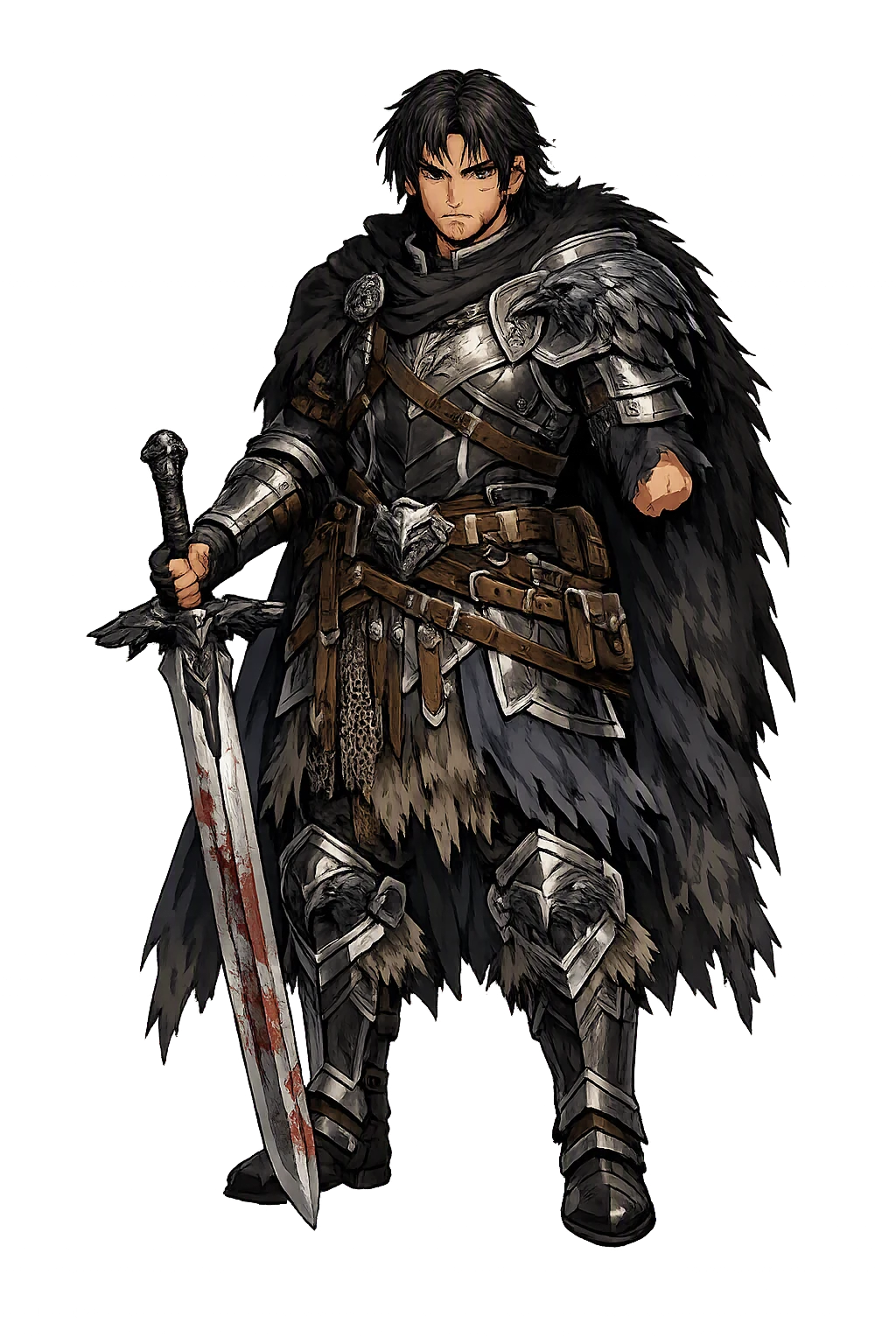
No medieval image of Bedwyr survives, and the Welsh tradition never fixed his appearance; the texts arm him for the imagination instead — one hand, a lance that wounds like nine, the diadem he wears above three crowned kings. His visual afterlife begins only once the name has become French. The printed Morte Darthur of 1485 and, above all, the illustrated editions of the nineteenth century made Bedivere the kneeling knight at the water's edge: Gustave Doré's engravings for Tennyson's Idylls of the King (1868) and Aubrey Beardsley's line for Dent's Le Morte Darthur (1893–94) fixed the arm clothed in white samite rising from the lake as the period's emblem of a knight's last service. The one-handed companion of Cei is still rarely drawn; every image of him postdates his texts by centuries.

06

Reception & Transformation

The name after its own age — transmission, translation, survival

Afterlives

Bedwyr's transmission is a journey across three languages and six centuries of manuscripts. His dossier begins in Welsh codices: the Black Book of Carmarthen (mid-thirteenth century) preserves the gatekeeper poem that lists him among Arthur's companions, while Culhwch ac Olwen and the triads survive in the White Book of Rhydderch and the Red Book of Hergest. Geoffrey of Monmouth carried him into Latin as Beduerus (c. 1136); Wace's Roman de Brut (1155) re-spoke the chronicle in French verse, and Layamon's Brut (c. 1200) brought Bedivere into English for the first time. The French prose cycles passed the figure from hand to hand until Malory's Morte Darthur — printed by Caxton in 1485 — fixed the English form of the name and the office of the last knight. The Welsh original then spent centuries in manuscript obscurity before the Romantic antiquarians recovered it: Edward Jones printed Welsh Arthurian lore for a wide readership in 1784, and Lady Charlotte Guest's Mabinogion (1838–49) returned the one-handed hero to the Anglophone world, where modern Welsh editions have since kept him.

Identifications Across Traditions

Bedwyr's transmission is the clearest case in the Arthurian corpus of a Welsh hero passing whole into the continental tradition: Welsh Bedwyr becomes Geoffrey's Latin Beduerus, then the Bedivers and Bedoier of Old French romance, and at last Malory's Sir Bedivere — one continuous name-line from the Black Book of Carmarthen to Caxton's print shop. Within Celtic comparison the one-handed warrior who loses nothing of his worth has tempted scholars toward the Irish parallel of [[nuada|Nuadu]] of the Silver Hand, the king who lost his arm at Mag Tuired and ruled again by means of a silver one; the handbooks treat this as a shared Celtic motif of the maimed-but-undiminished champion, not a derivation of one figure from the other. What the Welsh tradition keeps distinct is the pairing: Cei and Bedwyr are a fixed couple — the tradition names them in that order, never the reverse — as elemental a bond in early Welsh Arthurian lore as any kinship.

Modern Legacy

Bedwyr's afterlife runs under a French name. Wace's Roman de Brut and Layamon's Brut carried Geoffrey's Beduerus into the vernacular chronicles; the French romances made him Bedivere, one of the first and last of the Round Table; and Malory gave him the role the whole world now knows — the last knight alive with Arthur after the day of destiny, commanded to cast Excalibur into the water, twice hiding it for its worth and twice rebuked, until at the third throw an arm clothed in white samite rose from the lake, caught the sword, brandished it thrice, and vanished. Tennyson's Idylls of the King sealed the image: it is to Bedivere that the dying Arthur speaks the great consolation — 'The old order changeth, yielding place to new' — before the barge bears him away. Twentieth-century scholarship brought the Welsh original back into view: Bromwich's edition of the triads restored the battle-diadem to Bedwyr son of Bedrawc, and the standard handbooks now present the romance Bedivere as what he is — a Welsh heroic companion who had served Arthur in Welsh for perhaps three hundred years before French poetry ever heard of him. In Wales itself the name never left: Bedwyr remains a living Welsh given name.

07

The Meditation

What Bedwyr means — beyond the dictionary

Bedwyr is the tradition's proof that loss is not the measure of a man. The texts hand him to us already one-handed — the wound is never narrated, never mourned, never explained — and then spend every remaining line insisting on the arithmetic of what is left: one arm that sheds blood faster than three warriors, one lance that wounds like nine, one diadem above the three crowned. The silence about the missing hand is the point: the Welsh tradition does not tell a story about a maimed warrior; it tells stories about the swiftest, surest companion Arthur has, who happens to fight with one arm.

And beneath the arithmetic stands the quieter fact: he never shrank from any enterprise on which Cei was bound. The tradition could have made him Arthur's mirror or Cei's rival; it made him Cei's shadow instead — the second name in every pair, the hand on the cauldron while the cunning works the gate. Loyalty, in the oldest Welsh telling, is not obedience to the crown but fidelity to a companion: the willingness to sit in the highest wind in the world, on a cairn on Pumlumon, because that is where the quest requires the two of you to sit.

08

Frequently Asked Questions

Common questions about Bedwyr, Knight, One-handed, and Unicode restoration

01How do you pronounce Bedwyr?

In reconstructed pronunciation, Bedwyr is /ˈbɛd.ʊɨr/ — approximately 'BED-weer' — stress the first syllable; read the w as the vowel 'oo' and the final y as a vowel between 'i' and 'u', with the r lightly rolled.

02What does Bedwyr mean?

Bedwyr means Unknown in the celtic tradition.

03What are the symbols of Bedwyr?

Bedwyr is associated with The one-handed lance (A single arm doing the work of nine — prowess measured by what remains, not what is missing), The battle-diadem (The triad's crown above the crowned — the one name set over Drystan, Hueil, and Cei), Cavall, Arthur's hound (The king's own dog entrusted to his hand in the Twrch Trwyth hunt — trust made visible), The wooden tweezers (The impossible instrument for the impossible task — craft serving the quest on Pumlumon), The sword cast back to the water (In the later Malorian tradition, Bedivere is the last knight, who returns Excalibur to the lake — loyalty outliving the kingdom).

04Why restore Bedwyr in Unicode?

Bedwyr is written entirely in ASCII letters, so its restoration is about canonical fidelity rather than recovered diacritics: the temple fixes the name in its scholarly standard spelling, attested in the source tradition, instead of leaving it to drift.

05What is the most important myth about Bedwyr?

“The War-Band Remembered” — the Pa gŵr? · Black Book of Carmarthen story that anchors the mythology of Bedwyr, told in full on the lore page.

09

Scholarly Sources

The philological foundations of this restoration

Every claim on this page is grounded in established scholarship. The orthographic restorations follow disciplinary convention. The etymological chain follows the best available reference works. This is not invention — it is resurrection through scholarship.

◈

Lexicography & Philology

  • Arthurian legend
  • MacKillop
◎

Primary Texts

  • The Immram Brain (Voyage of Bran); Tochmarc Étaíne; Cóir Anmann; medieval Irish saga literature.
◉

Archaeology & Art History

  • Material evidence — iconography, inscriptions, and temple archaeology — for Bedwyr and related cults.
✦

Religious Studies

  • Culhwch ac Olwen (White Book of Rhydderch; Red Book of Hergest), trans. Gwyn Jones and Thomas Jones, The Mabinogion (Everyman); ed. Bromwich and D. Simon Evans, Culhwch and Olwen: An Edition and Study (University of Wales Press, 1992) — the one-handed passage; Dillus Farfawc; Gwrnach; Diwrnach Wyddel; the Twrch Trwyth hunt
  • Pa gŵr yv y porthaur?, in the Black Book of Carmarthen (NLW Peniarth MS 1) — the earliest Arthurian poem in Welsh; Bedwyr in Arthur's roster
  • Trioedd Ynys Prydein: The Triads of the Island of Britain, ed. and trans. Rachel Bromwich, 4th ed. (University of Wales Press, 2014) — Triad 21, the Three Battle-Diademed; Triad 26, the Three Powerful Swineherds
  • Geoffrey of Monmouth, Historia Regum Britanniae IX (Reeve & Wright), ed. Michael D. Reeve, trans. Neil Wright — Beduerus the cupbearer; his death before Soissons and burial at Bayeux
  • Sir Thomas Malory, Le Morte d'Arthur (Caxton, 1485), Book XXI — Sir Bedivere and the returning of Excalibur
  • Koch, John T., ed., Celtic Culture: A Historical Encyclopedia (ABC-CLIO, 2006), s.v. Bedwyr; Jackson, “The Arthur of History,” in Arthurian Literature in the Middle Ages, ed. R. S. Loomis (1959)
Return

The Surface Awaits

You have traced the name from its earliest attestation to its Unicode restoration. Now return to the myth. The story is where the name lives.

Back to Lore
Bedwyr mascot