PuniCodex

Extended Lore

Balor

Etymology · Orthography · Cult · Iconography · Reception · Sources

Tier 2 Balor
Balor — Destruction, Evil Eye, Fomorians
01

Quick Facts

Essential information about Balor, Destruction, Evil Eye, Fomorians

Scholarly TransliterationBalor
Unicode RestorationBalor
Reconstructed Pronunciation/ˈba.lor/
PantheonCeltic
DomainDestruction, Evil Eye, Fomorians
MeaningFomorian king whose destructive eye blasts armies when its lid is raised, slain by his grandson Lúg with a sling-stone at Cath Maige Tuired.
ClassificationTier 2
Primary DomainBalor
Sacred SymbolsThe venomed eye, The polished lid-lifter, The tower of Tory, The Glas Gaibhnenn, The sling-stone
02

Etymology & Word Family

From original script to Unicode restoration

Scholarly Transliteration Balor Balor — "Fomorian king whose destructive eye blasts armies when its lid is raised, slain by his grandson Lúg with a sling-stone at Cath Maige Tuired."
Unicode Restoration Balor Canonical scholarly spelling — ASCII-identical
Modern ASCII balor Plain-ASCII fallback

The name Balor reaches the modern world through scholarly transliteration of the celtic tradition. Because the conventional spelling uses only Latin letters, its Unicode and ASCII forms coincide — the tradition it carries is in the name itself, not in diacritics.

03

Unicode Character Breakdown

Character-by-character philological analysis

CharacterUnicodeNameBlockPhonetic Role
BU+0042Latin Capital Letter BBasic LatinSame, capitalized
aU+0061Latin Small Letter ABasic LatinSame
lU+006CLatin Small Letter LBasic LatinSame
oU+006FLatin Small Letter OBasic LatinSame
rU+0072Latin Small Letter RBasic LatinSame

The Tier 2 classification here reflects fidelity to the attested tradition, not recovered diacritics: every character of Balor already survives in ASCII. What the restoration preserves is the canonical spelling itself — the form scholarship standardised.

04

Cult & Worship

How the sacred was kept — rites, sanctuaries, remains

The Cult

Balor was never worshipped, so far as any evidence reaches: no Irish inscription names him, no sanctuary can be assigned to him, and the medieval literati who wrote him down were antiquarians of their own past, not his priests. What the corpus preserves in place of a cult is a landscape and a fear. The landscape is Tory Island off the Donegal coast, whose oral tradition pins his fortress and Eithne's tower to named rocks — Tór Mór above all — so that his 'cult site' is the cliff-line itself, still pointed out from boats. The fear is the evil-eye complex: Irish folk practice kept a working armoury of protections against the withering look — spitting, salt, turned garments, praise deliberately qualified — and Mac Cana and Sjoestedt are surely right to read Balor as that folk-belief grown into a king. Between the rocks and the rituals stands the only institution that demonstrably served him: the monastic schools whose scribes copied Cath Maige Tuired into Harley 5280, keeping the tyrant's dossier alive as literature.

In the Earth

Balor is a textual and oral figure: no ogham stone names him, no votive inscription invokes him, and Irish paganism generally left literature rather than dedications. His manuscript witnesses are exact — Cath Maige Tuired survives uniquely in the sixteenth-century British Library MS Harley 5280, the basis of Gray's edition, while Lebor Gabála Érenn is preserved in the twelfth-century Book of Leinster and its sister codices. His geographical anchor is one of the most dramatic pieces of coastline in Europe: Tory Island (Toraigh), nine miles off the Bloody Foreland of Donegal, whose cliffs and sea-stacks — above all the great rock called Tór Mór — the oral tradition names as Balor's fortress and the site of Eithne's tower. The nineteenth-century collectors who wrote the tower story down were recording a living Donegal tradition anchored to those rocks, and the island's medieval monastic remains and round tower have kept the name in continuous local memory.

05

Iconography

How Balor was imaged across the ages

The Image

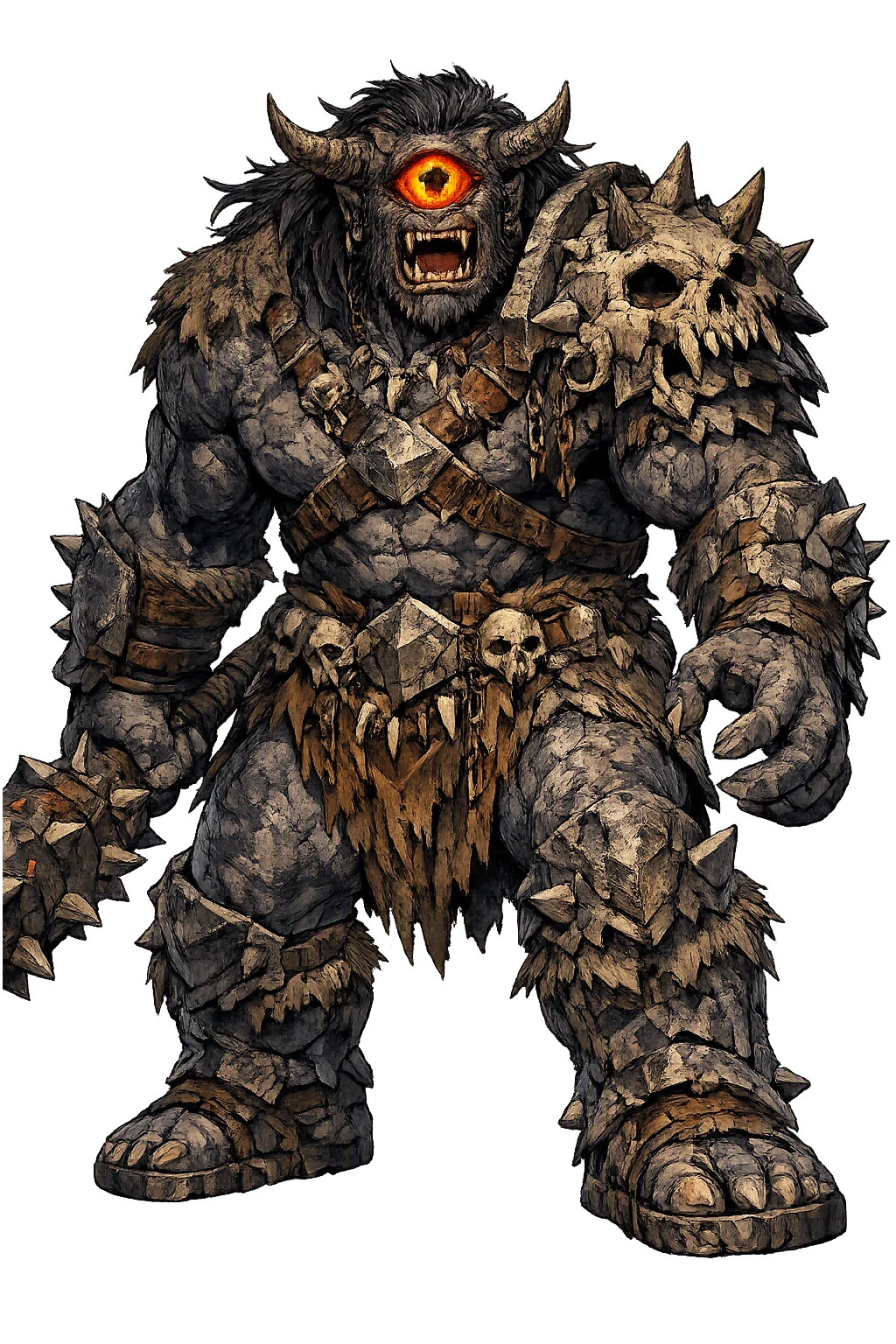
Balor has no surviving portrait from any period of his story's life — no carved head with its single socket survives from early Ireland, no manuscript illumination shows the lid and its four lifters, and the cross-carvers of the conversion left the Fomorians unpersonified. The texts are the iconography, and they are exact: one eye, opened on a battlefield only by four men raising its lid on a polished handle passed through it, and a gaze whose venom dates to a boyhood glance into a druids' brew. Later tradition adds the props — the tower on Tory's rock, the grey-green cow, the sling-stone — but these are narrative furniture, not images. The modern age supplied the face: Celtic revival illustration and twentieth-century genre art fixed him as the one-eyed sea-king of the west, and Tory Island's cliff profile, pointed at from the water, remains his only likeness with any claim to antiquity. Where a god was never imaged, the landscape does the work.

06

Reception & Transformation

The name after its own age — transmission, translation, survival

Afterlives

Balor reached the modern world by two roads that met in the nineteenth century. The written road runs from the monastic codices — the Book of Leinster's Lebor Gabála and Harley 5280's unique Cath Maige Tuired — into the age of scholarly editing, when Whitley Stokes printed an English Moytura for the readers of Revue Celtique in 1891 and the Irish Texts Society later gave the text its standard edition and translation through Elizabeth Gray. The oral road ran through Donegal: John O'Donovan recorded the island tradition and set it in a footnote to his 1856 edition of the Annals of the Four Masters, from which every later retelling has drawn; Jeremiah Curtin's Hero-Tales of Ireland (1894) and W. Larminie's West Irish Folk-Tales (1893) carried the fuller versions — tower, stolen cow, child cast into the sea — into print. The popularizers then welded the two roads: Rolleston's Myths and Legends of the Celtic Race (1911) set the one-eyed king before a mass readership, while the Dictionary of the Irish Language pinned his manuscript spellings in place. The scholarship and the folklore have never since been separable.

Identifications Across Traditions

Balor's clearest cross-border witnesses are comparative, not cognate. The Welsh corpus preserves no figure derived from the same name — the Brythonic silence is total, as it is for so many of the Fomorian cycle. The parallels the scholarship actually leans on are typological. First, the Greek Acrisius: the king who prisoned his daughter Danaë because a prophecy named her son his slayer, and died by that grandson Perseus all the same — the Eithne tower is the same tale-shape, and comparatists have set the two side by side since the nineteenth century. Second, the one-eyed monster answered by aimed cunning — the Polyphemus pattern — where the single enormous eye is both the ogre's strength and the one place he can be struck. Third, and nearest home, the Irish and Mediterranean complex of the evil eye itself: the belief that a look can wither cattle, milk, and men, which Sjoestedt and Mac Cana both treat as the living folk-ground of Balor's venomed gaze. O'Rahilly read him further, as a figure of death and the western sea; the handbooks register the reading without making it doctrine.

Modern Legacy

Balor entered the modern world through two doors. The first was scholarship: Lady Gregory's Gods and Fighting Men (1904) carried the sling-stone and the tower into English reading, and O'Rahilly's Early Irish History and Mythology (1946) made him the type-case of the Irish death-king — a scholarly afterlife as large as his medieval dossier is short. The second was the folklore itself: the Donegal oral versions — the tower, the stolen cow, the child cast into the sea — were collected in the nineteenth century and never stopped being retold, and 'Balor of the Evil Eye' remains the standing name of the figure in Irish and in English. In the modern imagination he has become the Celtic dark lord par excellence: the remote tyrant in his island fortress whose one weapon poisons everything it touches, answered not by a greater weapon but by the prophesied grandchild the fortress was built to prevent. Tory Island keeps his address; the Irish language never lost his name.

07

The Meditation

What Balor means — beyond the dictionary

Every part of Balor's story is about containment failing. The eye is contained — cloaked, lidded, lifted only by machinery — and containment is the whole catastrophe: a gaze so dangerous it must be operated by four other men is no longer a weapon but an occupation, a king reduced to the caretaker of his own poison. The daughter is contained in a tower against a prophecy, and the tower is the prophecy's instrument: no tower, no Cian, no Lugh. Balor is the tradition's purest study of power that can only destroy — he is given no craft, no counsel, no feast, no children worth the having, nothing but the eye and the tax it enforces.

And the answer the tradition gives him is exact. Not a bigger eye, not a stronger king, but a sling-stone: small, aimed, and thrown by the one hand the whole machinery existed to forestall. The venom that could wither an army is turned in a single instant into the Fomorians' own epitaph — it was his own host that looked into it. That is the Irish judgment on the evil eye, and on every power built to wither rather than to make: it ends by looking inward. The grandson does not defeat the weapon. He simply turns it around.

08

Frequently Asked Questions

Common questions about Balor, Destruction, Evil Eye, Fomorians, and Unicode restoration

01How do you pronounce Balor?

In reconstructed pronunciation, Balor is /ˈba.lor/ — approximately 'BAH-lor' — stress the first syllable hard, keep the l dark and broad, and let the final r stay tapped. Modern Irish 'Balor' keeps essentially the same shape.

02What does Balor mean?

Balor means Fomorian king whose destructive eye blasts armies when its lid is raised, slain by his grandson Lúg with a sling-stone at Cath Maige Tuired. in the celtic tradition.

03What are the symbols of Balor?

Balor is associated with The venomed eye (A weapon the owner cannot aim without an army to raise the lid — power that outgrew its possessor.), The polished lid-lifter (Four men with a handle passed through the eyelid — kingship reduced to machinery, a gaze other men must operate.), The tower of Tory (The sea-girt prison built against a prophecy — the fortress that made the doom it feared.), The Glas Gaibhnenn (The grey-green cow Balor stole from Cian in the oral tradition — the theft that set the grandson's birth in motion.), The sling-stone (The small, aimed answer to the vast, unaimed gaze — the grandson's hand the druids foretold.).

04Why restore Balor in Unicode?

Balor is written entirely in ASCII letters, so its restoration is about canonical fidelity rather than recovered diacritics: the temple fixes the name in its scholarly standard spelling, attested in the source tradition, instead of leaving it to drift.

05What is the most important myth about Balor?

“Balor Son of Dot, Grandson of Nét” — the Lebor Gabála Érenn story that anchors the mythology of Balor, told in full on the lore page.

09

Scholarly Sources

The philological foundations of this restoration

Every claim on this page is grounded in established scholarship. The orthographic restorations follow disciplinary convention. The etymological chain follows the best available reference works. This is not invention — it is resurrection through scholarship.

◈

Lexicography & Philology

  • Irish folklore
  • Lebor Gabála
◎

Primary Texts

  • The Immram Brain (Voyage of Bran); Tochmarc Étaíne; Cóir Anmann; medieval Irish saga literature.
◉

Archaeology & Art History

  • Material evidence — iconography, inscriptions, and temple archaeology — for Balor and related cults.
✦

Religious Studies

  • Cath Maige Tuired (The Second Battle of Mag Tuired), ed. and trans. Elizabeth A. Gray — the poisoned eye and its boyhood origin; the four lid-lifters; the sling-stone and the fall on the Fomorian host
  • Lebor Gabála Érenn, ed. and trans. R. A. S. Macalister — Balor mac Doit meic Néit; Cethlenn and the Dagda's death-wound; the Fomorian tribute
  • The Donegal oral tradition of Balor on Tory Island — the tower of Eithne, the Glas Gaibhnenn, the child cast into the sea (collected versions: O'Donovan's note in the Annals of the Four Masters, 1856; Curtin, Hero-Tales of Ireland, 1894; Larminie, West Irish Folk-Tales and Romances, 1893)
  • O'Rahilly, T. F., Early Irish History and Mythology (1946) — Balor as death-king; the reading of the Fomorian cycle
  • Mac Cana, Celtic Mythology — the Fomorians and the evil-eye complex; the Mag Tuired settlement
  • Sjoestedt, Gods and Heroes of the Celts — the two peoples at war; the folk-ground of the withering gaze
  • Koch, ed., Celtic Culture: A Historical Encyclopedia, s.v. Balor, Cath Maige Tuired, Fomorians
  • Gregory, Lady Augusta, Gods and Fighting Men (1904) — the revival retelling of the tower and the sling-stone
  • Dictionary of the Irish Language (eDIL) — the name and its manuscript forms
Return

The Surface Awaits

You have traced the name from its earliest attestation to its Unicode restoration. Now return to the myth. The story is where the name lives.

Back to Lore
Balor mascot