PuniCodex

Extended Lore

Ἄρτεμις Ártemis

Etymology · Orthography · Cult · Iconography · Reception · Sources

Tier 2 Ártemis.com
Ártemis — Hunt, Wilderness, Moon
01

Quick Facts

Essential information about Ártemis, Hunt, Wilderness, Moon

Original ScriptἌρτεμις
Unicode RestorationÁrtemis
Reconstructed Pronunciation/ár.te.mis/
PantheonGreek
DomainHunt, Wilderness, Moon
MeaningSafe, unharmed (from ἀρτεμής)
ClassificationTier 2
Primary DomainÁrtemis.com
Sacred SymbolsBow and arrows, Deer, Cypress, Crescent moon, Hunting dogs
02

Etymology & Word Family

From original script to Unicode restoration

Proto-indo-european *h₂r-tem- bear, great goddess
Original Script Ἄρτεμις Ártemis — "Safe, unharmed (from ἀρτεμής)"
Unicode Restoration Ártemis Restored stress, length, and script
Modern ASCII artemis Plain-ASCII fallback

Possibly from ἄρκτος "bear" + suffix, or pre-Greek. Mistress of animals (potnia theron).

03

Unicode Character Breakdown

Character-by-character philological analysis

CharacterUnicodeNameBlockPhonetic Role
ÁU+00C1Latin Capital Letter A with AcuteLatin-1 SupplementAcute on alpha
rU+0072Latin Small Letter RBasic LatinRho
tU+0074Latin Small Letter TBasic LatinTau
eU+0065Latin Small Letter EBasic LatinShort epsilon
mU+006DLatin Small Letter MBasic LatinMu
iU+0069Latin Small Letter IBasic LatinShort iota
sU+0073Latin Small Letter SBasic LatinSigma

The Tier 2 classification reflects how much of the original phonology this restoration preserves — stress and vowel length for Greek names, distinctive letters and diacritics for every other tradition.

04

Cult & Worship

How the sacred was kept — rites, sanctuaries, remains

The Cult

Her cult is one of the best documented in Greece, and it begins in Arcadia. Pausanias (8.37) reports that the Arcadians at Lycosura showed temples of Artemis and Despoina together and believed them among the oldest sanctuaries in the Peloponnese. At Brauron in Attica, girls of five to ten served her as arktoi, 'bears' racing in her sanctuary before marriage — a rite preserved by the Aristophanes scholia (on Lysistrata 645). At Halai Araphenides the point of a sword was drawn across a man's throat in her honor, a rite Euripides himself explains in the closing lines of Iphigenia among the Taurians. The Ephesian Artemision kept the strangest priesthood in the Greek world, the Megabyzi, eunuch servants of the goddess described by Strabo (14.1.23), tending the great temple whose columns bore Croesus's dedications (Herodotus 1.92). At Patras the annual Laphria — transferred with its cult image from Calydon — released wild beasts into a towering pyre (Pausanias 7.18). These were living cults with calendars and personnel, not mythological afterthoughts.

In the Earth

Ephesus preserves her greatest monument: the Artemision, whose archaic colossal temple — rebuilt after the fire of 356 BCE — was one of the Seven Wonders; column drums inscribed with the name of Croesus confirm the Lydian king's patronage, and John Turtle Wood's excavations of 1869 recovered its plan. At Brauron in Attica, the sanctuary of Artemis Brauronia has yielded the famous kore statuettes of little girls dedicated after their service as arktoi, together with the Π-shaped stoa where the rites unfolded. In Arcadia, the sanctuary of Artemis Hemera at Lousoi — excavated in the 1990s — produced rich votive deposits from a healing spring cult. Her sanctuaries at Delos, Mounichia in Piraeus, and the Amyklaion complement the record, and the terracotta 'Lady of Ephesus' figures found across the Mediterranean trace her Anatolian form from cult to souvenir.

05

Iconography

How Ártemis was imaged across the ages

The Image

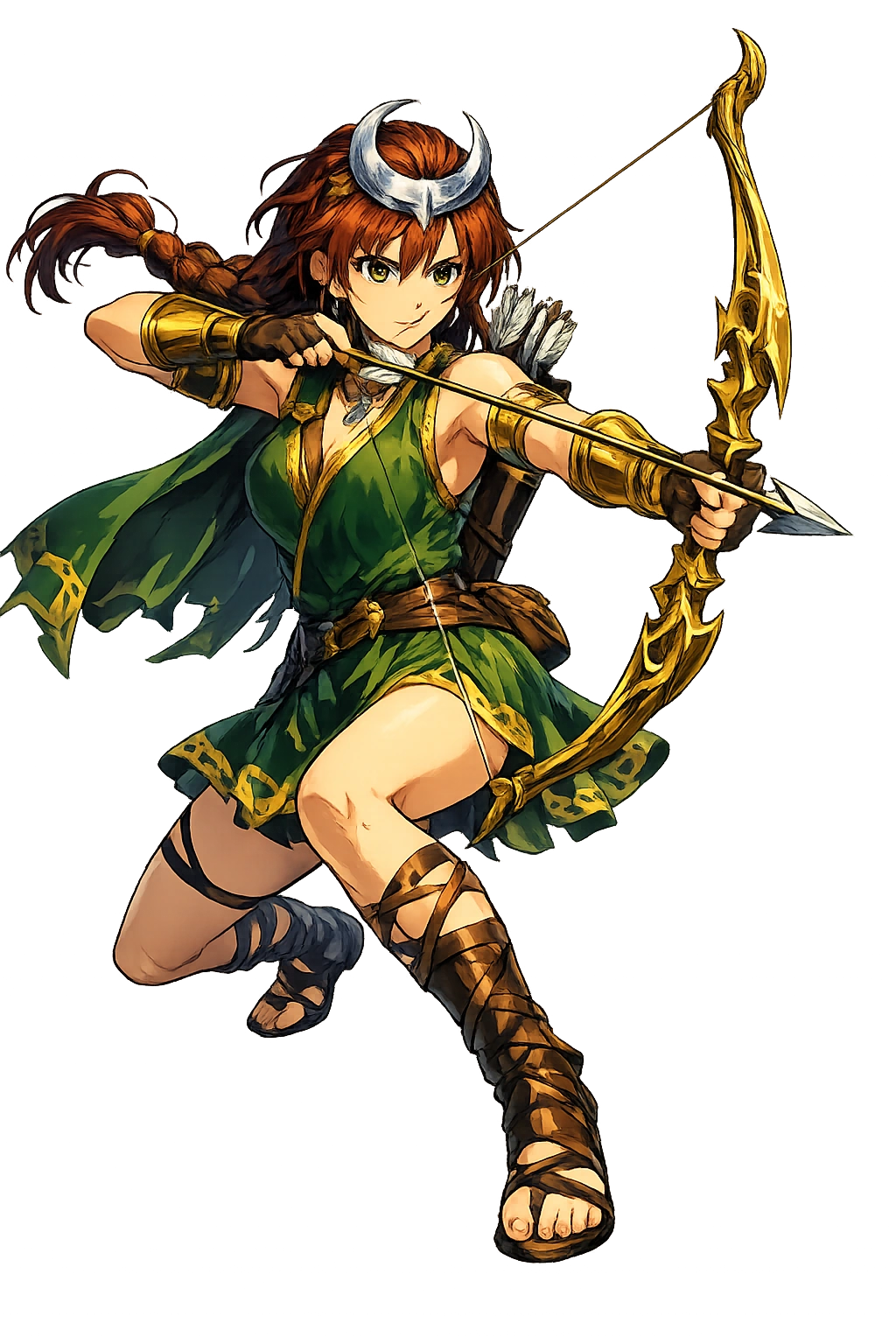
She is recognized by her bow, and by everything that attends it: quiver, short hunting chiton, deer, and hounds, with the crescent diadem arriving only in the Hellenistic period. Her earliest secure images are Archaic. On the François Vase (c. 570 BCE, Florence) she stands at the edge of the Calydonian hunt, the goddess watching men ruin themselves over her boar. Classical art gave her a place among the Olympians — on the Parthenon east frieze she sits among the assembled gods — while the fourth century gave her motion: the Artemis of Versailles type (Louvre; a Roman copy of a late-fourth-century bronze) runs, reaching back over her shoulder for an arrow, a stag at her side. The draped Diana of Gabii (Louvre), adjusting her mantle, shows the serene Praxitelean alternative. Ephesus imaged her altogether differently: a stiff frontal figure in a polos, hung with ranked round protuberances whose meaning — breasts, eggs, or bull testicles — is still argued. Her great cult image burned with the temple in 356 BCE, and the Ephesians called their ancient xoanon 'the sky-fallen one' (Acts 19:35).

06

Reception & Transformation

The name after its own age — transmission, translation, survival

Afterlives

Rome carried her across the Mediterranean as Diana — Virgil opens the Aeneid's human story by likening Dido to the goddess striding through the wilds (1.498–504) — and early Christianity answered her at the source of her power: Paul's preaching at Ephesus nearly incited a riot, and 'Great is Diana of the Ephesians' (Acts 19:28) is the moment her cult enters the Christian record. The Renaissance refashioned her myths as painting's great set pieces: Titian's Diana and Actaeon and Diana and Callisto (1556–1559, National Gallery, London) carry Ovid into Venetian color, and Cellini's great relief for Fontainebleau, long read as Diana, whispered her to every French courtier. Her tragedies never left the stage: Racine's Iphigénie (1674) and Goethe's Iphigenie auf Tauris (1779–1787) descend directly from Euripides' one surviving escape-drama. Nineteenth-century scholarship crowned her again when Frazer opened The Golden Bough (1890) beneath her oak at Nemi. Today her name rides humanity's return to the Moon — NASA's Artemis program — a crescent that has closed its circle.

Identifications Across Traditions

The Romans identified Ártemis with Diana, a goddess of the hunt, the moon, and the crossroads whose famous grove at Aricia, beside Lake Nemi, was guarded by the Rex Nemorensis — the runaway slave who ruled as long as he could kill his successor, the strangest priesthood in Italy (Strabo 5.3.12; the site is excavated). In Egypt she absorbed aspects of Bastet and other lunar goddesses; in Anatolia her Ephesian form, the many-breasted Artemis of the great temple, was a cosmic mother goddess unlike the Greek huntress. The crescent crown that Byzantine and Renaissance artists set on the Virgin Mary's head descends from Diana's iconography. Modern Wicca and Neopaganism have made her one of the most widely invoked goddesses of feminine autonomy and wild nature — a reading her ancient virgins' cults would, at least, not have found strange.

Modern Legacy

Ártemis is the archetype of independent, untamable feminine power. Her temple at Ephesus was one of the Seven Wonders of the Ancient World, its colossal many-breasted cult image the emblem of nature's abundance. The Brauronia, in which Athenian girls 'played the bear' in her sanctuary before marriage, was a central rite of female initiation, and the little votive bear-girls excavated at Brauron are among the most moving objects in Greek archaeology. Her bow remains a symbol of focused, lethal skill, and in modern environmentalism she has become a patroness of wilderness preservation and animal protection. Restoring Ártemis restores the name of the goddess who refuses to be domesticated.

07

The Meditation

What Ártemis means — beyond the dictionary

Ártemis is the goddess of the untouched. Not the virginity of inexperience, but the virginity of self-possession. She hunts not because she lacks feeling but because she has chosen a boundary and will kill to defend it. The forest is not her prison; it is her chosen territory.

In a culture that constantly demands women's availability, Ártemis is radical. She is not available. She is not domestic. She is not safe. The restoration of her name is a small acknowledgment that the ancient world knew a feminine power that needed no relation to masculinity to be complete.

08

Screen & Culture

Where Ártemis echoes through film, television, and games — and how

09

Frequently Asked Questions

Common questions about Ártemis, Hunt, Wilderness, Moon, and Unicode restoration

01How do you pronounce Ártemis?

In reconstructed pronunciation, Ártemis is /ár.te.mis/ — approximately 'AR-te-miss' — the first syllable is sharp and high; the name is quick, like the arrow she looses.

02What does Ártemis mean?

Ártemis means Safe, unharmed (from ἀρτεμής) in the greek tradition.

03What are the symbols of Ártemis?

Ártemis is associated with Bow and arrows (The silver bow of the hunt and the plague shafts she shares with Apollo; sudden, unpitying, and precise), Deer (Her sacred chariot team and protected prey — the Ceryneian hind had golden antlers and brazen hooves), Cypress (The mourning tree of the wild grove, planted where the huntress's arrows fall), Crescent moon (Her later lunar aspect; the crescent diadem becomes standard on Hellenistic and Roman statues), Hunting dogs (Her companions in the chase — fifty hounds in Callimachus' Hymn to Artemis, swifter than deer).

04Why restore Ártemis in Unicode?

Plain ASCII artemis strips the stress, length, and script that make the name specific. Unicode restoration returns the name to its original written dignity.

05What is the most important myth about Ártemis?

“Born on Ortygia, Midwife of Her Twin” — the The Birth story that anchors the mythology of Ártemis, told in full on the lore page.

10

Scholarly Sources

The philological foundations of this restoration

Every claim on this page is grounded in established scholarship. The orthographic restorations follow disciplinary convention. The etymological chain follows the best available reference works. This is not invention — it is resurrection through scholarship.

◈

Lexicography & Philology

  • Liddell, H. G., Scott, R., & Jones, H. S. A Greek-English Lexicon. Oxford: Clarendon Press, 9th ed. 1996.
  • Pape, W., & Benseler, G. E. Wörterbuch der griechischen Eigennamen. Braunschweig: Vieweg, 1884.
  • Beekes, R. S. P. Etymological Dictionary of Greek. Leiden: Brill, 2010.
◎

Primary Texts

  • Homer, Iliad 9.533–599; Odyssey 5.121–124
  • Homeric Hymn to Delian Apollo 14–18
  • Pseudo-Apollodorus, Bibliotheca 1.4.1; 1.8.2; 3.8.2
  • Euripides, Iphigenia among the Taurians
  • Ovid, Metamorphoses 2.401–531; 3.138–252
◉

Archaeology & Art History

  • Material evidence — iconography, inscriptions, and temple archaeology — for Ártemis and related cults.
✦

Religious Studies

  • Callimachus, Hymn 3 to Artemis
Return

The Surface Awaits

You have traced the name from its earliest attestation to its Unicode restoration. Now return to the myth. The story is where the name lives.

Back to Lore
Ártemis mascot