PuniCodex

Extended Lore

अर्जुन Arjuna

Etymology · Orthography · Cult · Iconography · Reception · Sources

ASCII-equivalent form Arjuna
Arjuna — Archery, Dharma, Bhagavad Gītā
01

Quick Facts

Essential information about Arjuna, Archery, Dharma, Bhagavad Gītā

Original Scriptअर्जुन
Unicode RestorationArjuna
Reconstructed Pronunciation/ˈɑːrdʒʊnə/
PantheonSanskrit
DomainArchery, Dharma, Bhagavad Gītā
MeaningThe third of the Pāṇḍava princes, a son of Indra and Kuntī; the great archer of the Mahābhārata, to whom Kṛṣṇa speaks the Bhagavad-gītā.
ClassificationASCII-equivalent form
Primary DomainArjuna
Sacred SymbolsThe Gandiva, The Svayaṃvara, The Gītā’s Chariot, The Tīrtha Pilgrimage
02

Etymology & Word Family

From original script to Unicode restoration

Original Script अर्जुन Arjuna — "The third of the Pāṇḍava princes, a son of Indra and Kuntī; the great archer of the Mahābhārata, to whom Kṛṣṇa speaks the Bhagavad-gītā."
Unicode Restoration Arjuna Canonical scholarly spelling — ASCII-identical
Modern ASCII arjuna Plain-ASCII fallback

The name Arjuna reaches the modern world through scholarly transliteration of the sanskrit tradition. Because the conventional spelling uses only Latin letters, its Unicode and ASCII forms coincide — the tradition it carries is in the name itself, not in diacritics.

03

Unicode Character Breakdown

Character-by-character philological analysis

CharacterUnicodeNameBlockPhonetic Role
AU+0041Latin Capital Letter ABasic LatinSame
rU+0072Latin Small Letter RBasic LatinSame
jU+006ALatin Small Letter JBasic LatinSame
uU+0075Latin Small Letter UBasic LatinSame
nU+006ELatin Small Letter NBasic LatinSame
aU+0061Latin Small Letter ABasic LatinSame

This restoration reflects fidelity to the attested tradition, not recovered diacritics: every character of Arjuna already survives in ASCII. What the restoration preserves is the canonical spelling itself — the form scholarship standardised.

04

Cult & Worship

How the sacred was kept — rites, sanctuaries, remains

The Cult

No temple to Arjuna, but his svayaṃvara-archery is the wedding-ceremony’s standard boast, and the Gītā’s recitation is a complete liturgy. The Arjuna-penance reliefs of Mamallapuram’s great bas-relief panel may show his Kirātārjunīya austerities.

In the Earth

Arjuna’s monuments are the epic’s geography itself — Indraprastha’s Purāṇa Qila in Delhi claims his city; and the wayang kulit’s refined Arjuna puppets of Java are among the finest objects of Indonesian art. The Gītā’s palm-leaf manuscripts number in the millions.

05

Iconography

How Arjuna was imaged across the ages

The Image

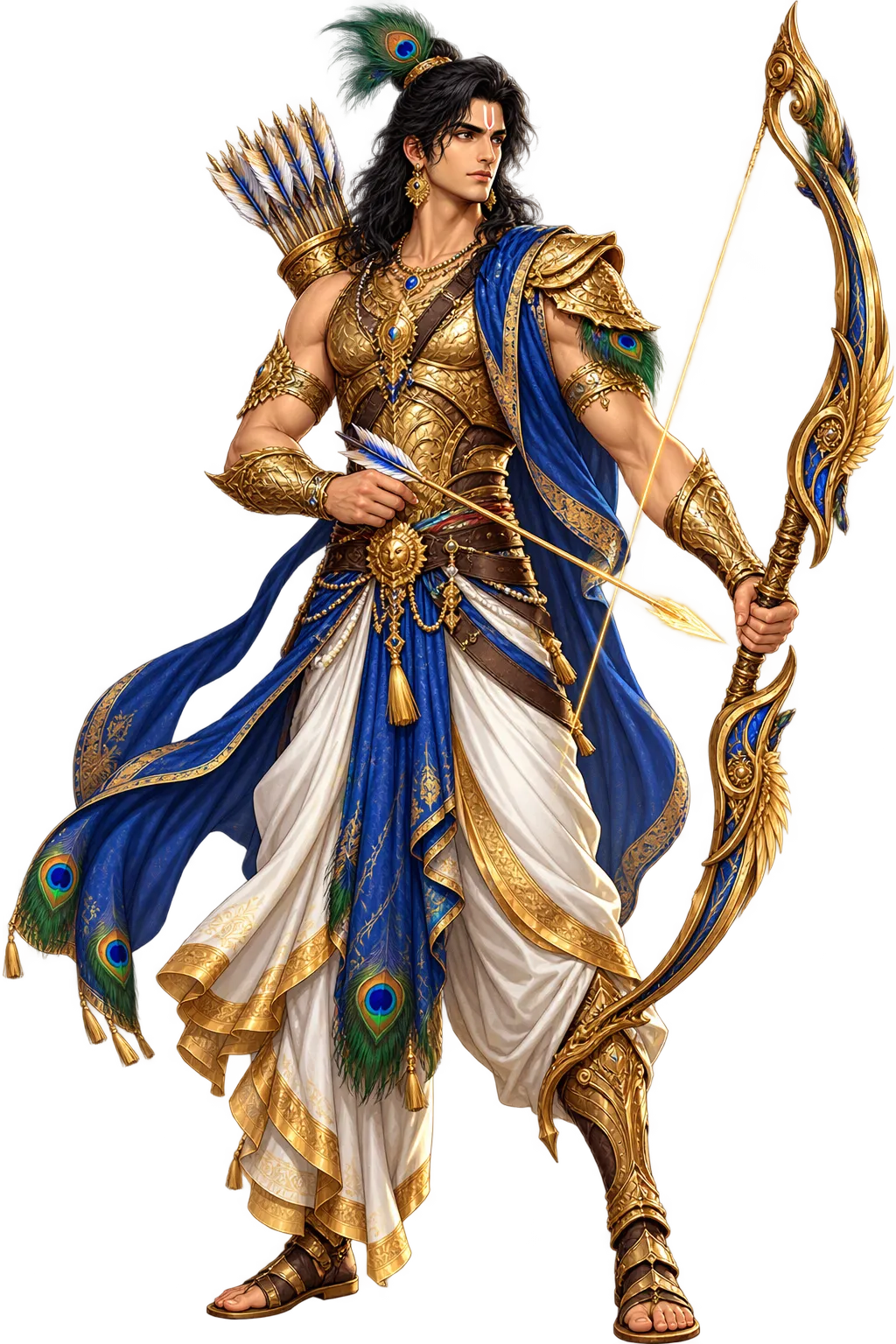
The archer with the Gandiva and the two inexhaustible quivers, Krishna as charioteer before him; the diadem and the ape-banner. His icon is the drawn bow at rest — the moment before the Gītā, frozen forever.

06

Reception & Transformation

The name after its own age — transmission, translation, survival

Afterlives

World literature knows him through the Gītā, where he is the eternal student; comparative epic pairs him with Achilles’ rival-enemies and with the archers of every tradition. In modern India he is the sportsperson’s patron, the doubter honoured above the certain — the hero whose question was worth more than his arrows.

Identifications Across Traditions

Arjuna is the Nara of the Nara-Nārāyaṇa pair — the human half of Vishnu’s eternal companion — making his friendship with Krishna a theology in dialogue-form. In Javanese and Balinese tradition he becomes the refined knight of the wayang cycle; and the Gītā made him, doubting, the everyman of all later Indian philosophy.

Modern Legacy

The Gītā’s chariot is the world’s most reproduced scene of instruction; the phrase ‘Kurukshetra’ entered the political vocabulary of every Indian language as the name of any field where duty and doubt collide. His name crowned South Indian kings (Arjunavarman) and the great tank of Rajput legend; and ‘Arjuna award’ is India’s highest honour for a sportsperson — the archer’s prize.

07

The Meditation

What Arjuna means — beyond the dictionary

Arjuna: the silvery one, the third of five, the hero whose greatest act was a question. Restored plainly, the name holds the Gītā’s whole setting — the bow lowered, the armies waiting, the friend about to become God. Four syllables, one chariot, eighteen chapters.

08

Frequently Asked Questions

Common questions about Arjuna, Archery, Dharma, Bhagavad Gītā, and Unicode restoration

01How do you pronounce Arjuna?

In reconstructed pronunciation, Arjuna is /ˈɑːrdʒʊnə/ — approximately “AHR-joo-nuh”.

02What does Arjuna mean?

Arjuna means The third of the Pāṇḍava princes, a son of Indra and Kuntī; the great archer of the Mahābhārata, to whom Kṛṣṇa speaks the Bhagavad-gītā. in the sanskrit tradition.

03What are the symbols of Arjuna?

Arjuna is associated with The Gandiva (The bow of Brahmā, won from Agni at Khaṇḍava; its twang alone routs armies.), The Svayaṃvara (He alone shot the eye of the rotating fish at Draupadī’s bride-choice, looking only at its reflection.), The Gītā’s Chariot (Between the armies he faltered — and Krishna answered with eighteen chapters that became a scripture.), The Tīrtha Pilgrimage (His year of exile became the Tīrthayātrā — the epic’s encyclopedia of India’s sacred geography.).

04Why restore Arjuna in Unicode?

Arjuna is written entirely in ASCII letters, so its restoration is about canonical fidelity rather than recovered diacritics: the temple fixes the name in its scholarly standard spelling, attested in the source tradition, instead of leaving it to drift.

05What is the most important myth about Arjuna?

“The Pāṇḍavas’ Birth” — the Ādi Parvan story that anchors the mythology of Arjuna, told in full on the lore page.

09

Scholarly Sources

The philological foundations of this restoration

Every claim on this page is grounded in established scholarship. The orthographic restorations follow disciplinary convention. The etymological chain follows the best available reference works. This is not invention — it is resurrection through scholarship.

◈

Lexicography & Philology

  • MW
  • KEWA
◎

Primary Texts

  • The Ṛgveda; the Śatapatha Brāhmaṇa; the early Upaniṣads; the Śiva Purāṇa and Liṅga Purāṇa.
◉

Archaeology & Art History

  • Material evidence — iconography, inscriptions, and temple archaeology — for Arjuna and related cults.
✦

Religious Studies

  • Mahābhārata, Ādi Parvan (birth and training)
  • Bhagavadgītā (the chariot dialogue)
  • Kālidāsa, Kirātārjunīya
  • Mahābhārata, Aśvamedhika & Svargārohaṇika Parvans
Return

The Surface Awaits

You have traced the name from its earliest attestation to its Unicode restoration. Now return to the myth. The story is where the name lives.

Back to Lore
Arjuna mascot