PuniCodex

Extended Lore

Arachnē — The Deeper Record

Etymology · Orthography · Cult · Iconography · Reception · Sources

Preserves vowel length Arachnē.com
Arachnē — Weaver, Turned into Spider
01

At a Glance

Arachnē — every fact links to its home

PantheonGreek
DomainWeaver, Turned into Spider
Original ScriptἈράχνη →
Primary Sources2 cited →
02

Etymology & Word Family

From original script to Unicode restoration — the full etymology page →

Original Script Ἀράχνη Arachnē — "Mythological weaver who was transformed into a spider"
Unicode Restoration Arachnē Restored stress, length, and script
Modern ASCII arachne Plain-ASCII fallback

The name Arachnē carries the orthographic signature of the greek tradition: Ἀράχνη. Unicode restoration recovers what ASCII flattens.

03

Unicode Character Breakdown

Character-by-character philological analysis

CharacterUnicodeNameBlockPhonetic Role
AU+0041Latin Capital Letter ABasic LatinSame
rU+0072Latin Small Letter RBasic LatinSame
aU+0061Latin Small Letter ABasic LatinSame
cU+0063Latin Small Letter CBasic LatinSame
hU+0068Latin Small Letter HBasic LatinSame
nU+006ELatin Small Letter NBasic LatinSame
ēU+0113Latin Small Letter E with MacronLatin Extended-AMacron: long eta

More than one historically valid Unicode spelling of Arachnē exists — each variant is a real, attested restoration, and the owned forms live as temples.

04

Cult & Worship

How the sacred was kept — rites, sanctuaries, remains

The Cult

Arachnē was never worshipped, and honesty requires saying so plainly: no altar, festival, or votive deposit bears her name, and her entire ancient dossier is a single Ovidian episode. What she has is an institutional backdrop — the weaving cult of Athena at Athens, where the arrhēphoroi and the ergastinai wove the goddess's peplos for the Panathenaic procession, and where the loom was a matter of civic religion. Ovid's tale reads like the dark twin of that piety: the weaver who works outside the patronage system entirely. Her true cultus is linguistic and naturalistic — the Greeks named the spider for her, Pliny treats arachnēs as a natural kind (Natural History 11.27–28), and the zoological class Arachnida still bears her transformation. Modern pagan circles sometimes invoke her as patroness of textile art, but that is twentieth-century revival, not attested ancient cult.

In the Earth

The myth of Arachnē was extremely popular in Roman wall painting and on sarcophagi, where the contest and transformation appear repeatedly — the House of the Labyrinth at Pompeii preserved a famous version. Greek vase painting more often shows Athena with weaving women than the specific Arachnē scene, but the goddess's patronage of the loom is constant from the Archaic period. Spiders and their webs appear as decorative motifs in Byzantine and Renaissance art, often carrying the moral weight of the myth.

05

Iconography

How Arachnē was imaged across the ages

The Image

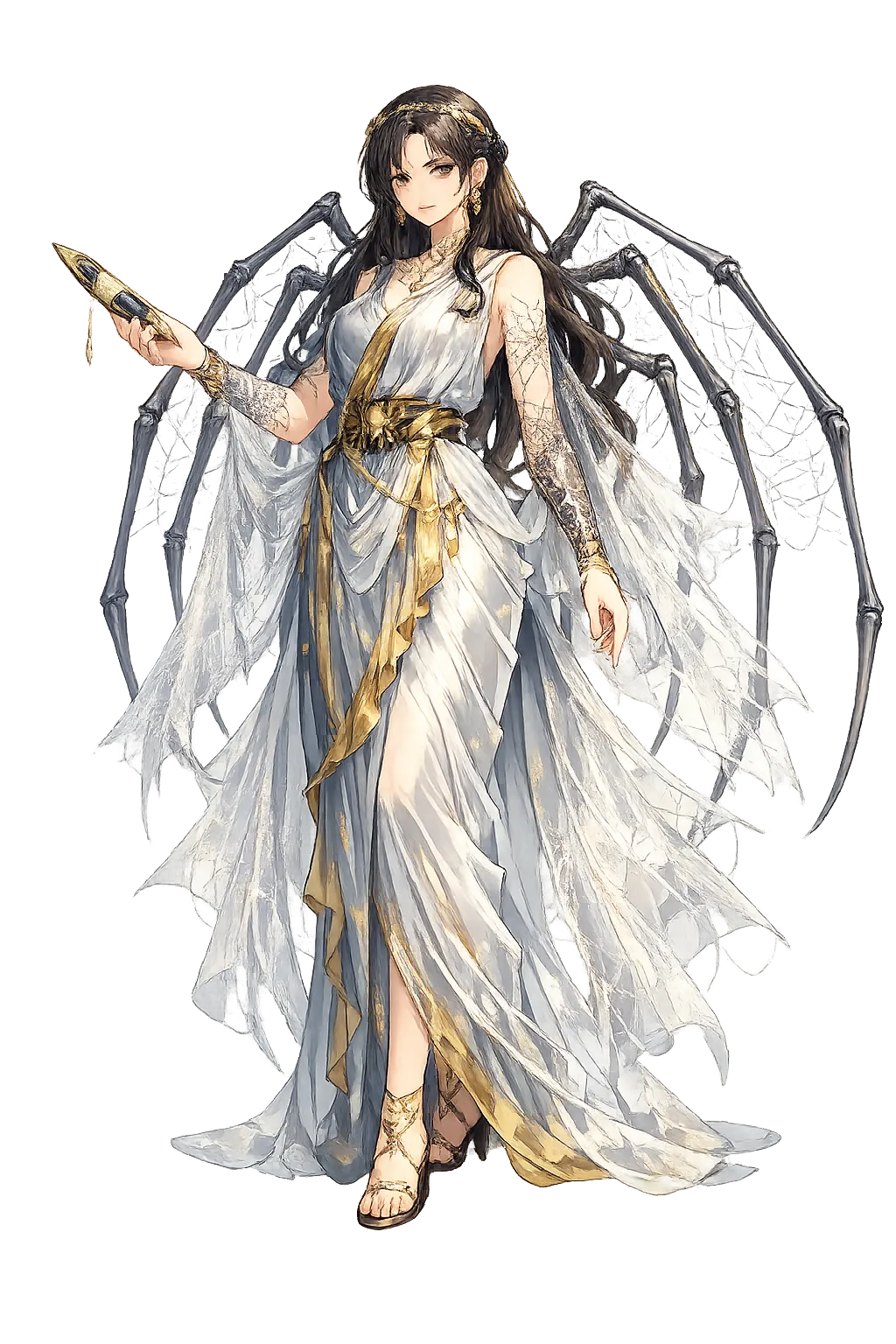
Arachnē entered art late and Roman. Greek vase painters almost never show her contest — the tale survives antiquity on Ovid's authority — but Pompeii painted it large: the fresco from the House of the Labyrinth, now in Naples, sets the two weavers at their looms, and Roman sarcophagus reliefs repeat the metamorphosis, the girl dwindling toward the spider she becomes. Her attributes are a lesson in reading: loom, shuttle, and web, with the hanging thread marking her interrupted suicide. Renaissance designers restored the contest to monumental art — Raphael's workshop placed it in the Vatican Loggie — and Velázquez's Las Hilanderas (Prado) painted it as a meditation on art and labor. The image froze where Ovid left it: a mortal at the loom, and a goddess who cannot answer the work, only destroy it.

06

Reception & Transformation

The name after its own age — transmission, translation, survival

Afterlives

Arachnē's afterlife is almost entirely Ovid's afterlife. The Middle Ages met her in the Metamorphoses, the most-read pagan book in Europe, and the fourteenth-century Ovide moralisé turned her into a sermon on pride against God. Arthur Golding's 1567 English translation — the Metamorphosis that Shakespeare knew — kept her at the Elizabethan loom, while painters and printers made the contest a set piece of Renaissance art. Her name's strangest journey was scientific: when eight-legged arthropods needed a class, early nineteenth-century zoology fixed on the transformed girl, and Arachnida became permanent taxonomy. In twentieth-century classical scholarship she became a test case — read as victim of divine envy, as parable of the artist under power, and as Ovid's own self-portrait, the poet weaving truths too dangerous to leave standing. The weaver who lost her shape won the most durable afterlife of any mortal in the poem: a word for spiders, and a question about art that criticism has never finished asking.

Identifications Across Traditions

Arachnē has few direct non-Greek parallels, but the motif of the transformed weaver appears in many traditions. The Greeks themselves gave her name to the spider class Arachnida. In Roman and Renaissance art she becomes an emblem of human artistry and its risks. Modern biology still uses 'arachnid' for spiders, scorpions, and mites, preserving her metamorphosis in scientific Latin.

Modern Legacy

Arachne's name lives in the word 'arachnid' and in every spiderweb glistening with dew. She is the patron spirit of artists who challenge authority, of women whose skill threatens the powerful, and of the punished genius. In feminist readings she is a victim of divine jealousy; in cautionary readings, a warning against hubris. Both readings agree on one point: her art was unforgettable.

08

The Original Script Note

What the written record preserves — and what it does not

Original Script

The name is written in Greek as Ἀράχνη, which is simply the Greek word for 'spider', from a root family of webs and snares; the accent falls on the penult and the final eta is long. The written record is asymmetric. The word is old and common in Greek, but the metamorphosis tale survives whole only in Latin, in Ovid's Metamorphoses (6.5–145), where the presumptuous weaver of Colophon becomes the first spider. Earlier Greek evidence for the story is fragmentary — references, glosses, and images rather than a full telling — so the fullest account of this 'Greek' myth is a Roman poem. The ASCII arachne loses the accent and the vowel length.

09

The Meditation

What Arachnē means — beyond the dictionary

Arachnē is the artist as transgressor. Her fingers knew what her tongue could not safely say. The loom became her printing press, her courtroom, her rebellion. Athena did not destroy the tapestry; she destroyed the weaver — a sign that the work itself could not be answered.

The transformation into a spider is ambiguous. Is it punishment or preservation? Arachnē loses her human form but keeps her gift, weaving now without rivalry, without audience, without end. In that ceaseless making there is something like immortality, and something like loneliness. She is every creator whose excellence outruns their place.

10

Frequently Asked Questions

Deep-dives into the cult, attestation, reception, and sources of Arachnē

01How do we know how Arachnē was worshipped?

The myth of Arachnē was extremely popular in Roman wall painting and on sarcophagi, where the contest and transformation appear repeatedly — the House of the Labyrinth at Pompeii preserved a famous version. The full cult record →

02Where do the earliest attestations of Arachnē come from?

The record rests on LSJ, Beekes, Etymological Dictionary of Greek, Ovid, Metamorphoses 6.1–145, among 5 cited works. The full source apparatus →

03How did later traditions reinterpret Arachnē?

Arachnē's afterlife is almost entirely Ovid's afterlife. Reception & transformation →

04What do the surviving images of Arachnē actually show?

Arachnē entered art late and Roman. The iconography →

05What does the written record of Arachnē actually preserve?

The name is written in Greek as Ἀράχνη, which is simply the Greek word for 'spider', from a root family of webs and snares; the accent falls on the penult and the final eta is long. The Original Script note →

11

Scholarly Sources

The philological foundations of this restoration

Every claim on this page is grounded in established scholarship. The orthographic restorations follow disciplinary convention. The etymological chain follows the best available reference works. This is not invention — it is resurrection through scholarship.

◈

Lexicography & Philology

  • Liddell, H. G., Scott, R., & Jones, H. S. A Greek-English Lexicon. Oxford: Clarendon Press, 9th ed. 1996.
  • Pape, W., & Benseler, G. E. Wörterbuch der griechischen Eigennamen. Braunschweig: Vieweg, 1884.
  • Beekes, R. S. P. Etymological Dictionary of Greek. Leiden: Brill, 2010.
◎

Primary Texts

  • Ovid, Metamorphoses 6.1–145
  • Virgil, Georgics 4.246
◉

Archaeology & Art History

  • Boardman, J. Greek Sculpture: The Classical Period; Carpenter, T. H. Art and Myth in Ancient Greece.
✦

Religious Studies

  • Beekes, Etymological Dictionary of Greek
  • Pliny, Natural History 11.28 (the spider that rivals Arachne)
Return

The Surface Awaits

You have traced the name from its earliest attestation to its Unicode restoration. Now return to the myth. The story is where the name lives.

Back to Lore
Arachnē mascot