PuniCodex

Extended Lore

𒀊𒍪 Apsû

Etymology · Orthography · Cult · Iconography · Reception · Sources

Tier 1 Apsû.com
Apsû — Phonological Reconstruction, Fresh Water, Abyss
01

Quick Facts

Essential information about Apsû, Phonological Reconstruction, Fresh Water, Abyss

Original Script𒀊𒍪
Unicode RestorationApsû
Reconstructed Pronunciation/apˈsuː/
PantheonMesopotamian
DomainPhonological Reconstruction, Fresh Water, Abyss
MeaningReconstruction node for the Mesopotamian abyss Apsu (Sumerian Abzu): the circumflex marks a discussable vowel length, not a canonical spelling claim.
ClassificationTier 1
Primary DomainApsû.com
Sacred SymbolsUnderground water, Ea's temple, Mingled waters, The slain body, The well and the spring
02

Etymology & Word Family

From original script to Unicode restoration

Original Script 𒀊𒍪 Apsû — "Reconstruction node for the Mesopotamian abyss Apsu (Sumerian Abzu): the circumflex marks a discussable vowel length, not a canonical spelling claim."
Unicode Restoration Apsû Restored stress, length, and script
Modern ASCII apsu Plain-ASCII fallback

Standard Assyriology transliterates the primordial freshwater abyss as Apsu (Akkadian) or Abzu (Sumerian 𒀊𒍪). The length of the final vowel in Akkadian Apsû is reconstructed from linguistic convention, not from the cuneiform signs themselves; the circumflex on Apsû is a pedagogical mark that makes that open question visible, not a claim of canonical spelling.

03

Unicode Character Breakdown

Character-by-character philological analysis

CharacterUnicodeNameBlockPhonetic Role
AU+0041Latin Capital Letter ABasic LatinSame, capitalized
pU+0070Latin Small Letter PBasic LatinSame
sU+0073Latin Small Letter SBasic LatinSame
ûU+00FBLatin Small Letter U with CircumflexLatin-1 SupplementCircumflex: a visible question mark — the length of Apsu's final vowel is discussable, not certain

The Tier 1 classification reflects how much of the original phonology this restoration preserves — stress and vowel length for Greek names, distinctive letters and diacritics for every other tradition.

04

Cult & Worship

How the sacred was kept — rites, sanctuaries, remains

The Cult

Apsû had no independent priesthood or festival; his cult was embedded in the temples of Enki/Ea and in the hydraulic symbolism of Mesopotamian sanctuaries. The abzu shrine at Eridu, repeatedly rebuilt from the Ubaid period onward, was understood as the cosmic freshwater source upon which the god dwelt, and libations of water were a routine offering at Ea's cella in Esagila at Babylon. Temple basins, drainage channels, and stepped platforms evoked the primordial deep. Because Apsû was a place and a cosmic condition more than a personal god, worship of him was inseparable from the service of the water-god to whom his abyss belonged.

In the Earth

Archaeological evidence for the abzu centers on temple architecture and textual deposits. The abzu shrine of Enki at Eridu — among the earliest sacred structures in southern Mesopotamia — was rebuilt repeatedly from the Ubaid period onward as the cosmic freshwater source. At Babylon, Esagila's cella of Ea and its apsû-basin embodied the god's dwelling upon the primordial deep. Cuneiform copies of the Enuma Elish from Nineveh and Sippar preserve the myth of Apsû's defeat.

05

Iconography

How Apsû was imaged across the ages

The Image

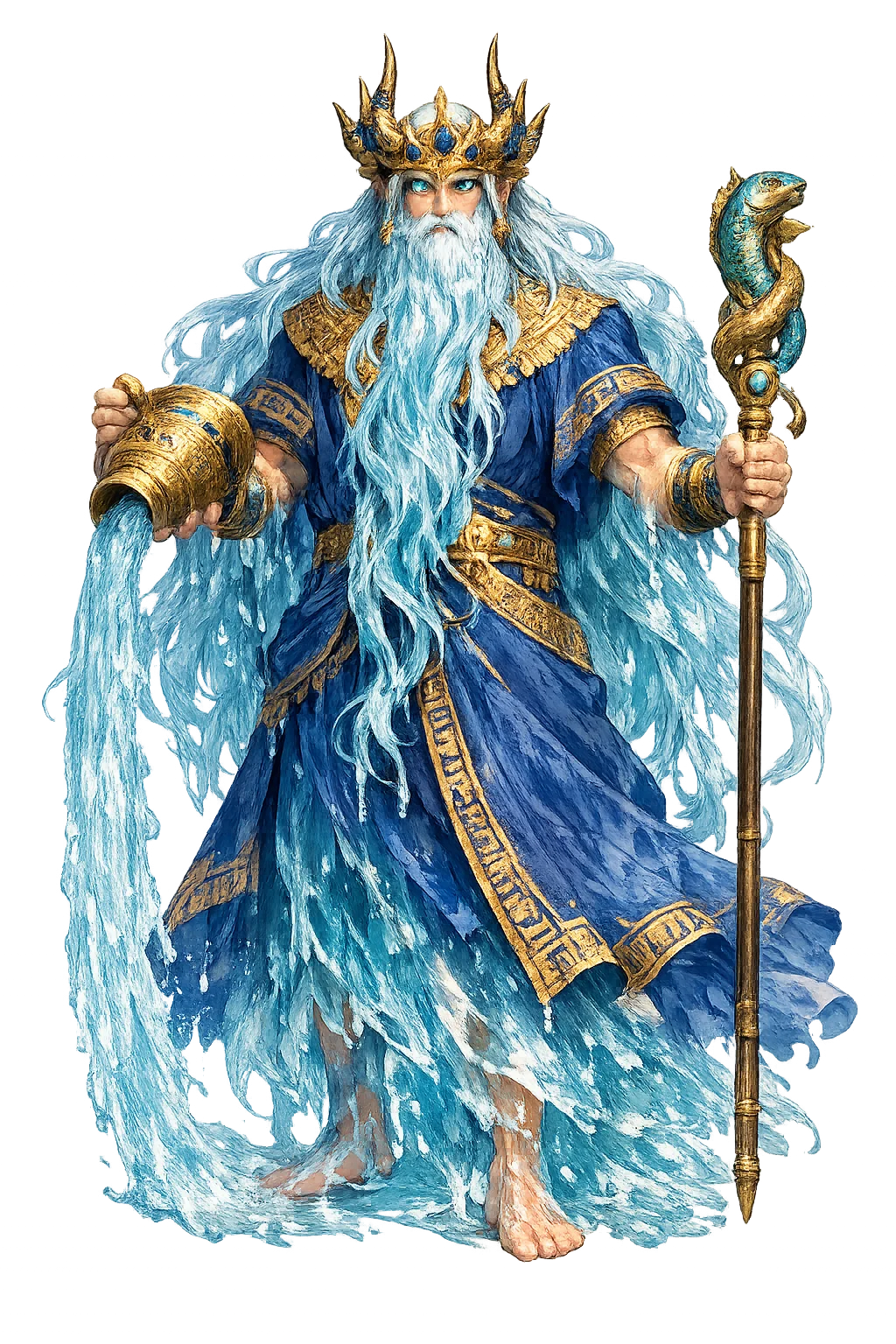
Apsû was imaged as water itself rather than as a standing deity. Cylinder seals and temple reliefs show Enki/Ea enthroned above flowing streams or surrounded by fish, with the water-lines standing in for the abyss beneath. The apsû-basin of Esagila at Babylon gave architectural form to the idea, and Late Babylonian kudurru stones sometimes mark sacred watercourses. There is no canonical portrait of Apsû as a figure; instead, the visual tradition relies on waves, rivers, marine creatures, and the god's association with the subterranean freshwater ocean.

06

Reception & Transformation

The name after its own age — transmission, translation, survival

Afterlives

The Mesopotamian abyss survived into Late Babylonian religion, was reported by Berossus to Greek audiences, and provided a template for later cosmologies of primordial waters. The conflict between Apsû and the younger gods in the Enuma Elish has often been compared with biblical tehôm and other ancient Near Eastern combat myths, though scholars debate the direction and degree of influence. After the cuneiform tradition went silent, Apsû was recovered only in the nineteenth century through Assyriology. Today the name circulates in studies of Mesopotamian cosmogony and in popular accounts of Babylonian mythology, usually as the primordial freshwater deep.

Identifications Across Traditions

The abzu travelled far beyond Mesopotamia.

The Unicode form Apsû is a reconstruction node: standard Assyriology writes Apsu or Abzu, while the circumflex makes visible the open question of final-vowel length. In the Hebrew Bible, the primordial tĕhôm ('deep') of Genesis 1:2 likely preserves a memory of Tiamat and Apsû. Greek sources knew Mesopotamian cosmology through Berossus, whose Babyloniaca described Oannes emerging from the Erythraean Sea, an avatar of the apkallu sage associated with the abzu. In later esoteric traditions, the abyss became a symbol of hidden knowledge and the unconscious. The abzu is thus one of the ancient Near East's most influential geographical ideas: a freshwater deep beneath the world, the source of both physical fertility and divine wisdom.

Modern Legacy

The idea of a watery abyss beneath the earth has never disappeared.

It survives in the biblical 'fountains of the great deep' (Genesis 7:11), in medieval maps showing subterranean rivers, and in modern geology's aquifers and groundwater systems. Science fiction and fantasy continue to imagine hidden freshwater seas beneath the crust. The name Apsû itself has been revived in games, novels, and occult cosmologies as a primordial power. PuniCodex keeps the circumflex not as a settled fact but as an invitation: every visitor is invited into the philological conversation. What began as a Mesopotamian explanation of wells and springs became one of the West's foundational images of depth, origin, and the unconscious.

07

The Meditation

What Apsû means — beyond the dictionary

Apsû is the deep that thought it could sleep. In the Enuma Elish he is the oldest thing in the universe, and his first recorded wish is for quiet: the young gods' noise disturbs his rest, and so he resolves to unmake them. It is the primordial's tragedy — the deep cannot bear the life that arose within it. Ea's victory makes the theological point brutally: the old abyss does not govern the world; it is repurposed as its floor.

Every later tradition that imagines hidden waters beneath the earth — the biblical tehom, the fountains of the great deep, the aquifer under the modern city — descends from this Babylonian intuition: that below the world we walk on runs another, older one, and that civilization floats on a freshness it cannot see. PuniCodex's circumflex turns the name into a visible question: the length of that final vowel is genuinely uncertain, and the temple wears its uncertainty openly. Apsû is the patron of everything deep, necessary, and not fully knowable.

08

Frequently Asked Questions

Common questions about Apsû, Phonological Reconstruction, Fresh Water, Abyss, and Unicode restoration

01How do you pronounce Apsû?

In reconstructed pronunciation, Apsû is /apˈsuː/ — approximately 'ahp-SOO' — stress the second syllable and draw out the final vowel like a deep reservoir.

02What does Apsû mean?

Apsû means Reconstruction node for the Mesopotamian abyss Apsu (Sumerian Abzu): the circumflex marks a discussable vowel length, not a canonical spelling claim. in the mesopotamian tradition.

03What are the symbols of Apsû?

Apsû is associated with Underground water (The invisible freshwater feeding springs, rivers, and wells), Ea's temple (The abzu as the house of wisdom, built upon the defeated abyss), Mingled waters (Apsû and Tiamat as the primordial couple from whom the gods arise), The slain body (The defeated abyss beneath Ea's house — the primordial power made into a foundation, depth repurposed as dwelling.), The well and the spring (The abzu rising in wells and springs — Apsu's body feeding the living world above invisibly, the freshness civilization cannot see.).

04Why are there different spellings of Apsû?

Each form is a historically attested restoration rather than a mistake: Abzu is the alt form (Sumerian form of the primordial freshwater abyss). PUNICODEX registers the full set so the tradition is preserved under every defensible spelling.

05Why restore Apsû in Unicode?

Plain ASCII apsu strips the stress, length, and script that make the name specific. Unicode restoration returns the name to its original written dignity.

06What is the most important myth about Apsû?

“The Freshwater Abyss” — the Cosmogony story that anchors the mythology of Apsû, told in full on the lore page.

09

Scholarly Sources

The philological foundations of this restoration

Every claim on this page is grounded in established scholarship. The orthographic restorations follow disciplinary convention. The etymological chain follows the best available reference works. This is not invention — it is resurrection through scholarship.

◈

Lexicography & Philology

  • Black-Green
◎

Primary Texts

  • Enuma Elish
  • Enuma Elish
  • Epic of Gilgamesh, Tablet XI (Standard Babylonian version: Utnapištim recounts Ea's counsel from the Apsû)
  • Atrahasis (Akkadian Flood Story: Ea dwells in the Apsû and warns Atraḫasis of the deluge)
  • Enki and Ninhursag (Sumerian myth of the abzu and the paradise of Dilmun)
  • Enki and the World Order (Sumerian hymn: Enki assigns the me from the Apsû)
◉

Archaeology & Art History

  • Material evidence — iconography, inscriptions, and temple archaeology — for Apsû and related cults.
✦

Religious Studies

  • CAD (Chicago Assyrian Dictionary)
  • ETCSL (Electronic Text Corpus of Sumerian Literature)
  • Jacobsen, The Treasures of Darkness
Return

The Surface Awaits

You have traced the name from its earliest attestation to its Unicode restoration. Now return to the myth. The story is where the name lives.

Back to Lore
Apsû mascot