PuniCodex

Extended Lore

Annwn

Etymology · Phonology · Orthography · Cultural Legacy · Primary Sources

Tier 2 Annwn
Annwn — Otherworld, Underworld
01

Quick Facts

Essential information about Annwn, Otherworld, Underworld

Scholarly TransliterationAnnwn
Unicode RestorationAnnwn
Reconstructed Pronunciation/ˈanʊn/
PantheonCeltic
DomainOtherworld, Underworld
MeaningThe deep, the abyss
ClassificationTier 2
Primary DomainAnnwn
Sacred SymbolsThe cauldron of Pen Annwn, White hounds with red ears, Caer Sidi and the fortresses, Prydwen, The year's exchange
02

Etymology & Word Family

From original script to Unicode restoration

Scholarly Transliteration Annwn Annwn — "The deep, the abyss"
Unicode Restoration Annwn Restored stress, length, and script
Modern ASCII annwn Plain-ASCII fallback

Annwn is Tier 2 by the mechanical rule: the normalized Welsh form is already plain ASCII — there is no diacritic and no distinctive letter for the ASCII alphabet to lose. The capital alone distinguishes the temple form from the input; the realm's fame in the tradition is beside the point.

03

Unicode Character Breakdown

Character-by-character philological analysis

CharacterUnicodeNameBlockPhonetic Role
AU+0041Latin Capital Letter ABasic LatinSame, capitalized
nU+006ELatin Small Letter NBasic LatinSame
wU+0077Latin Small Letter WBasic LatinSame
nU+006ELatin Small Letter NBasic LatinSame

The Tier 2 classification reflects how much of the original phonology this restoration preserves — stress and vowel length for Greek names, distinctive letters and diacritics for every other tradition.

04

Cultural Significance

From ancient cult to modern Unicode

Ancient Domain

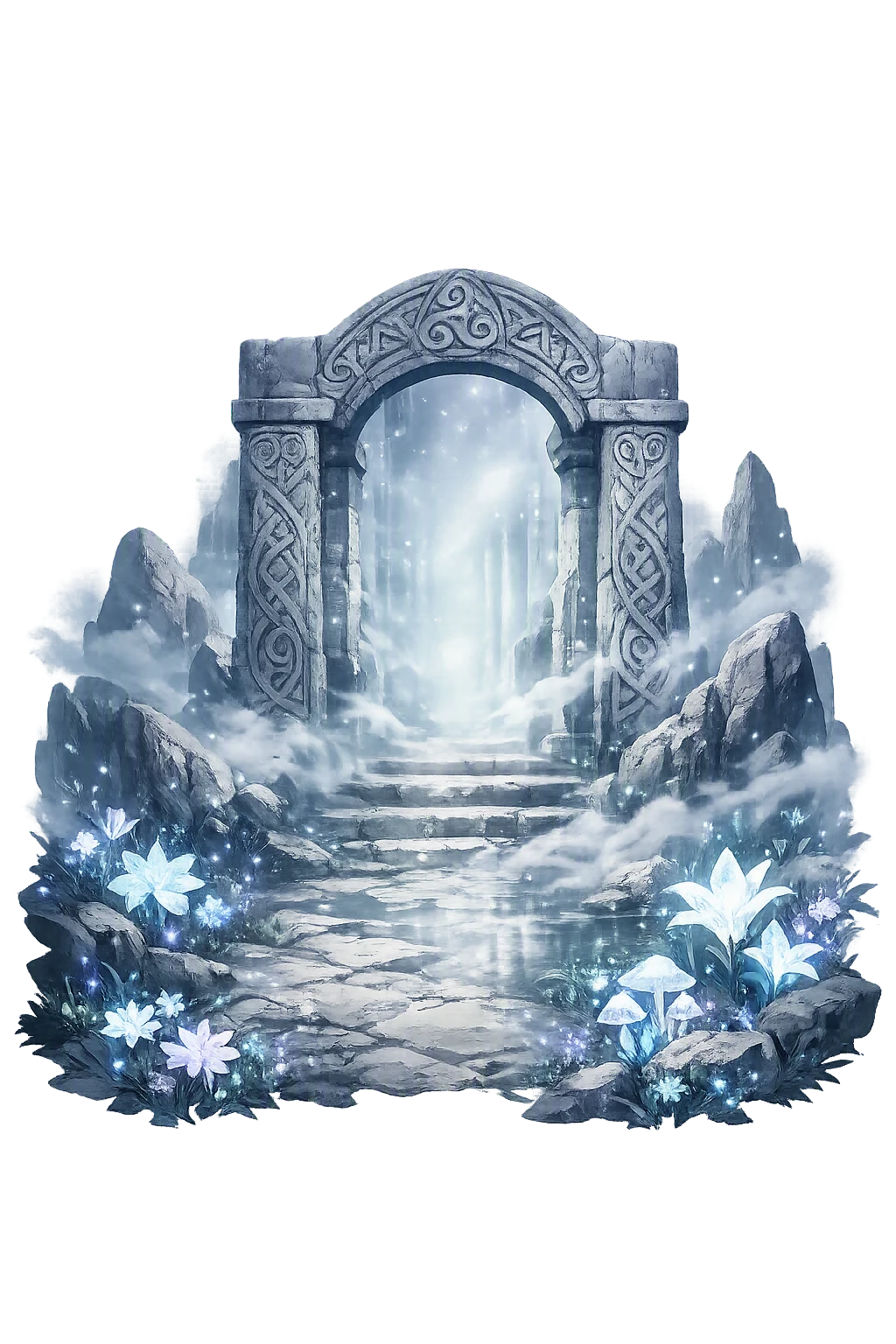
Annwn is the Welsh Otherworld of the Mabinogi and the oldest Welsh poetry — a realm of plenty where the feast never fails, ruled in the First Branch by [[arawn|Arawn]], and hunted across by Gwyn ap Nudd, whom God set over the demons of Annwn lest they destroy this world. Its cauldron, borne home from its fortresses at terrible cost, is the oldest quest of Arthurian tradition.

Annwn in Later Traditions

Annwn's clearest kin are Irish: the síd of the Túatha Dé Danann, where the feast likewise never fails — the Dagda's cauldron of Murias, from which no company went away unsatisfied, is the standing comparison for the cauldron of the Head of Annwn, and Mac Cana sets the two vessels side by side as one Celtic figure-type. The Irish Otherworld of the immrama and echtrai — Mag Mell, Emain Ablach, lands 'without grief, without sorrow, without death' — matches Annwn's profile point for point: plenty, beauty, and the suspension of age and sickness. Yet the Brythonic tradition is not a copy of the Gaelic one: no Irish text knows the name Annwn, and the Welsh corpus built its Otherworld on its own geography — the ford at Glyn Cuch, the revolving fortresses of the Taliesin poem, the Tor at Glastonbury. The Christian redactors left the structure intact while re-labelling its inhabitants: by Buchedd Collen, Gwyn ap Nudd's splendid court could be dismissed as a demonic glamour without surrendering one detail of the feast.

Modern Legacy

Preiddeu Annwfn stands at the head of the Arthurian tradition: the raid on the Otherworld fortresses is older than every romance of the Grail, and scholars from Loomis onward have read the quest for the Head of Annwn's cauldron — a vessel of plenty that tests the worthy — as the Grail story's deepest Welsh root. The name kept working in Welsh: Annwn remains the living word for the Otherworld, and the white red-eared hounds became the Cŵn Annwn of later Welsh folklore, the pack whose crying in the night sky foretells a death. Gwyn ap Nudd rode out of the texts into modern Druidry and pagan practice as the great huntsman and psychopomp of the Welsh tradition, and Glastonbury Tor — crowned now by the stump of St Michael's tower — still carries his court in the popular imagination. Restoring Annwn in Unicode costs nothing and fixes something: the canonical spelling of the deep, held against the drift of anglicized spellings like Annwvyn and Annwyn.

Unicode Restoration as Cultural Act

Restoring Annwn in a domain name is more than orthographic accuracy. It is a statement that the internet should recognize the full range of human writing — not only the ASCII keyboard.

05

Frequently Asked Questions

Common questions about Annwn, Otherworld, Underworld, and Unicode restoration

01How do you pronounce Annwn?

In reconstructed pronunciation, Annwn is /ˈanʊn/ — approximately 'AN-oon' — two syllables, stress on the first; the w is sounded as a short 'oo', so the name rhymes with 'cannon' said with Welsh vowels..

02What does Annwn mean?

Annwn means The deep, the abyss in the celtic tradition.

03What are the symbols of Annwn?

Annwn is associated with The cauldron of Pen Annwn (Plenty that will not serve the coward — abundance that answers only to courage), White hounds with red ears (The colours of the Otherworld made flesh — beauty that marks the boundary crossed), Caer Sidi and the fortresses (The revolving castle and its sister fortresses — the Otherworld as architecture that must be won, not visited), Prydwen (Arthur's ship — the voyage into the deep from which only seven returned), The year's exchange (Arawn and Pwyll trading shapes and kingdoms — the Otherworld close enough to wear a man's face).

04Why restore Annwn in Unicode?

Plain ASCII annwn strips the stress, length, and script that make the name specific. Unicode restoration returns the name to its original written dignity.

05What is the most important myth about Annwn?

Pwyll, prince of Dyfed, is hunting in Glyn Cuch when he drives a strange pack off a stag — hounds gleaming white, with red ears, the colours of the Otherworld — and feeds his own dogs on the kill. Their master rides up: [[arawn|Arawn]], a king of Annwn, and the offense is real. To make amends Pwyll accepts Arawn's bargain: for a year and a day they will exchange shapes and kingdoms, and at the year's end Pwyll must face Arawn's rival Hafgan — a king who can be killed by a single blow only; strike him twice and by the next day he fights as strongly as before.Pwyll rules Annwn for the year in Arawn's likeness, in a court of unsurpassed plenty — and each night lies beside Arawn's queen without once touching her. At the appointed ford he strikes Hafgan once, refuses the second blow the wounded king begs for, and Annwn is united under Arawn. When the two kings meet again at Glyn Cuch and resume their own shapes, Arawn learns of the year's chastity and the friendship is sealed with gifts of horses, greyhounds, hawks, and gold. From that day Pwyll was called not Pwyll Prince of Dyfed but Pwyll Pen Annwn — Pwyll, Head of Annwn.

06

Scholarly Sources

The philological foundations of this restoration

Every claim on this page is grounded in established scholarship. The orthographic restorations follow disciplinary convention. The etymological chain follows the best available reference works. This is not invention — it is resurrection through scholarship.

Lexicography & Philology

  • Mabinogion
  • MacKillop

Primary Texts

  • The Immram Brain (Voyage of Bran); Tochmarc Étaíne; Cóir Anmann; medieval Irish saga literature.

Archaeology & Art History

  • Material evidence — iconography, inscriptions, and temple archaeology — for Annwn and related cults.
  • Annwn is a wholly textual realm: no inscription invokes it, and the Romano-British epigraphy of Wales is silent on the Otherworld by name. Its manuscript witnesses, however, are exact. The Mabinogi survives complete in the White Book of Rhydderch (c. 1350) and the Red Book of Hergest (c. 1400), the two great codices of medieval Welsh prose; Preiddeu Annwfn is preserved uniquely in the Book of Taliesin (National Library of Wales, Peniarth MS 2, early fourteenth century); and Culhwch ac Olwen comes down in a White Book fragment and the full Red Book text. The one site the tradition ties to Annwn is Glastonbury Tor, Gwyn ap Nudd's seat in Buchedd Collen: excavations on the Tor in the 1960s found sub-Roman and early medieval occupation beneath the ruins of St Michael's church — real archaeology on the hill, though none of it speaks to the Otherworld, whose only true location is the text.

Religious Studies

  • Pwyll Pendefig Dyfed (First Branch of the Mabinogi) — the meeting at Glyn Cuch, the year's exchange, the defeat of Hafgan, the title Pen Annwn; ed. Ifor Williams, Pedeir Keinc y Mabinogi (1930); trans. Sioned Davies, The Mabinogion (2007)
  • Preiddeu Annwfn (The Spoils of Annwfn), Book of Taliesin — Arthur's voyage in Prydwen, the fortresses, the cauldron of the Head of Annwfn, 'except seven, none returned'; ed. and trans. Marged Haycock, Legendary Poems from the Book of Taliesin (2007)
  • Culhwch ac Olwen — Gwyn ap Nudd set over the demons of Annwn; the May Day fight with Gwythyr for Creiddylad; ed. Rachel Bromwich and D. Simon Evans (1992)
  • Buchedd Collen (The Life of St Collen) — Gwyn ap Nudd's court on Glastonbury Tor and the banquet dispelled by holy water
  • Geiriadur Prifysgol Cymru / A Dictionary of the Welsh Language, s.v. annwfn ('the otherworld, the abyss')
  • Mac Cana, Celtic Mythology; Koch, Celtic Culture: A Historical Encyclopedia, s.v. Annwfn; MacKillop, Dictionary of Celtic Mythology, s.v. Annwn (lexicon authorities for this entry: Mabinogion, MacKillop)
Return

The Surface Awaits

You have traced the name from its earliest attestation to its Unicode restoration. Now return to the myth. The story is where the name lives.

Back to Lore
Annwn mascot