PuniCodex

Extended Lore

ᛅᚾᚴᚱᛒᚢᚦᛅ Angrboða

Etymology · Orthography · Cult · Iconography · Reception · Sources

Tier 1 Angrboða.com
Angrboða — Monster Mother, Sorcery
01

Quick Facts

Essential information about Angrboða, Monster Mother, Sorcery

Original Scriptᛅᚾᚴᚱᛒᚢᚦᛅ
Unicode RestorationAngrboða
Reconstructed Pronunciation/ˈɑŋɡrˌboðɑ/
PantheonNorse
DomainMonster Mother, Sorcery
MeaningShe who offers sorrow
ClassificationTier 1
Primary DomainAngrboða.com
Sacred SymbolsThe wolf Fenrir, The serpent Jörmungandr, Hel's half-dark face, The ironwood (Járnviðr), Jötunheimr
02

Etymology & Word Family

From original script to Unicode restoration

Original Script ᛅᚾᚴᚱᛒᚢᚦᛅ Angrboða — "She who offers sorrow"
Unicode Restoration Angrboða Restored stress, length, and script
Modern ASCII angrboda Plain-ASCII fallback

Old Norse Angrboða, from angr 'sorrow, grief' + boða 'to offer, to announce'; mother of Fenrir, Jörmungandr, and Hel by Loki.

03

Unicode Character Breakdown

Character-by-character philological analysis

CharacterUnicodeNameBlockPhonetic Role
AU+0041Latin Capital Letter ABasic LatinSame, capitalized
nU+006ELatin Small Letter NBasic LatinSame
gU+0067Latin Small Letter GBasic LatinSame
rU+0072Latin Small Letter RBasic LatinSame
bU+0062Latin Small Letter BBasic LatinSame
oU+006FLatin Small Letter OBasic LatinSame
ðU+00F0Latin Small Letter EthLatin-1 SupplementEth: voiced dental fricative
aU+0061Latin Small Letter ABasic LatinSame

The Tier 1 classification reflects how much of the original phonology this restoration preserves — stress and vowel length for Greek names, distinctive letters and diacritics for every other tradition.

04

Cult & Worship

How the sacred was kept — rites, sanctuaries, remains

The Cult

No temple, festival, or votive offering to Angrboða is attested anywhere. She was, so far as the record shows, never worshipped in the Viking Age at all: she belongs to the narrative layer of the myth — the genealogy of Ragnarök — not to the cult layer of blót and sanctuary. The nearest thing to ritual that the sources preserve is inverted: the anxious binding of her son Fenrir, a ceremony performed against her brood, which is itself a kind of testimony to her power. Modern Germanic Heathenry has since restored her to worship, but that is a contemporary revival, not a survival.

In the Earth

Angrboða has left no cult site, no amulet, and no image that can be securely tied to her — the record is entirely textual. The witnesses are the vellum books: Völuspá survives whole in the Codex Regius (GKS 2365 4°, c. 1270) and fragmentarily in AM 748 I 4°; Snorri's sentence naming her rides in the Prose Edda manuscripts, above all Codex Upsaliensis (DG 11, early 14th century) and the Codex Regius of the Prose Edda (GKS 2367 4°). Indirect iconography exists for her brood: the eighth-century Gotland picture stone Ardre VIII shows the bound wolf, and the Gosforth Cross in Cumbria carves scenes from the end-time she mothers. But of the giantess herself the Middle Ages drew nothing — an absence that suits her.

05

Iconography

How Angrboða was imaged across the ages

The Image

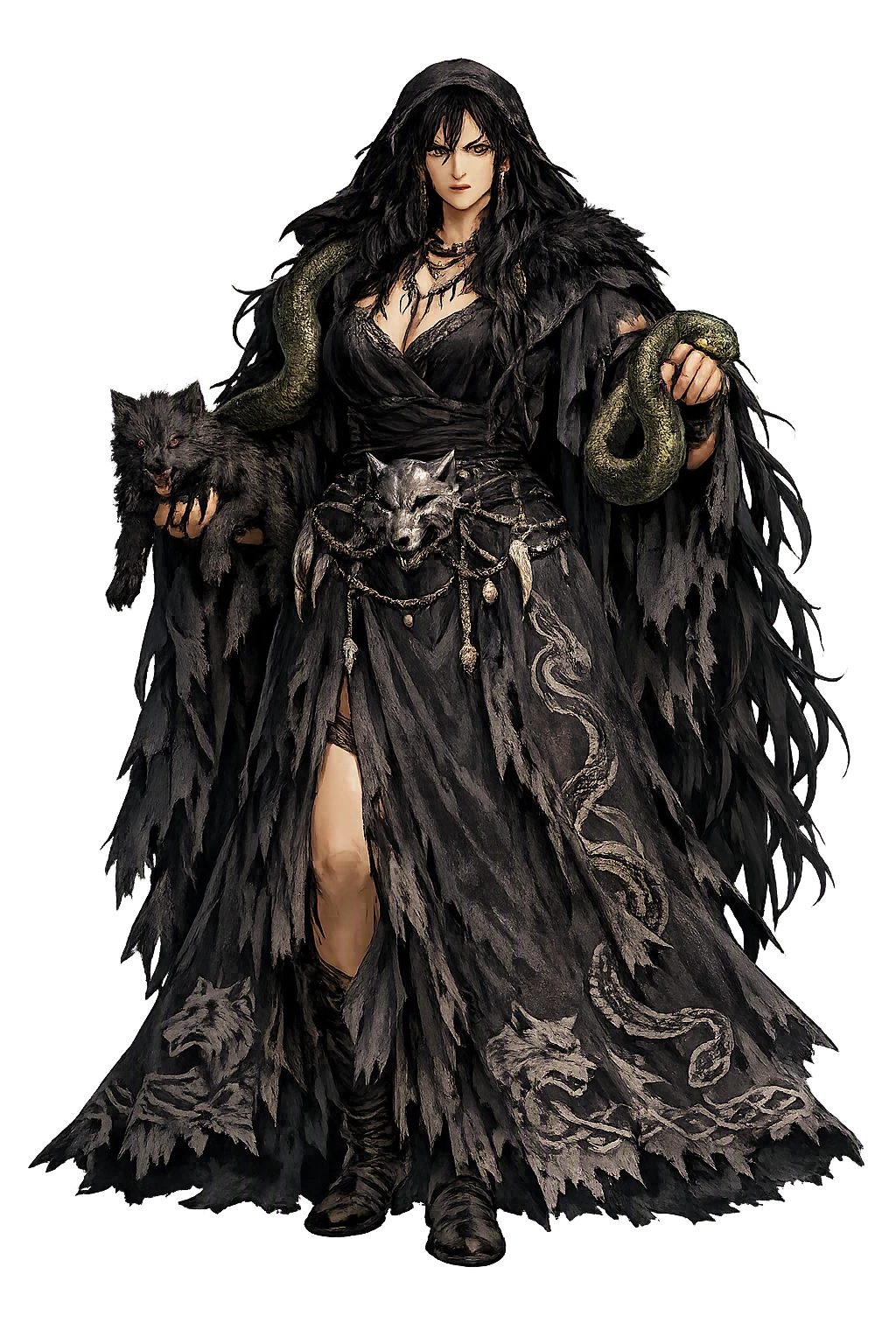
No medieval image of Angrboða survives — the giantess was drawn nowhere, and the Middle Ages seem not to have pictured her at all. The iconography belongs to her children: the eighth-century Gotland picture stone Ardre VIII carves the bound wolf Fenrir, and the Gosforth Cross in Cumbria cuts Ragnarök scenes — the wolf's struggle and the serpent's — that visualize her progeny if not her person. A wolf-riding giantess who reins her mount with snakes, on the tenth-century Hunnestad monument in Scania, is usually identified as Hyrrokkin, but it shows the type-image that would have suited Angrboða: armed, mounted on her brood's own emblem. The texts give her a single attribute — motherhood of the three — and no body, dress, or weapon; later ages imaged her through them, which remains the nearest thing to a portrait she has.

06

Reception & Transformation

The name after its own age — transmission, translation, survival

Afterlives

Angrboða's transmission is a story of survival by a single page. Völuspá came down in the Codex Regius and in the Hauksbók copy; Snorri's naming sentence rode the Prose Edda manuscripts, and the antiquarians of the seventeenth century put the Eddas into print with Resen's 1665 edition. The nineteenth century made her name current: Jakob Grimm gave her a place in Deutsche Mythologie (1835), and the Edda translations — Thorpe's of 1866, Vigfusson and Powell's Corpus Poeticum Boreale — carried the etymology, she who offers grief, into English philology. The first scholarly generation catalogued her as a genealogy, not a goddess; the gender-conscious re-readings of recent decades — Jóhanna Katrín Friðriksdóttir's Women in Old Norse Literature (2013) treats her giantess tradition with care — have argued her case as a figure the male-authored sources refuse to let speak. The reception is thus double: philology preserved the name, and modern scholarship recovered the silenced figure behind it.

Identifications Across Traditions

Angrboða entered the wider European imagination in the nineteenth century, when Jakob Grimm gave her a place in Deutsche Mythologie and the Eddas became central to Germanic romanticism; in that climate the 'monster mother' was read sometimes as a warning, sometimes as a matriarchal heroine. Her closest literary cousin is Grendel's mother in Beowulf — another armed giant-woman avenging her offspring against a male warrior order — though the kinship is typological, not textual. Modern Germanic Heathenry has restored her to cult, honoring her as an ancestress of power rather than a villain. Popular culture has been generous to her: she recurs across comics and fantasy, and most prominently as a major character in the video game God of War Ragnarök (2022), the first telling to give her a voice, a craft, and a future.

Modern Legacy

Angrboða's legacy runs through two channels: language and archetype. The Old Norse angr, 'grief, affliction,' crossed into Middle English and survives whenever anyone feels anger — her name's root is spoken daily by millions who have never heard of her. As an archetype she is the mother of monsters, the figure who embodies the fear of female generative power operating outside male control; scholarship on Norse giantesses, notably Margaret Clunies Ross's Prolonged Echoes, reads her children as the gods' own projected anxieties given flesh. In modern Heathenry she is honored as a goddess of the wolf-kin and of sorrow honestly borne. And her children outgrew her obscurity: Fenrir, Jörmungandr, and Hel anchor three of the most retold figures of the Norse canon, each famous enough to carry their silent mother with them into every retelling.

07

The Meditation

What Angrboða means — beyond the dictionary

Angrboða is the most important character in Norse myth who never does anything. That is precisely her fascination. The gods do not fight her, trick her, or marry her; they manage her children — chain the wolf, drown the serpent's threat in the sea, exile the daughter to the dead — and never once confront the mother. The asymmetry is the message. Her power is generative and therefore unanswerable by the Þórr-pattern of meeting force with force: you cannot smash a womb. So the myth does what an order does with what it cannot answer — it quarantines the products and leaves the producer unnamed at the edge of the map, in Jötunheimr, in the ironwood, in a silence the listener is meant to notice. To meditate on Angrboða is to ask what a tradition fears when it fears a mother. Ragnarök, when it comes, will come from her line — but it is worth remembering that every one of her monsters was made monstrous first by the gods' own fear, and that the word she is named from, angr, crossed into English as ordinary, everyday anger.

08

Frequently Asked Questions

Common questions about Angrboða, Monster Mother, Sorcery, and Unicode restoration

01How do you pronounce Angrboða?

In reconstructed pronunciation, Angrboða is /ˈɑŋɡrˌboðɑ/ — approximately 'ANG-er-BOH-thah' — the eth (ð) is the soft voiced th of 'this'; the second syllable is long.

02What does Angrboða mean?

Angrboða means She who offers sorrow in the norse tradition.

03What are the symbols of Angrboða?

Angrboða is associated with The wolf Fenrir (Her firstborn: the bound wolf whose breaking loose kills Óðinn and begins the end.), The serpent Jörmungandr (The Midgard-serpent, her child, whose thrashings drown the world at Ragnarök.), Hel's half-dark face (Her daughter, half-living and half-rotted, sent down to rule those who die of sickness and age.), The ironwood (Járnviðr) (The eastern forest where Völuspá's old woman raises wolf-kind; scholars since the nineteenth century have read the foster-mother as Angrboða.), Jötunheimr (The giant-realm east of Midgard, her home outside the gods' order — the map-edge where the myth keeps her.).

04Why restore Angrboða in Unicode?

Plain ASCII angrboda strips the stress, length, and script that make the name specific. Unicode restoration returns the name to its original written dignity.

05What is the most important myth about Angrboða?

“Three Children by Loki” — the The Mother of Monsters story that anchors the mythology of Angrboða, told in full on the lore page.

09

Scholarly Sources

The philological foundations of this restoration

Every claim on this page is grounded in established scholarship. The orthographic restorations follow disciplinary convention. The etymological chain follows the best available reference works. This is not invention — it is resurrection through scholarship.

◈

Lexicography & Philology

  • Cleasby-Vigfusson
◎

Primary Texts

  • Prose Edda
  • Poetic Edda, Völuspá st. 40–41 (ed. Neckel–Kuhn; trans. Larrington, 2014)
  • Prose Edda, Gylfaginning (ed. Faulkes, 1982)
◉

Archaeology & Art History

  • Material evidence — iconography, inscriptions, and temple archaeology — for Angrboða and related cults.
✦

Religious Studies

  • Grimm, Jakob, Deutsche Mythologie (1835)
  • Simek, Rudolf, Dictionary of Northern Mythology (1993), s.v. Angrboða
  • Clunies Ross, Margaret, Prolonged Echoes, vol. 1 (1994)
Return

The Surface Awaits

You have traced the name from its earliest attestation to its Unicode restoration. Now return to the myth. The story is where the name lives.

Back to Lore
Angrboða mascot