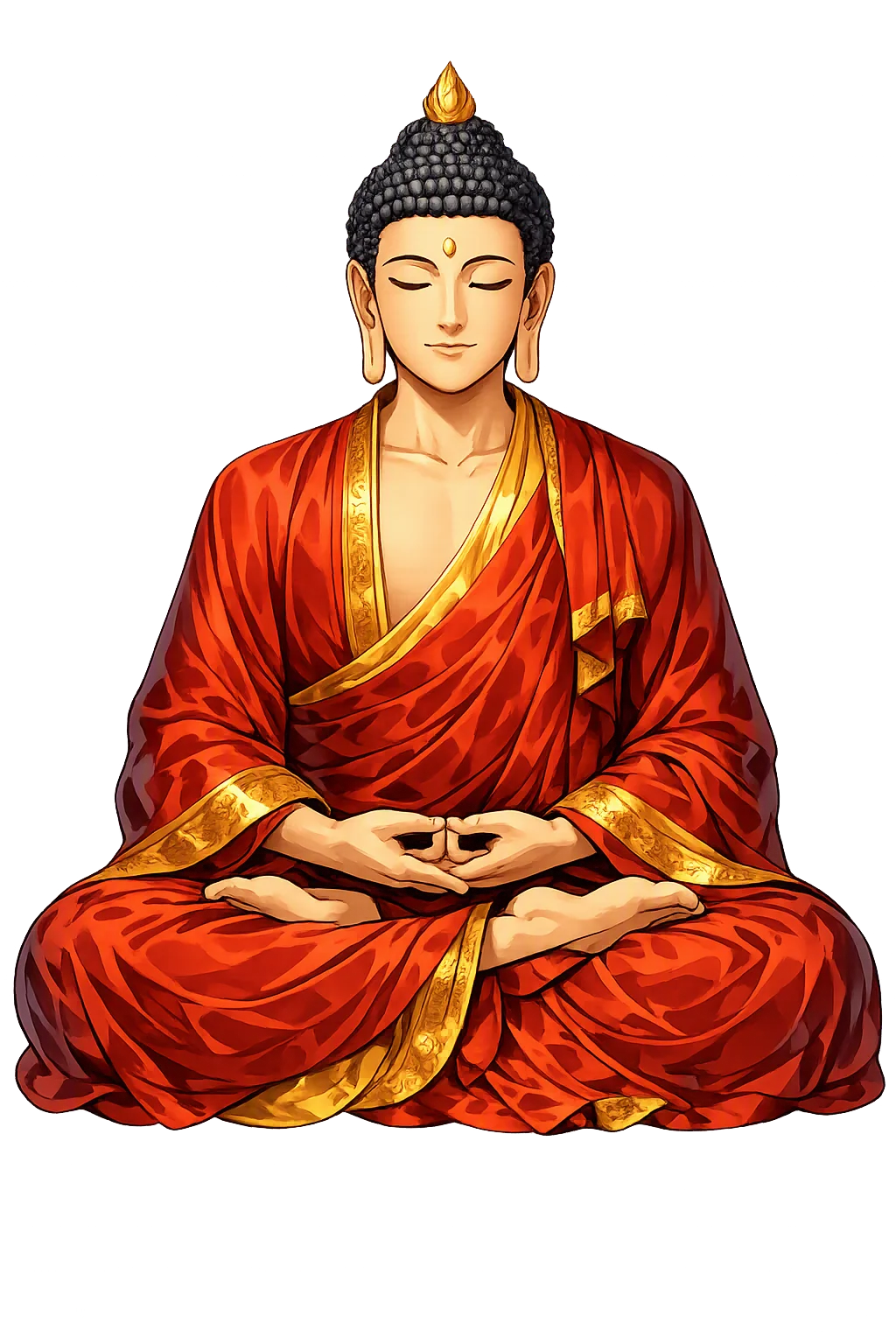
Stories of Amida
Amida's mythology runs from the Indian vows of Dharmākara through Chinese translation into Japan's nenbutsu movement: the radical teaching that calling the Buddha's name with faith is itself the path. His stories are devotional rather than epic — vows, recitations, and descents — and they reshaped how Japan faced death.
In the Larger Sukhāvatīvyūha Sūtra the Buddha tells how, in an inconceivably remote past, the monk Dharmākara knelt before the Buddha Lokeśvararāja and set himself a task no being had dared: to survey every Buddha-field in the ten directions, gather the best of each, and build from them a single land where no one who trusted him would fail to reach enlightenment. After five aeons of contemplation he pronounced forty-eight vows. The eighteenth — the Primal Vow (hongan) — promises that anyone who, with sincere entrusting, desires rebirth in his land and calls his name even ten times will be born there. Dharmākara then practiced for countless kalpas until the vows stood fulfilled, and he became Amida, whose Sukhāvatī lies to the west like a shore beyond every storm. The sūtra's logic is startling: enlightenment is not climbed but received, because someone else finished the climbing first.
By the twelfth century the Tendai establishment taught that every practice could lead to awakening — and therefore, argued the monk Hōnen, none was being done wholeheartedly by ordinary people mired in the latter days of the Dharma. In 1198 he set down his answer in the Senchakushū: select the one practice the Buddha himself had promised would suffice — the nenbutsu, the calling of Amida's name, Namu Amida Butsu — and let every other good act adorn it rather than compete with it. His disciples carried the teaching from the capital to the fishing villages, until peasants and soldiers who had never read a sūtra were reciting the Buddha's name in fields and on battlefields. The authorities proscribed the movement in 1207 and exiled Hōnen, but the nenbutsu had already escaped every gate: the single practice made the highest path the commonest road.
Hōnen's disciple Shinran pushed the nenbutsu one step further — and into a new religion. If salvation depended on Amida's Primal Vow, then even the recitation must be the Buddha's own working through the believer; even faith was a gift, not an achievement. The saying attributed to him in the Tannishō became the movement's signature: even the good person attains birth in the Pure Land, how much more so the evil person — because the good still secretly trust their own goodness, while the evil have nothing left to trust but the vow. Driven from Kyoto and settled among the peasants of Kantō, Shinran married, raised a family, and wrote the Kyōgyōshinshō in huts and borrowed halls, founding what became Jōdo Shinshū, Japan's largest Buddhist school. The scandal of his teaching is its mercy: it works precisely for those the other paths screen out.
The myth Amida's devotees painted most is the raigō — the Welcoming Descent: on clouds, flanked by Kannon and Seishi, Amida comes down to meet the dying, and deathbed practice aimed every sense toward that arrival. Temple legends gave the descent a mischievous edge. Zenkōji's own tradition (Zenkōji engi) tells that when a summons came from the retired emperor in Kamakura, the temple's Amida image rose at night and set off eastward; the abbot Eikan chased it through the dark and caught hold of it, but the Buddha slipped from his arms — and only the head remained, the body going on to Kamakura, leaving Zenkōji the Eikanbetsu Amida, a face without a body eternally gazing east. A Buddha who refuses to stay put is the legend's whole point: Amida is bound to no temple, because his vow already covers every deathbed.
Pure Land, Faith, and the Promise of Rebirth
Amida is the Japanese face of Amitābha, the Buddha whose immeasurable light built a pure land in the west. For over a thousand years his name has been Japan's most repeated prayer — Namu Amida Butsu — and the promise behind it is radical: even those crushed by karma they cannot undo can be born in his Pure Land and attain enlightenment.
His name — Amida, from Sanskrit Amitābha — is itself the first teaching: light with no edge, dissolving the karma-darkness of beings.
The Land of Bliss in the west: jeweled ponds and gold trees, where birth in a lotus guarantees the path to Buddhahood.
Hōnen (Senchakushū, 1198) and Shinran (Kyōgyōshinshō) taught that a single recitation, taken on faith, is the working of the vow itself.
Raigō painting: Amida descends on clouds with Kannon and Seishi — the deathbed vision of medieval Japan, from temple murals to death registers.
From the original script to the living URL
阿弥陀
The name in its original Japanese form. Amida (阿弥陀) is attested in the source tradition — “Immeasurable light”. Its original diacritics and script distinctions carry the full phonetic and orthographic weight of the source tradition.
amida
The plain amida form is identical to the Unicode restoration. Because this name is already written in Latin letters, no diacritics, stress, or script information were lost — only capitalization differs.
Amida
The Unicode restoration does not need to recover lost marks for Amida. Its value is canonical spelling and consistent cataloguing, not the reconstruction of erased orthography. The domain is readable as-is to both DNS and humanity.
Amida.com
This restoration is written entirely in ASCII letters — no Punycode encoding stands between Amida and the DNS. The domain reads identically to machines and to human eyes.
Owned, ideal, and ASCII forms of Amida
Amida
Restores 阿弥陀. The full Unicode restoration. amida.com is not in the PuniCodex collection — it is watched for release; if it drops, this temple upgrades to an owned flagship.
How Amida was spoken
How Amida is preserved in writing
A bespoke provenance study for Amida is being prepared by the PUNICODEX scholarly team.
Contribute scholarly provenance →The lore you have read is the living myth. Extended Lore opens the scholarly vault beneath it: the cult and its material remains, a history of the image, the name after antiquity, a meditation on what the name still means, and the full scholarly apparatus — etymology, orthography, sources.
Enter Extended Lore