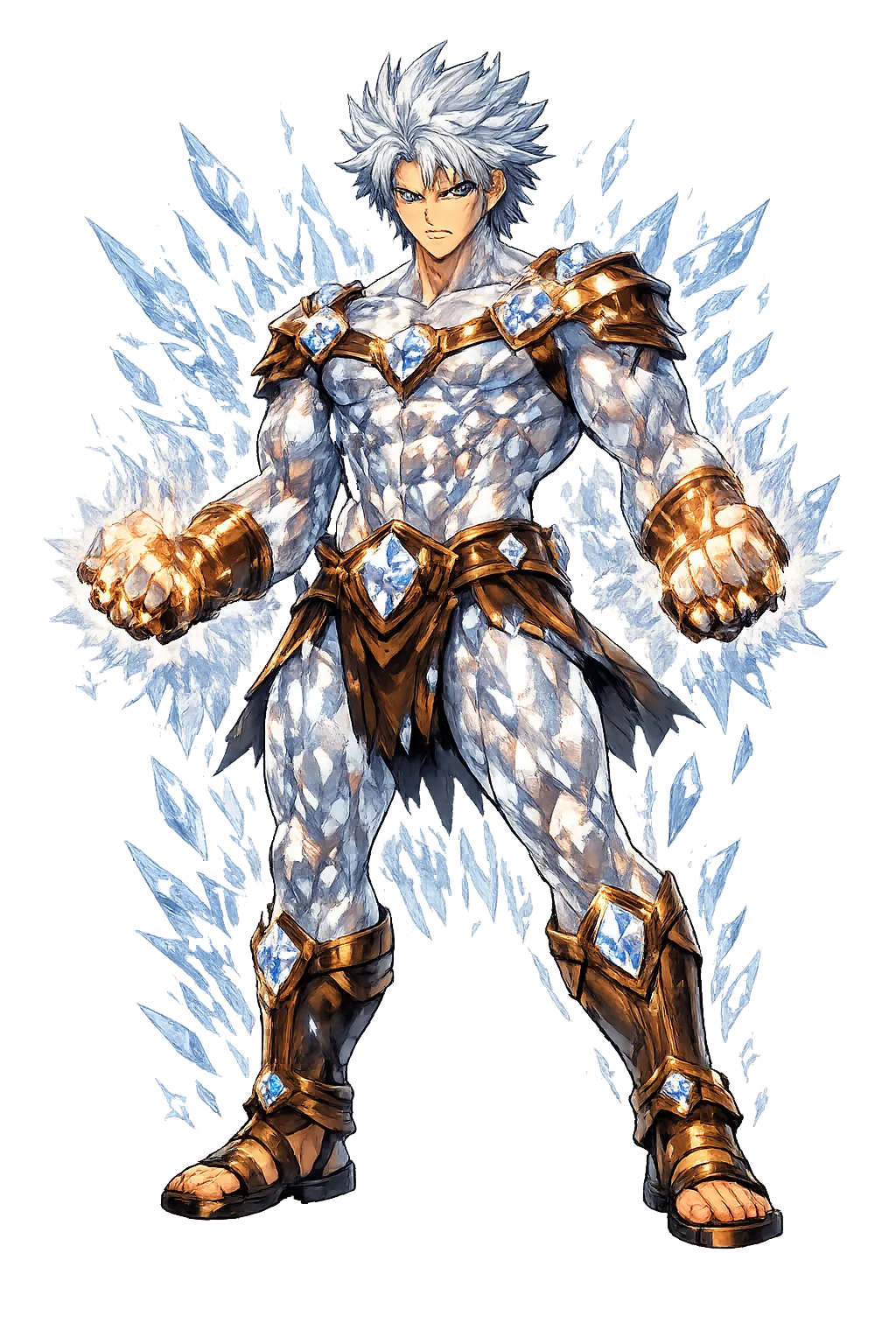
Stories of Adámas
Adámas appears in Greek myth not as a character but as a substance that binds, wounds, or pivots the cosmos itself. Its hardness creates the drama: what can hold an immortal must be stronger than the divine. From the sickle that cuts the sky to the spindle that turns the heavens, the unbreakable metal marks the exact points where Greek imagination needed something stronger than god.
Gaia, weary of Ouranos pressing down upon her and hiding their children inside her depths, fashioned a plan and set her youngest, Kronos, to ambush his father. She made a great long sickle with jagged teeth — of adamant, ἅρπη ἀδάμαντος (Hesiod, Theogony 161) — and bade Kronos wait in a hidden place. When Ouranos came at night, 'stretched all over Gaia, desiring love,' Kronos reached out with his left hand and swung with his right, severing his father's genitals and hurling them behind him. From the blood that fell on the earth were born the Erinyes, the great Giants, and the Meliai; from the sea-foam where they landed, Aphrodite (Theogony 173–192). Adamant matters here because the myth needs a material harder than the sky: only the unbreakable can break the original order. The word appears at the exact hinge where cosmic succession — and all Greek generation — begins.
Aeschylus opens Prometheus Bound at the edge of the world, where Hephaistos, ordered by Strength and Force, must rivet the rebel Titan to the crags of the Caucasus. His bonds are adamantine — the material whose name means 'unconquerable' — and Hephaistos grieves as he works: his own craft, the fire he gave the world, is being turned to chain the god who gave it to men. The cosmology behind the image is already in Hesiod (Theogony 521–616): Zeus bound Prometheus in indissoluble fetters and set an eagle to tear his liver, because the Titan had tricked him over the sacrifice and stolen the fire. But Aeschylus sharpens the metal's meaning: adamant is not merely strong — it is the substance of the new regime, the hardness of power that will not negotiate, set against a mind that will not yield. The chains hold. The argument, Prometheus insists, will outlast them.
In the great myth that closes Plato's Republic (616b–617d), the soul journeys beyond the heavens and sees the cosmos from outside: a column of light binding the sky together, and Necessity — Anankē — enthroned, with her daughters the Fates, turning the spindle that carries the whorls of the planetary spheres. 'The shaft and the hook of the spindle were of adamant,' Plato writes, while the great whorl mixed adamant with other materials. Adamant is the chosen metal of the world's axis: harder than anything the heavens contain, it alone is fit to be the pivot on which every sphere, every fate, every mortal life visibly turns. The choice is philosophically deliberate. The cosmos is not held up by Zeus's strength but by something stronger — a fixed, unyielding order that even the gods must revolve around. Through the later Platonists, and through Boethius, the image became canonical: fate turns on an adamantine hinge.
For the ancient naturalists adamas was not only a poetic metal but a real substance — and an infuriating one. Pliny devotes a long entry to it (Natural History 37.61–65): a small, dark, impregnable stone that no anvil survives, that resists fire and hammer alike, and that some said could be split only by soaking it in goat's blood. Pliny's account is a museum of marvels and errors, but its testimony is decisive for the word's history: by the first century CE, adamas had drifted from 'unbreakable metal' toward 'hardest known stone' — the ancestor, through Latin adamas, Vulgar Latin *diamantem, and Old French diamant, of the English diamond. The lapidary tradition then laid a moral on the mineral: like faith, the true stone cannot be crushed. The myth of the stone that breaks its tools outlived the tools — modern mineralogy still measures every material against diamond, adamas's direct heir, on the Mohs scale.
Invincible Substance, Obdurate Will, Philosophical Symbol
Adámas is the Greek word for the hardest, most untamable substance — the adamant. In Homer it is the metal of chains that bind even gods; in later philosophy it becomes a metaphor for an unyielding soul. The word carries no cult of its own, yet it cuts across Greek literature as the image of absolute resistance.
The hardest material known to Greek poets; used for chains, weapons, and the unbreakable core of things.
In Homer and tragedy, adamantine fetters hold Prometheus, Ares, and other immortals fast.
Philosophers from Plato to the Stoics use adámas as an image of an unconquerable mind.
The medieval and modern word 'diamond' descends from this Greek root, preserving its brilliance and hardness.
From the original script to the living URL
ἀδάμας
The name in its original Greek form. Adámas (ἀδάμας) is attested in the source tradition — “Unbreakable; the adamant; the hardest substance; origin of "diamond"”. Its acute accents carry the full phonetic and orthographic weight of the source tradition.
adamas
Reduced to plain adamas, the name loses everything that made it specific: acute accents. What remains is an ASCII string that machines can parse but that no longer speaks with its original voice.
Adámas
The Unicode restoration recovers what ASCII flattened. Adámas restores acute accents, returning the name to its original written dignity. The domain encodes to Punycode, but the browser displays the truth.
Adámas.com → xn--admas-yqa.com
The non-ASCII characters in Adámas are encoded while the ASCII remains visible. To the DNS, it is Punycode. To humanity, it is Adámas.
Owned, ideal, and ASCII forms of Adámas
Adámas
Restores ἀδάμας. The live temple domain — adámas.com.
adamas
Flattens ἀδάμας. The plain ASCII fallback — what DNS and legacy systems see.
How Adámas was spoken
How Adámas is preserved in writing
A bespoke provenance study for Adámas is being prepared by the PUNICODEX scholarly team.
Contribute scholarly provenance →The lore you have read is the living myth. Extended Lore opens the scholarly vault beneath it: the cult and its material remains, a history of the image, the name after antiquity, a meditation on what the name still means, and the full scholarly apparatus — etymology, orthography, sources.
Enter Extended Lore