PuniCodex

Extended Lore

Tāne

Etymology · Phonology · Orthography · Cultural Legacy · Primary Sources

Tier 1 Tāne.com
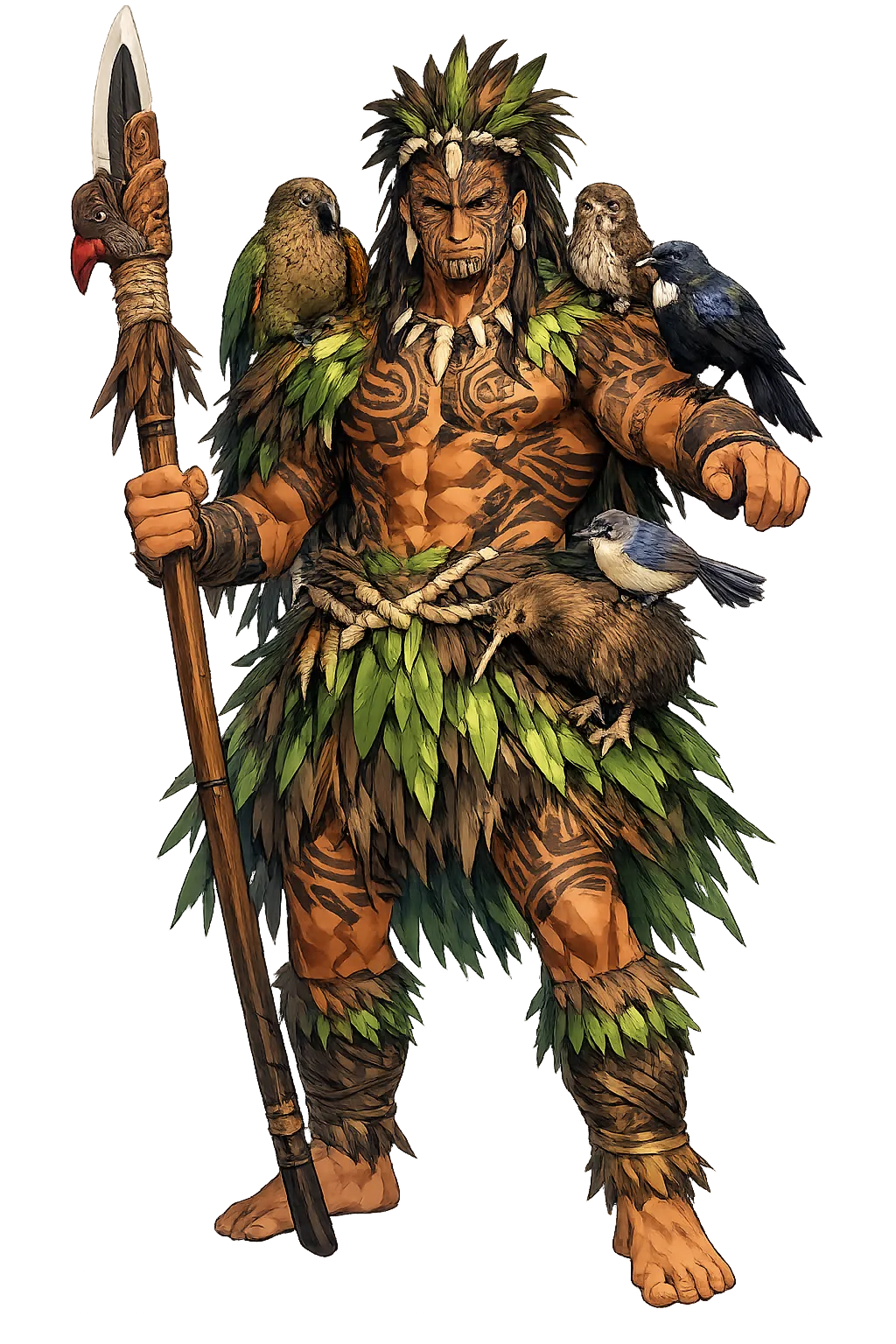
Tāne — Forests, Birds, First Man
01

Quick Facts

Essential information about Tāne, Forests, Birds, First Man

Scholarly TransliterationTāne
Unicode RestorationTāne
Reconstructed Pronunciation/ˈtaː.ne/
PantheonPolynesian
DomainForests, Birds, First Man
MeaningMan (from Proto-Polynesian *tane)
ClassificationTier 1
Primary DomainTāne.com
Sacred SymbolsKauri tree, Birds and feathers, Red clay, The three baskets of knowledge
02

Etymology & Word Family

From original script to Unicode restoration

Proto-polynesian *tane Man
Scholarly Transliteration Tāne Tāne — "Man (from Proto-Polynesian *tane)"
Unicode Restoration Tāne Restored stress, length, and script
Modern ASCII tane Plain-ASCII fallback

Tāne is one of the simplest and oldest theonyms in the corpus: a Proto-Polynesian common noun for 'man' or 'male' elevated to divine status. The macron on ā marks the long vowel that distinguishes the name in Māori. Tier 1: the single long vowel is the distinctive prosodic feature preserved in the Unicode restoration.

03

Unicode Character Breakdown

Character-by-character philological analysis

CharacterUnicodeNameBlockPhonetic Role
TU+0054Latin Capital Letter TBasic LatinSame
āU+0101Latin Small Letter A with MacronLatin Extended-AMacron: long /aː/
nU+006ELatin Small Letter NBasic LatinSame
eU+0065Latin Small Letter EBasic LatinSame

The Tier 1 classification reflects which ancient features stress, length, or script are preserved in this restoration.

04

Cultural Significance

From ancient cult to modern Unicode

Ancient Domain

Tāne is the forest made conscious, the bird made ancestor, and the man made god. In Māori cosmology he is the child who separated earth and sky, the father of humankind who shaped the first woman from clay, and the lord of every tree and winged thing. He stands at the axis of nature and culture, the one who makes space for life by pushing upward.

Tāne in Later Traditions

Tāne has cognates across Polynesia, including the Hawaiian Kāne, the Tahitian Tane, and the Tongan Tangaloa in overlapping roles as creator and sky-related deity. The precise distribution of attributes varies by island group. In Māori tradition, Tāne absorbed the forest and bird domains that other Polynesian cultures assigned to different figures. Contemporary Māori spirituality, environmentalism, and the arts frequently invoke Tāne-mahuta as a symbol of the living forest and indigenous ecological knowledge.

Modern Legacy

Tāne is one of the most widely known Māori deities, especially through the famous kauri tree named Tāne Mahuta in Waipoua Forest, a major tourist and spiritual site. His image appears in carving, painting, dance, and environmental advocacy throughout Aotearoa. The story of the separation of Rangi and Papa is taught in schools as a founding narrative, and Tāne's quest for knowledge informs contemporary discussions of Māori education and intellectual tradition. He has become an emblem of the living forest in an age of deforestation and climate change.

Unicode Restoration as Cultural Act

Restoring Tāne in a domain name is more than orthographic accuracy. It is a statement that the internet should recognize the full range of human writing — not only the ASCII keyboard.

05

Frequently Asked Questions

Common questions about Tāne, Forests, Birds, First Man, and Unicode restoration

01How do you pronounce Tāne?

In reconstructed pronunciation, Tāne is /ˈtaː.ne/ — approximately 'TAH-neh' — hold the first vowel long, keep the t soft and unaspirated, and pronounce the final e as a clear 'eh.'.

02What does Tāne mean?

Tāne means Man (from Proto-Polynesian *tane) in the polynesian tradition.

03What are the symbols of Tāne?

Tāne is associated with Kauri tree (The great forest tree most closely identified with Tāne-mahuta, the lord of the forest), Birds and feathers (Creatures of the forest canopy and markers of sacred prestige, especially the huia and kiwi), Red clay (The substance from which Tāne shaped the first woman, Hineahuone), The three baskets of knowledge (The repositories of ritual, memory, and cosmic understanding brought down from the heavens).

04Why restore Tāne in Unicode?

Plain ASCII tane strips the stress, length, and script that make the name specific. Unicode restoration returns the name to its original written dignity.

05What is the most important myth about Tāne?

Born in the darkness between Ranginui and Papatūānuku, Tāne and his brothers longed for light and space. While Tū urged violence, Tāne turned onto his back and pressed his feet against Ranginui, pushing the sky upward. The parents were separated, and the world was born in the space between them. Ranginui wept tears of rain; Papatūānuku's mist rose to meet him. (Grey, Polynesian Mythology.)

06

Scholarly Sources

The philological foundations of this restoration

Every claim on this page is grounded in established scholarship. The orthographic restorations follow disciplinary convention. The etymological chain follows the best available reference works. This is not invention — it is resurrection through scholarship.

Lexicography & Philology

  • Tregear

Primary Texts

  • Primary sources in the polynesian tradition for Tāne.

Archaeology & Art History

  • Material evidence — iconography, inscriptions, and temple archaeology — for Tāne and related cults.
  • As with Papatūānuku, Tāne's primary preservation is oral and environmental rather than monumental. The Waipoua kauri forest in Northland contains Tāne Mahuta, one of the largest and oldest living kauri trees, which has become a natural shrine. Māori wharenui (meeting houses), waka taua (war canoes), and carvings invoke Tāne-mahuta through imagery of trees and birds. Nineteenth-century written records by Grey, Best, Smith, and others are the principal textual witnesses to his mythology.

Religious Studies

  • Grey, Polynesian Mythology
  • Tregear, The Maori-Polynesian Comparative Dictionary
  • Best, Maori Religion and Mythology
  • Smith, The Lore of the Whare-wananga
  • Buck (Te Rangi Hiroa), The Coming of the Maori
  • Orbell, The Illustrated Encyclopedia of Maori Myth and Legend
  • Māori Marsden, The Woven Universe
Return

The Surface Awaits

You have traced the name from its earliest attestation to its Unicode restoration. Now return to the myth. The story is where the name lives.

Back to Lore
Tāne mascot