
Ancient Domain
In the sanskrit tradition, Śiva governed destruction, transformation, dance. The name encodes a sphere of power that shaped ritual, narrative, and social order.
Extended Lore
Etymology · Phonology · Orthography · Cultural Legacy · Primary Sources
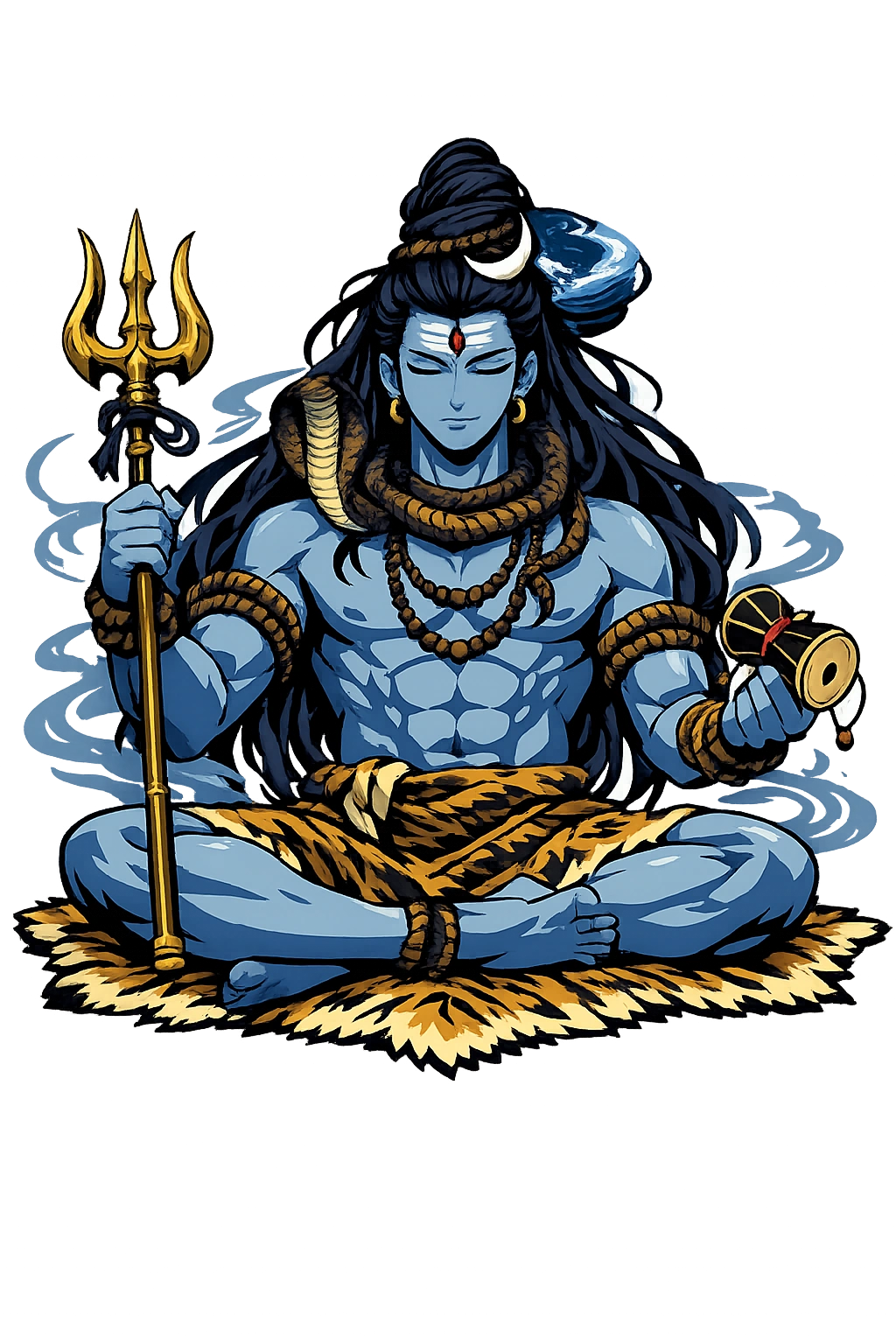
Essential information about Śiva, Destruction, Transformation, Dance
From original script to Unicode restoration
Śiva is Tier 2: the acute on Ś marks the palatal sibilant [ɕ], a sound distinct from both English 'sh' and Sanskrit retrophalatal ṣ. Sanskrit stress is pitch-accent based and not marked here; the acute is used to flag the palatal character of the initial sibilant.
Character-by-character philological analysis
| Character | Unicode | Name | Block | Phonetic Role |
|---|---|---|---|---|
| Ś | U+015A | Latin Capital Letter S with Acute | Latin Extended-A | S-acute: palatal /ɕ/ |
| — | N/A | Dropped character | Sanskrit orthography | Dropped: digraph simplified |
| i | U+0069 | Latin Small Letter I | Basic Latin | Short /i/ |
| v | U+0076 | Latin Small Letter V | Basic Latin | Same |
| a | U+0061 | Latin Small Letter A | Basic Latin | Short /a/ |
The Tier 2 classification reflects which ancient features stress, length, or script are preserved in this restoration.
From ancient cult to modern Unicode
In the sanskrit tradition, Śiva governed destruction, transformation, dance. The name encodes a sphere of power that shaped ritual, narrative, and social order.
Śiva absorbed and was absorbed by countless regional deities across South Asia and beyond. In Kashmir he became the focus of sophisticated monistic theology; in Tamil country he was the beloved of the Nāyaṉār poets; in Nepal and Tibet he entered tantric Buddhist pantheons as fierce protectors. Southeast Asian kingdoms from Champa to Angkor adopted Śaiva cult as a source of royal legitimacy, and his phallic liṅga became one of the most widespread aniconic emblems in Hindu worship.
The name endures in place names, scholarly vocabulary, modern fiction, and the ongoing recovery of ancient Greek culture through archaeology and philology. Restoring Śiva in Unicode preserves the name's cultural specificity against the flattening force of plain ASCII. Śiva is one of the most widely depicted and worshipped deities in the Hindu world, his image reproduced in temples, prints, and digital media across continents. The Unicode restoration honors the diacritics that signal his Sanskrit identity. The name Śiva, meaning 'auspicious' or 'kind,' also encompasses destruction as a creative necessity, a paradox central to Hindu theology. His dance is therefore not merely destruction but the rhythm by which illusion is dispelled and reality revealed.
Restoring Śiva in a domain name is more than orthographic accuracy. It is a statement that the internet should recognize the full range of human writing — not only the ASCII keyboard.
Common questions about Śiva, Destruction, Transformation, Dance, and Unicode restoration
In reconstructed pronunciation, Śiva is /ˈɕi.ʋə/ — approximately 'SHEE-vuh' — the first consonant is a sharp, high 'sh' made with the tongue near the hard palate, and the 'v' is light, almost like a 'w'..
Śiva means The auspicious one; the deity of destruction, transformation, and regeneration, the third member of the Hindu Trimūrti alongside Brahmā and Viṣṇu. in the sanskrit tradition.
Śiva is associated with Trishula (trident) (The three-pronged weapon representing Shiva's power to destroy evil and the three guṇas), Damaru drum (The hourglass drum whose beat creates and dissolves the cosmos), Third eye (The eye of wisdom that burned Kāma to ash and sees beyond illusion), Nandi bull (Shiva's vehicle and gatekeeper, the white bull of dharma), Rudrākṣa beads (The 'Rudra's-eye' seeds worn by devotees to concentrate Shiva's energy).
Each is a historically defensible restoration. Siva.com is the alt-stress form: Alternate transliteration: Siva.
Plain ASCII shiva strips the stress, length, and script that make the name specific. Unicode restoration returns the name to its original written dignity.
When the gods and demons churned the cosmic ocean in search of amṛta, the elixir of immortality, the first thing to rise was not nectar but Halāhala, a poison black enough to scorch every world. Creation began to suffocate. The gods fled to Śiva, who sat motionless on Kailāsa. Without hesitation he took the poison into his palm and drank it. Pārvatī pressed her hands against his throat to keep the toxin from descending, and it burned there forever, turning his neck blue. From that day he has been called Nīlakaṇṭha, the Blue-Throated One, the god who absorbs destruction so that life may continue.
The philological foundations of this restoration
Every claim on this page is grounded in established scholarship. The orthographic restorations follow disciplinary convention. The etymological chain follows the best available reference works. This is not invention — it is resurrection through scholarship.
You have traced the name from its earliest attestation to its Unicode restoration. Now return to the myth. The story is where the name lives.
Back to Lore