
Ancient Domain
Ọṣọọsì is the hunter orisha: lord of the forest, master of the bow, and patron of strategy — the one whose praise-poems say he kills with a single arrow, because he has learned what every hunter must learn: wait.
Extended Lore
Etymology · Phonology · Orthography · Cultural Legacy · Primary Sources
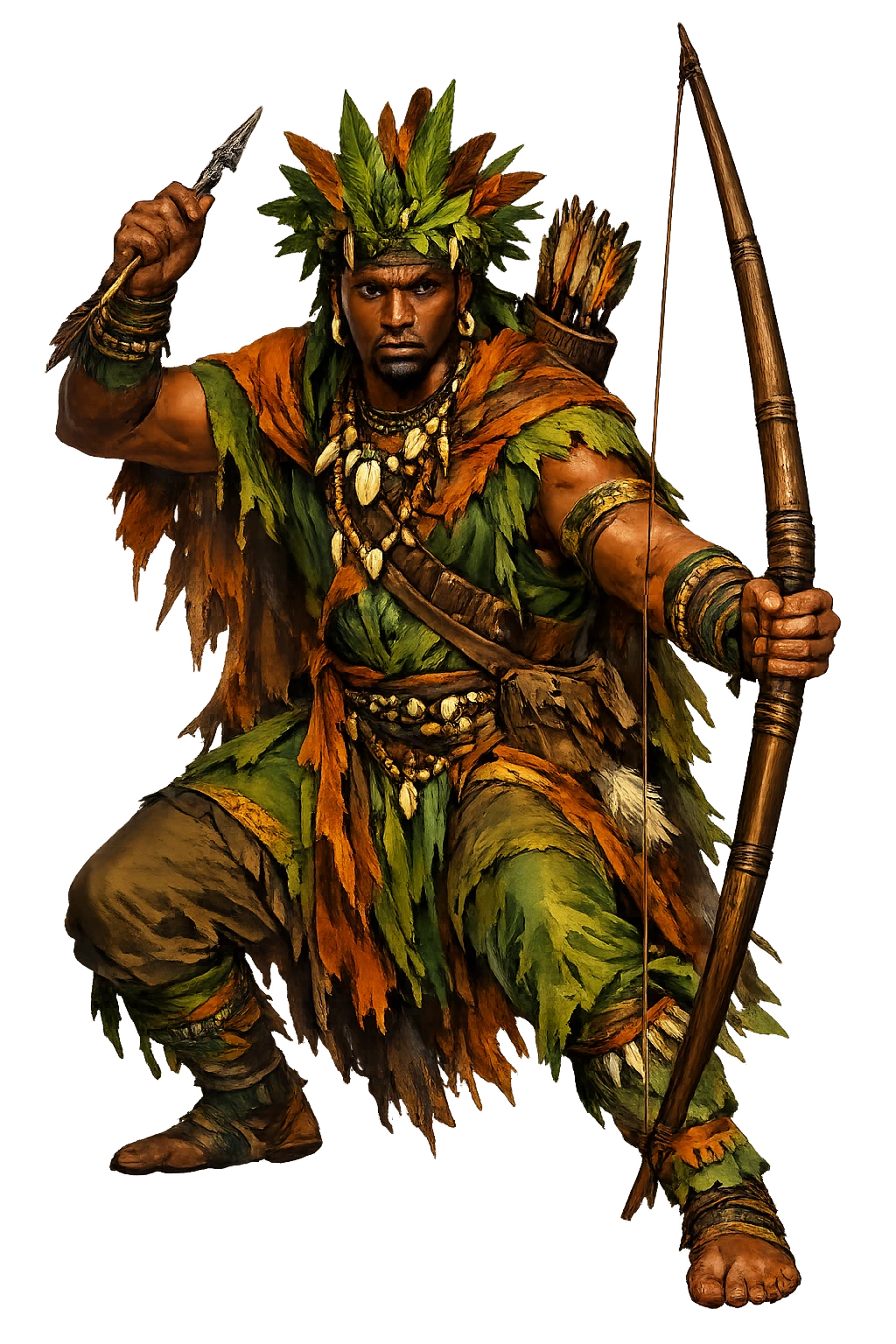
Essential information about Ọṣọọsì, Hunting, Forest, Justice
From original script to Unicode restoration
The name in standard Yoruba orthography is Ọ̀ṣọ́ọ̀sì, fully tone-marked; the owned form Ọṣọọsì keeps the underdotted vowels (ọ, the open o) and the long double-o while following the diaspora convention that leaves tone marks implicit — the spelling carried across the Santería and Candomblé worlds. Abraham's Dictionary of Modern Yoruba lists him as the god of hunters; the etymology is debated, though the ọ̀ṣọ́ element suggests swiftness. Tier-1 by rule: the underdots and the ṣ are distinctive letters the ASCII "Ochosi" cannot carry.
Character-by-character philological analysis
| Character | Unicode | Name | Block | Phonetic Role |
|---|---|---|---|---|
| Ọ | U+1ECC | Latin Capital Letter O with Dot Below | Unknown | O with dot below: open /ɔ/ |
| ṣ | U+1E63 | Latin Small Letter S with Dot Below | Unknown | S with dot below: /ʃ/ (Santería ch = Yoruba ṣ) |
| ọ | U+1ECD | Latin Small Letter O with Dot Below | Unknown | O with dot below: open /ɔ/ |
| ọ | U+1ECD | Latin Small Letter O with Dot Below | Unknown | O with dot below: open /ɔ/ |
| s | U+0073 | Latin Small Letter S | Basic Latin | Same |
| ì | U+00EC | Latin Small Letter I with Grave | Latin-1 Supplement | Grave: low tone |
The Tier 1 classification reflects how much of the original phonology this restoration preserves — stress and vowel length for Greek names, distinctive letters and diacritics for every other tradition.
From ancient cult to modern Unicode
Ọṣọọsì is the hunter orisha: lord of the forest, master of the bow, and patron of strategy — the one whose praise-poems say he kills with a single arrow, because he has learned what every hunter must learn: wait.
The diaspora rebuilt him with local materials and never lost the pattern. Cuba gave him the Guerreros and the courtroom; Brazil gave him São Sebastião's feast-day and the caboclos of Umbanda; Trinidad, Haiti, and the United States received the Lukumí lineages intact. Scholars from Bascom to Verger mapped the route: the Ketu nation's Oxóssi, the Oyo-heritage hunter, and the Yoruba Ọ̀ṣọ́ọ̀sì of Abraham's dictionary are one figure wearing three orthographies. His closest cousins abroad are the other divine hunters — but none of them shoots only once.
Ọṣọọsì is a living god, not a memory: his festivals still fill the terreiros of Bahia, his initiates still receive the Guerreros in Havana and Miami, and his oríkì are still sung in the tonal Yoruba that the written restoration tries to honor. The single arrow has become the tradition's own emblem of Afro-diasporic resilience — patience, precision, and provision against every odds. The spelling Ọṣọọsì keeps the marked vowels of the language the praise-poems were made in.
Restoring Ọṣọọsì in a domain name is more than orthographic accuracy. It is a statement that the internet should recognize the full range of human writing — not only the ASCII keyboard.
Common questions about Ọṣọọsì, Hunting, Forest, Justice, and Unicode restoration
In reconstructed pronunciation, Ọṣọọsì is /ɔ̀.ʃɔ́.ɔ̀.sì/ — approximately aw-shaw-AW-sih — the dotted ọ is the open 'aw' of 'law'; ṣ is 'sh'; the tones run low-high-low-low..
Ọṣọọsì means The hunter — orisha of the hunt, the forest, and deliberate strategy (standard Yoruba Ọ̀ṣọ́ọ̀sì; Cuban Ochosi, Brazilian Oxóssi) in the yoruba tradition.
Ọṣọọsì is associated with The bow and arrow (Skill married to patience: the whole doctrine of the hunt in one image), The forest (The realm of the provider — game, leaves, and the tests that make a tracker), The single shot (Strategy as worship: preparation so complete that one attempt suffices).
Each is a historically defensible restoration. Ọ̀ṣọ́ọ̀sì.com is the alt form: Standard Yoruba orthography, fully tone-marked.
Plain ASCII ochosi strips the stress, length, and script that make the name specific. Unicode restoration returns the name to its original written dignity.
His praise-poems are the hunt distilled: the oríkì greet Ọ̀ṣọ́ọ̀sì as the hunter who kills with a single arrow — the archer whose patience is so complete that the forest gives him what it denies the noisy and the hasty. In the Candomblé houses of Brazil the same idea opens his festivals: Oxóssi, rei das matas, king of the forest, the provider whose one shot feeds the whole town. The oríkì tradition is not ornament here; it is the liturgy of competence.
The philological foundations of this restoration
Every claim on this page is grounded in established scholarship. The orthographic restorations follow disciplinary convention. The etymological chain follows the best available reference works. This is not invention — it is resurrection through scholarship.
You have traced the name from its earliest attestation to its Unicode restoration. Now return to the myth. The story is where the name lives.
Back to Lore