PuniCodex

Extended Lore

女媧 Nǚwā

Etymology · Phonology · Orthography · Cultural Legacy · Primary Sources

Tier 1 Nǚwā.com
Nǚwā — Creation, Mending Heaven
01

Quick Facts

Essential information about Nǚwā, Creation, Mending Heaven

Original Script女媧
Unicode RestorationNǚwā
Reconstructed Pronunciation/ny˨˩˦ wa˥/
PantheonChinese
DomainCreation, Mending Heaven
MeaningWoman wa
ClassificationTier 1
Primary DomainNǚwā.com
Sacred SymbolsThe five colors, The compass, The turtle's legs
02

Etymology & Word Family

From original script to Unicode restoration

Original Script 女媧 Nǚwā — "Woman wa"
Unicode Restoration Nǚwā Restored stress, length, and script
Modern ASCII nuwa Plain-ASCII fallback

Nǚwā 女娲 bears the third tone on nǚ — the vowel ü written with its two dots, which the restoration keeps and plain ASCII drops. Wā is the level-toned archaic graph for this goddess alone: a character invented for her name, used for nothing else in the language. The ü is the front rounded vowel — the sound French writes u — which plain ASCII loses to plain u.

03

Unicode Character Breakdown

Character-by-character philological analysis

CharacterUnicodeNameBlockPhonetic Role
NU+004ELatin Capital Letter NBasic LatinSame, capitalized
ǚU+01DALatin Small Letter U with Diaeresis and CaronLatin Extended-BStress on u
wU+0077Latin Small Letter WBasic LatinSame
āU+0101Latin Small Letter A with MacronLatin Extended-ALong vowel

The Tier 1 classification reflects which ancient features stress, length, or script are preserved in this restoration.

04

Cultural Significance

From ancient cult to modern Unicode

Ancient Domain

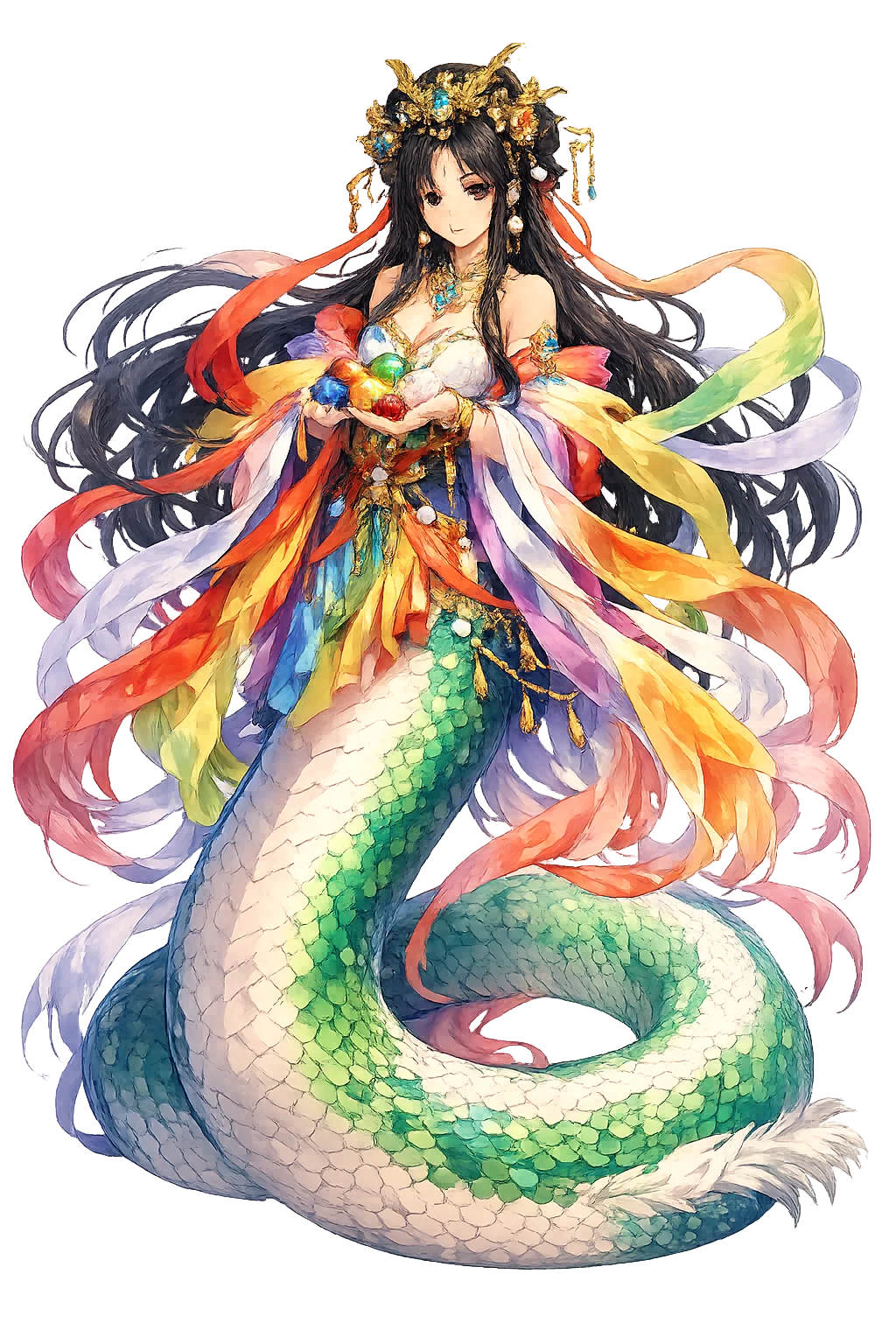
Nǚwā is the great repairer: the goddess who melted five-colored stones to patch the broken sky, cut off the giant turtle's legs to prop the corners of the world, and — on a quieter day — knelt by the Yellow River and made the first human beings out of mud.

Nǚwā in Later Traditions

She pairs with Fúxī as sister-wife in the Han synthesis — their intertwined serpent bodies, compass and square in hand, form the canonical image of cosmic order — and she absorbs older creation figures as the myth spread south and north. Modern readers note her kinship with every world-mother from Gaia to the Navajo Changing Woman, but the Chinese tradition keeps her distinct signature: she is not just a mother but a repairer, the goddess of maintenance.

Modern Legacy

Her stones became literature: the great novel Dream of the Red Chamber (Hónglóu mèng) opens with the one stone Nǚwā rejected for the sky — the stone that becomes the hero's jade and the book itself. "Nǚwā mends the sky" is the standing idiom for heroic repair; engineers, surgeons, and diplomats are all praised with it. Temples to her survive across North China — Shexian's cliff-hanging Wahuang Palace in Hebei is the grandest — where she is still prayed to for children.

Unicode Restoration as Cultural Act

Restoring Nǚwā in a domain name is more than orthographic accuracy. It is a statement that the internet should recognize the full range of human writing — not only the ASCII keyboard.

05

Frequently Asked Questions

Common questions about Nǚwā, Creation, Mending Heaven, and Unicode restoration

01How do you pronounce Nǚwā?

In reconstructed pronunciation, Nǚwā is /ny˨˩˦ wa˥/ — approximately nyoo-wah, low-dipping tone on Nǚ, high level on Wā..

02What does Nǚwā mean?

Nǚwā means Woman wa in the chinese tradition.

03What are the symbols of Nǚwā?

Nǚwā is associated with The five colors (The five phases (wood, fire, earth, metal, water) — the sky rebuilt in cosmic order), The compass (Her emblem in Han art, paired with Fúxī's square — heaven's measure in her hand), The turtle's legs (The four pillars she cut and set — sacrifice repurposed as architecture).

04Why restore Nǚwā in Unicode?

Plain ASCII nuwa strips the stress, length, and script that make the name specific. Unicode restoration returns the name to its original written dignity.

05What is the most important myth about Nǚwā?

The Huáinánzǐ tells it: in high antiquity the four pillars snapped, the nine provinces split; fire raged unquenched, waters rose undrained; fierce beasts devoured the people. Nǚwā melted stones of five colors to mend the azure sky, cut the legs of the great turtle to set the four pillars, slew the black dragon to save Jì province, and heaped reed-ashes to dam the flood. Then — and only then — the world was habitable, and the beasts went quiet.

06

Scholarly Sources

The philological foundations of this restoration

Every claim on this page is grounded in established scholarship. The orthographic restorations follow disciplinary convention. The etymological chain follows the best available reference works. This is not invention — it is resurrection through scholarship.

Lexicography & Philology

  • Shan Hai Jing
  • Chinese classics

Primary Texts

  • Primary sources in the chinese tradition for Nǚwā.

Archaeology & Art History

  • Material evidence — iconography, inscriptions, and temple archaeology — for Nǚwā and related cults.
  • The Wahuang Palace at Shexian — pavilions chained to a cliff above the Zhang River, founded in the Northern Qi dynasty (6th century) — is her principal surviving sanctuary and one of China's architectural marvels. Han pictorial stones pair her with Fúxī from Shandong to Sichuan; the Astana cemetery silk banner carried the image to the Silk Road's far end. Her myth's textual strata are mapped from the Huáinánzǐ (139 BCE) backward into Warring States fragments and forward into the Tang flood-cycle accounts.

Religious Studies

  • Huainanzi
  • Birrell
  • Shiji
  • Shan Hai Jing
  • Chinese classics
  • Chinese folklore
Return

The Surface Awaits

You have traced the name from its earliest attestation to its Unicode restoration. Now return to the myth. The story is where the name lives.

Back to Lore
Nǚwā mascot