PuniCodex

Extended Lore

मञ्जुश्री Mañjuśrī

Etymology · Phonology · Orthography · Cultural Legacy · Primary Sources

Tier 1 Mañjuśrī.com
Mañjuśrī — Wisdom, Intellect
01

Quick Facts

Essential information about Mañjuśrī, Wisdom, Intellect

Original Scriptमञ्जुश्री
Unicode RestorationMañjuśrī
Reconstructed Pronunciation/mɐɲ.ˈdʑu.ɕriː/
PantheonBuddhist
DomainWisdom, Intellect
MeaningGentle glory
ClassificationTier 1
Primary DomainMañjuśrī.com
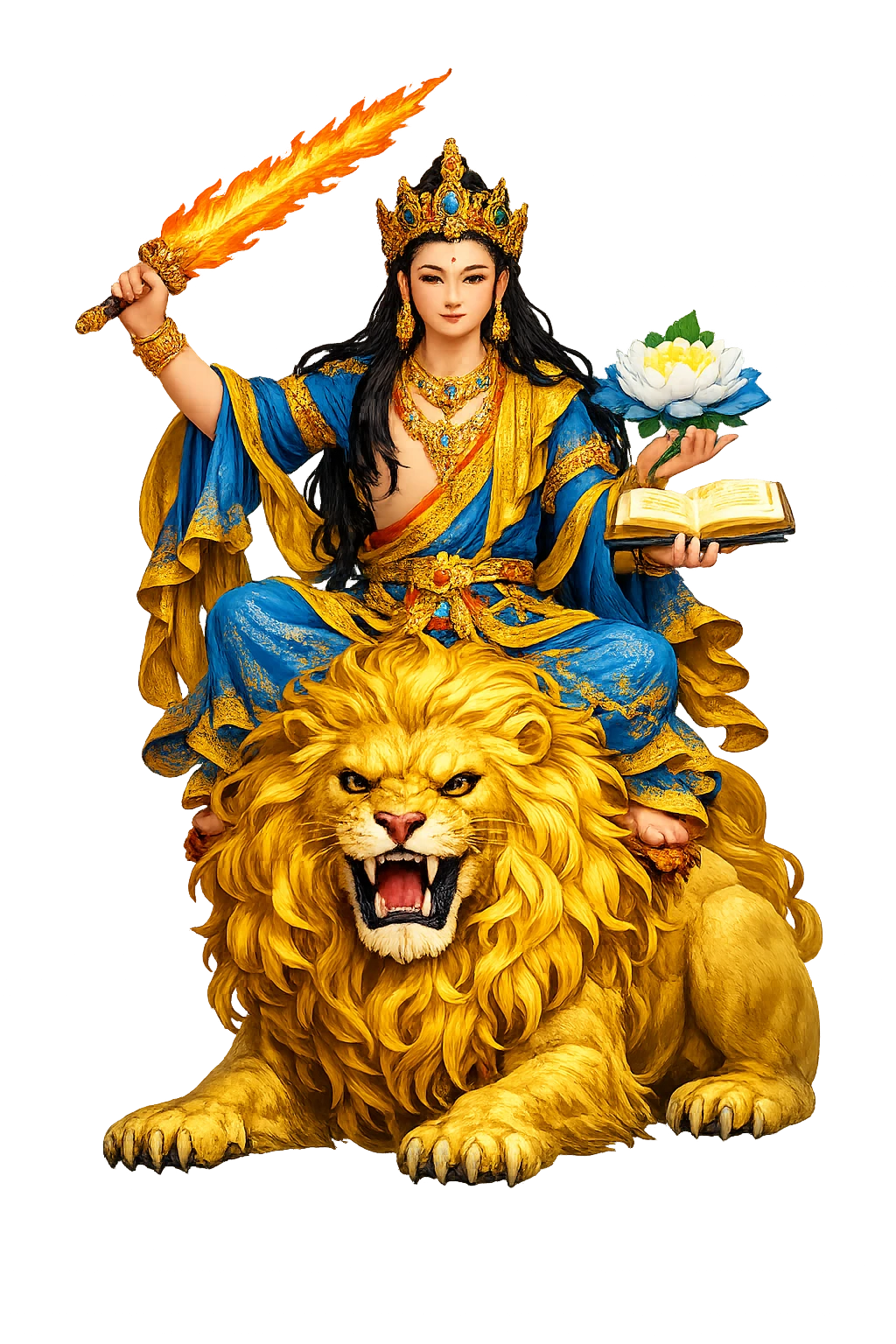
Sacred SymbolsThe flaming sword, The blue lotus and the book, The seed syllable Dhīḥ
02

Etymology & Word Family

From original script to Unicode restoration

Original Script मञ्जुश्री Mañjuśrī — "Gentle glory"
Unicode Restoration Mañjuśrī Restored stress, length, and script
Modern ASCII manjushri Plain-ASCII fallback

Mañjuśrī is a compound: mañju, "gentle, sweet, lovely," + śrī, "glory, splendor" (Monier-Williams) — "the Gentle Glory." His other names are a litany of the same music: Mañjughoṣa, "Gentle Voice"; Vāgīśvara, "Lord of Speech." The restoration keeps the palatal ñ, the ś, and the long ī; the ASCII "Manjushri" loses all three. Tier-1 by rule: three distinctive letters preserved.

03

Unicode Character Breakdown

Character-by-character philological analysis

CharacterUnicodeNameBlockPhonetic Role
MU+004DLatin Capital Letter MBasic LatinSame, capitalized
aU+0061Latin Small Letter ABasic LatinSame
ñU+00F1Latin Small Letter N with TildeLatin-1 SupplementStress on n
jU+006ALatin Small Letter JBasic LatinSame
uU+0075Latin Small Letter UBasic LatinSame
śU+015BLatin Small Letter S with AcuteLatin Extended-ASpecial character
N/ADropped characterBuddhist orthographyDropped
rU+0072Latin Small Letter RBasic LatinSame
īU+012BLatin Small Letter I with MacronLatin Extended-ALong vowel

The Tier 1 classification reflects how much of the original phonology this restoration preserves — stress and vowel length for Greek names, distinctive letters and diacritics for every other tradition.

04

Cultural Significance

From ancient cult to modern Unicode

Ancient Domain

Mañjuśrī is the bodhisattva of transcendent wisdom: the ever-youthful prince who raises the flaming sword that cuts ignorance and bears the book of the Perfection of Wisdom on a blue lotus — the mind of every Buddha made visible as a sixteen-year-old with a blade.

Mañjuśrī in Later Traditions

He is the most portable of the great bodhisattvas: Wénshū in China, Monju in Japan, 'Jam dpal in Tibet — and in Tibet his cult became inseparable from scholarship itself, Tsongkhapa venerated as his emanation and the Mañjuśrīnāmasaṃgīti, "Chanting the Names of Mañjuśrī," recited as the daily liturgy of the monasteries; Wayman's translation made the text a classic in the West. With Avalokiteśvara and Vajrapāṇi he forms the lords of the three families — wisdom, compassion, and power — the triad painted over a thousand Himalayan doorways. His sword-and-book traveled the sea routes as well: his images stand in the temples of Buddhist Java.

Modern Legacy

Mañjuśrī is the patron saint of students across half the world: Himalayan children still have the syllable Dhīḥ traced on their tongues for a quick mind, and his Arapacana mantra is murmured before examinations from Ladakh to Lhasa. His iconography — sword in the right hand, book on the lotus at the left — is the universal Buddhist shorthand for the two halves of wisdom, cutting and knowing. Mount Wutai, his earthly seat, is a UNESCO landscape where a dozen languages still call on Wénshū.

Unicode Restoration as Cultural Act

Restoring Mañjuśrī in a domain name is more than orthographic accuracy. It is a statement that the internet should recognize the full range of human writing — not only the ASCII keyboard.

05

Frequently Asked Questions

Common questions about Mañjuśrī, Wisdom, Intellect, and Unicode restoration

01How do you pronounce Mañjuśrī?

In reconstructed pronunciation, Mañjuśrī is /mɐɲ.ˈdʑu.ɕriː/ — approximately mun-joo-SHREE — the ñ is the nasal of 'canyon'; śrī is one syllable, the 'sh' softened..

02What does Mañjuśrī mean?

Mañjuśrī means Gentle glory in the buddhist tradition.

03What are the symbols of Mañjuśrī?

Mañjuśrī is associated with The flaming sword (Discrimination that liberates: the cut that ends confusion, not the one that starts it), The blue lotus and the book (Wisdom as a text to be carried and a flower that opens by itself), The seed syllable Dhīḥ (The sound of insight itself, traced on children's tongues in the Himalaya).

04Why restore Mañjuśrī in Unicode?

Plain ASCII manjushri strips the stress, length, and script that make the name specific. Unicode restoration returns the name to its original written dignity.

05What is the most important myth about Mañjuśrī?

When the layman Vimalakīrti feigned illness to teach, every bodhisattva found an excuse not to visit — each remembered being corrected by him once. Mañjuśrī alone went, leading the whole assembly, and their exchange is the sūtra's summit: asked how a bodhisattva enters non-duality, Vimalakīrti answered Mañjuśrī's courtesy with silence, and Mañjuśrī pronounced the silence itself the teaching. It is the most famous consultation in Buddhist literature — the wisdom bodhisattva certifying that the highest truth declines to be phrased.

06

Scholarly Sources

The philological foundations of this restoration

Every claim on this page is grounded in established scholarship. The orthographic restorations follow disciplinary convention. The etymological chain follows the best available reference works. This is not invention — it is resurrection through scholarship.

Lexicography & Philology

  • Mahayana texts
  • Buddhist texts

Primary Texts

  • The Larger Sukhāvatī-vyūha Sūtra; the Smaller Sukhāvatī-vyūha Sūtra; the Amitāyurdhyāna Sūtra; the Lotus Sūtra.

Archaeology & Art History

  • Material evidence — iconography, inscriptions, and temple archaeology — for Mañjuśrī and related cults.
  • His mountain is the monument: Wǔtái shān preserves the Nanchan temple (782) and the Foguang temple's East Hall (857) — the two oldest surviving timber halls in China — on the terraces pilgrims have climbed for fifteen centuries. The Kathmandu valley keeps his founding stroke in stone and water: the Chobhar gorge through which the lake drained, and the Svayambhū stūpa on its hill, eyes painted and sword remembered. His certain images emerge in the early centuries CE and multiply along the Silk Road; by the Pāla period the sword-and-book type was fixed, and it has not changed since.

Religious Studies

  • Vimalakīrti Sūtra
  • Saddharmapuṇḍarīka Sūtra (Lotus Sūtra)
  • Mañjuśrīnāmasaṃgīti
  • Svayambhū Purāṇa
  • Wayman, Chanting the Names of Mañjuśrī
  • Conze
Return

The Surface Awaits

You have traced the name from its earliest attestation to its Unicode restoration. Now return to the myth. The story is where the name lives.

Back to Lore
Mañjuśrī mascot