The Authentic Orthography
Protection of Children, Travelers · Earth treasury
Unicode restoration and ASCII comparison
地蔵
The name in its original Japanese form. Jizō (地蔵) is attested in the source tradition — “Earth treasury”. Its macron-length vowels carry the full phonetic and orthographic weight of the source tradition.
jizo
Reduced to plain jizo, the name loses everything that made it specific: macron-length vowels. What remains is an ASCII string that machines can parse but that no longer speaks with its original voice.
Jizō
The Unicode restoration recovers what ASCII flattened. Jizō restores macron-length vowels, returning the name to its original written dignity. The domain encodes to Punycode, but the browser displays the truth.
Jizō.com → xn--jiz-sxa.com
The non-ASCII characters in Jizō are encoded while the ASCII remains visible. To the DNS, it is Punycode. To humanity, it is Jizō.
How Jizō travels from ancient script to the modern URL
Sanskrit kṣiti 'earth' + garbha 'womb, embryo, interior'; rendered into Chinese as 地藏 'earth store' and borrowed into Japanese as 地蔵.
Earth Treasury Bodhisattva; guardian of children, travelers, firefighters, and beings in hell.
The Unicode restoration Jizō preserves the long vowel; the kanji form is not registrable in .com.
How Jizō was spoken
Guardian of Children, Travelers, and the Dead
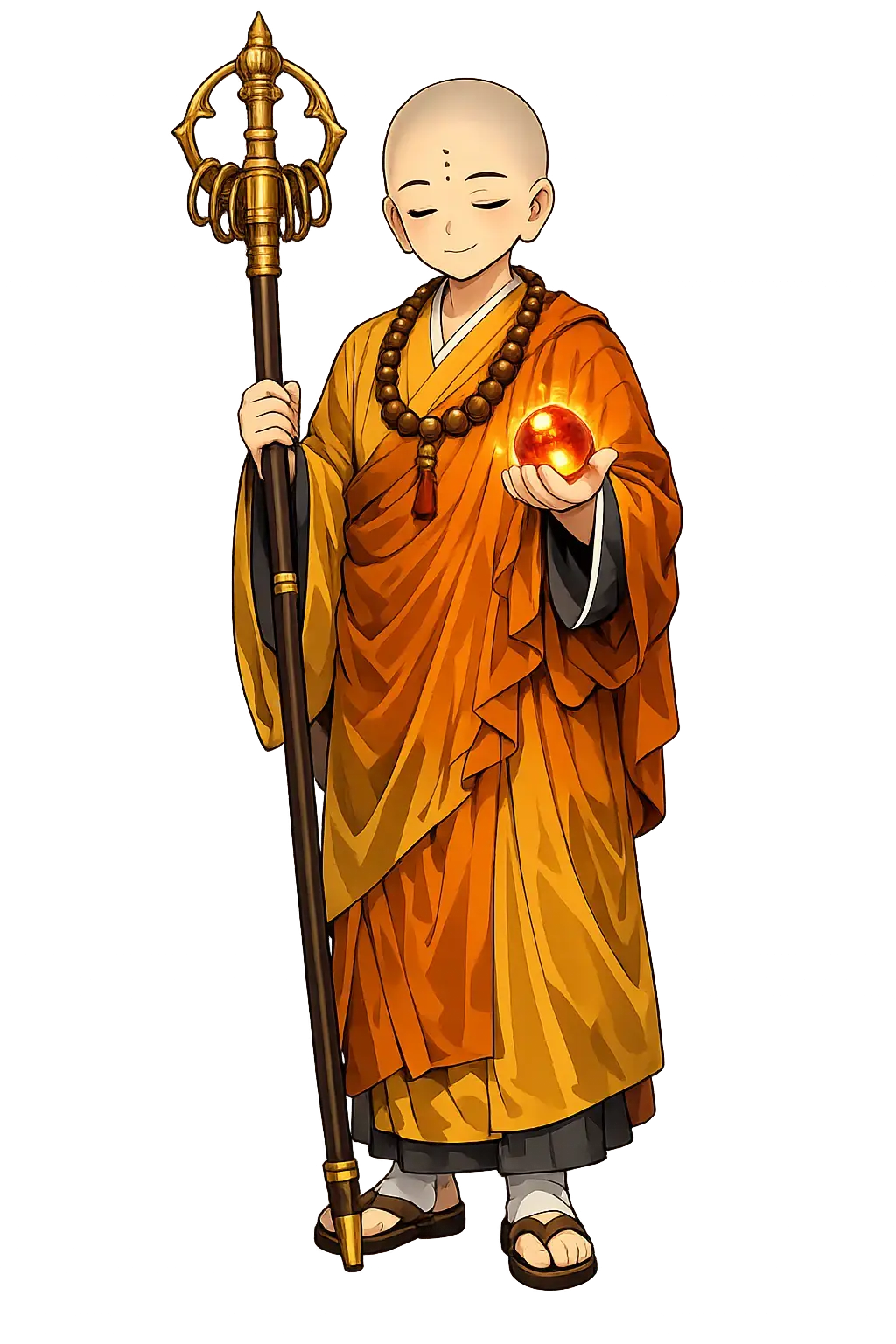
Jizō is the Bodhisattva Kṣitigarbha as known and loved in Japan: a gentle monk-like figure who refuses buddhahood until all beings, especially those in hell and the spirits of dead children, are saved. His statues stand by roadsides, cemeteries, and temples, clothed in red bibs and caps offered by grieving parents.
He protects children, including mizuko, the spirits of miscarried and aborted foetuses.
He descends into the hell realms to rescue those tormented by their karma.
Roadside Jizō guide and protect those on journeys, both living and dead.
He postpones his own enlightenment until every hell is emptied.
Stories of Jizō
Jizō's mythology blends Indian scripture, Chinese translation, and Japanese folk belief. He is one of the most actively worshipped Buddhist figures in Japan.
The Kṣitigarbha Sutra recounts that in a previous life the Bodhisattva was a Brahmin maiden whose mother had slandered the Dharma. After her mother's death, the daughter made offerings at a temple and was transported to hell, where she met a demon guardian. Moved by the suffering there, she vowed to save all beings in the hell realms, life after life, until not a single one remained.
On the banks of Sai no Kawara, the riverbed between life and rebirth, the souls of dead children are forced to pile stones as penance. Demons scatter their work, but Jizō appears in the guise of a monk to hide the children in his robes and comfort them. The red bibs and caps placed on his statues are gifts intended to warm these child-spirits.
Countless Japanese tales tell of a wandering monk who helps a traveller in distress, only to disappear, leaving behind a statue of Jizō. The stories encode a popular theology: Jizō is not distant in a pure land; he is present on the road, in the rain, at the crossroads where ordinary people lose their way.
Jizō is the Bodhisattva of refusal: he refuses to leave until everyone is safe. That sounds impossible, and it is. But the vow is not a plan; it is a posture. It says that the last and least worthy soul matters as much as the first enlightened one.
Enter Extended Lore