
Ancient Domain
Iānus has no Greek equivalent and no mythology of adventure: he is Rome's god of passages themselves — doors, bridges, beginnings, the month that opens the year. His two faces look both ways because every threshold faces two worlds.
Extended Lore
Etymology · Phonology · Orthography · Cultural Legacy · Primary Sources
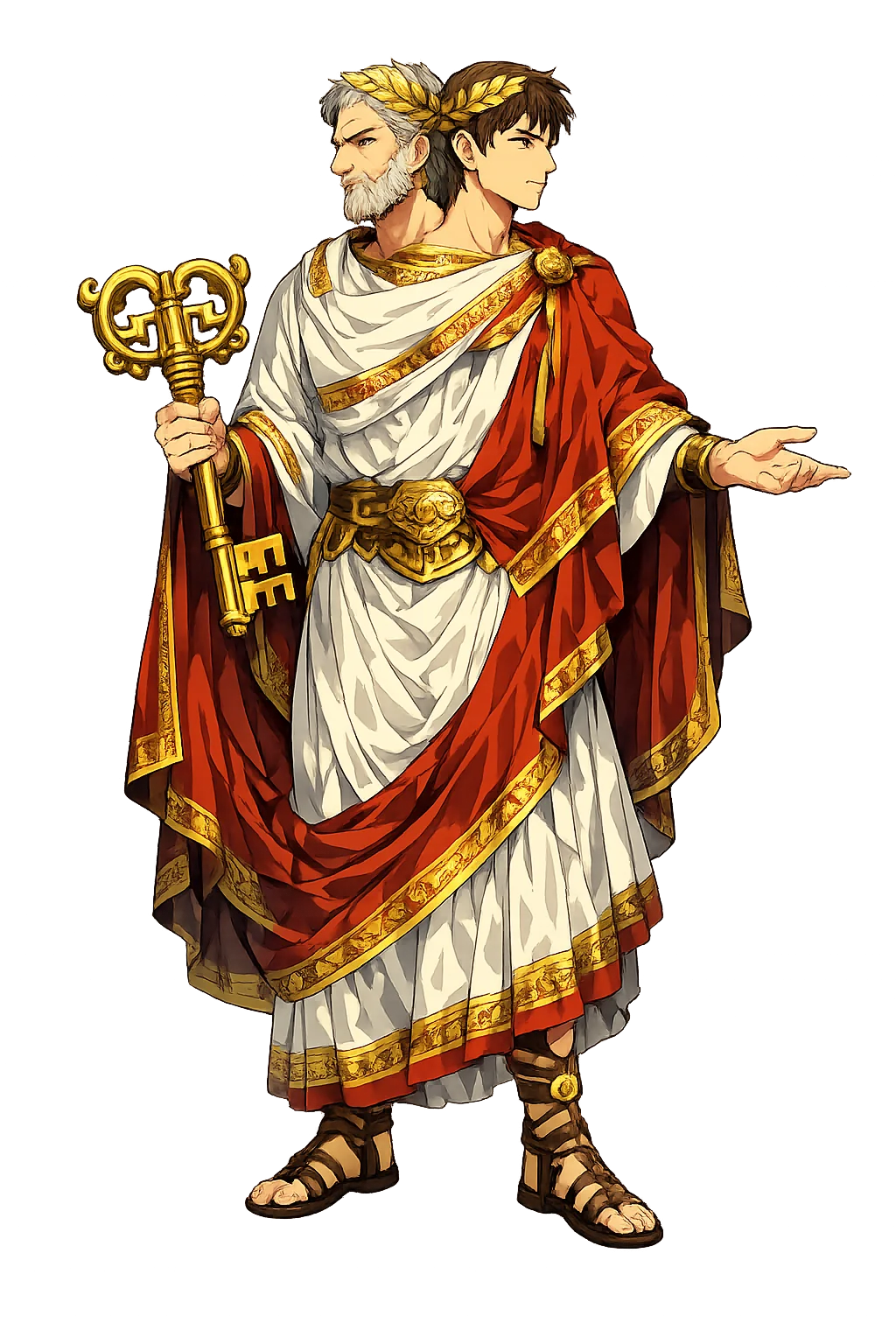
Essential information about Iānus, Beginnings, Doors, Transitions
From original script to Unicode restoration
Latin Iānus scans with a long i and long ā; Varro connected the name to ire, "to go," and Cicero to ianua, "door" — both folk etymologies of a genuinely old Italic god. The circumflex-less Roman name keeps its macrons in the restoration Iānus, the form dictionaries print. The poets scan both vowels long (Iānus); the temple calendars abbreviate him simply KAL, the Kalends he owns.
Character-by-character philological analysis
| Character | Unicode | Name | Block | Phonetic Role |
|---|---|---|---|---|
| I | U+0049 | Latin Capital Letter I | Basic Latin | Same letter |
| ā | U+0101 | Latin Small Letter A with Macron | Latin Extended-A | Macron marks the long vowel |
| n | U+006E | Latin Small Letter N | Basic Latin | Same letter |
| u | U+0075 | Latin Small Letter U | Basic Latin | Same letter |
| s | U+0073 | Latin Small Letter S | Basic Latin | Same letter |
The Tier 1 classification reflects which ancient features stress, length, or script are preserved in this restoration.
From ancient cult to modern Unicode
Iānus has no Greek equivalent and no mythology of adventure: he is Rome's god of passages themselves — doors, bridges, beginnings, the month that opens the year. His two faces look both ways because every threshold faces two worlds.
The Etruscans knew a two-faced gate-spirit (Culsans, paired with the one-faced Culsu), and Iānus absorbed that numinous door-power early. Having no Greek twin, he puzzled the mythographers: some aligned him with the sky, some with Chaos itself — Ovid reports both. Modern physics borrowed him for "Janus particles" (two-faced colloids), and psychology for "Janus-faced" ambivalence: the god of two ways of seeing became the name for the condition itself.
January keeps his name on every calendar; the janitor keeps his keys in every school; "Janus-faced" remains the standard charge in diplomacy and the standard diagnosis in literature. Historians read the rarity of his closed gates as Rome's autobiography: a republic that could count its years of peace on one hand, and a god whose open temple was the weather of empire.
Restoring Iānus in a domain name is more than orthographic accuracy. It is a statement that the internet should recognize the full range of human writing — not only the ASCII keyboard.
Common questions about Iānus, Beginnings, Doors, Transitions, and Unicode restoration
In reconstructed pronunciation, Iānus is /ˈjaː.nus/ — approximately YAH-nus, long ā on the first syllable..
Iānus means 'Passage, arched door' (from ianua) in the roman tradition.
Iānus is associated with The key (The opener and shutter — claviger, the key-bearer), The staff (The doorkeeper's rod of admission), The double face (Simultaneous sight of before and after).
Plain ASCII ianus strips the stress, length, and script that make the name specific. Unicode restoration returns the name to its original written dignity.
Ovid asks Iānus why, alone among gods, he sees both behind and before. The god replies: whatever you see — sky, sea, earth — all things are closed and opened by my hand; I preside over the gates of heaven with the gentle Seasons; I am called Chaos, for I was the ancient confusion out of which order came. Then he teaches the poet why the year begins in winter: the door of the year opens with the sun's rebirth.
The philological foundations of this restoration
Every claim on this page is grounded in established scholarship. The orthographic restorations follow disciplinary convention. The etymological chain follows the best available reference works. This is not invention — it is resurrection through scholarship.
You have traced the name from its earliest attestation to its Unicode restoration. Now return to the myth. The story is where the name lives.
Back to Lore