
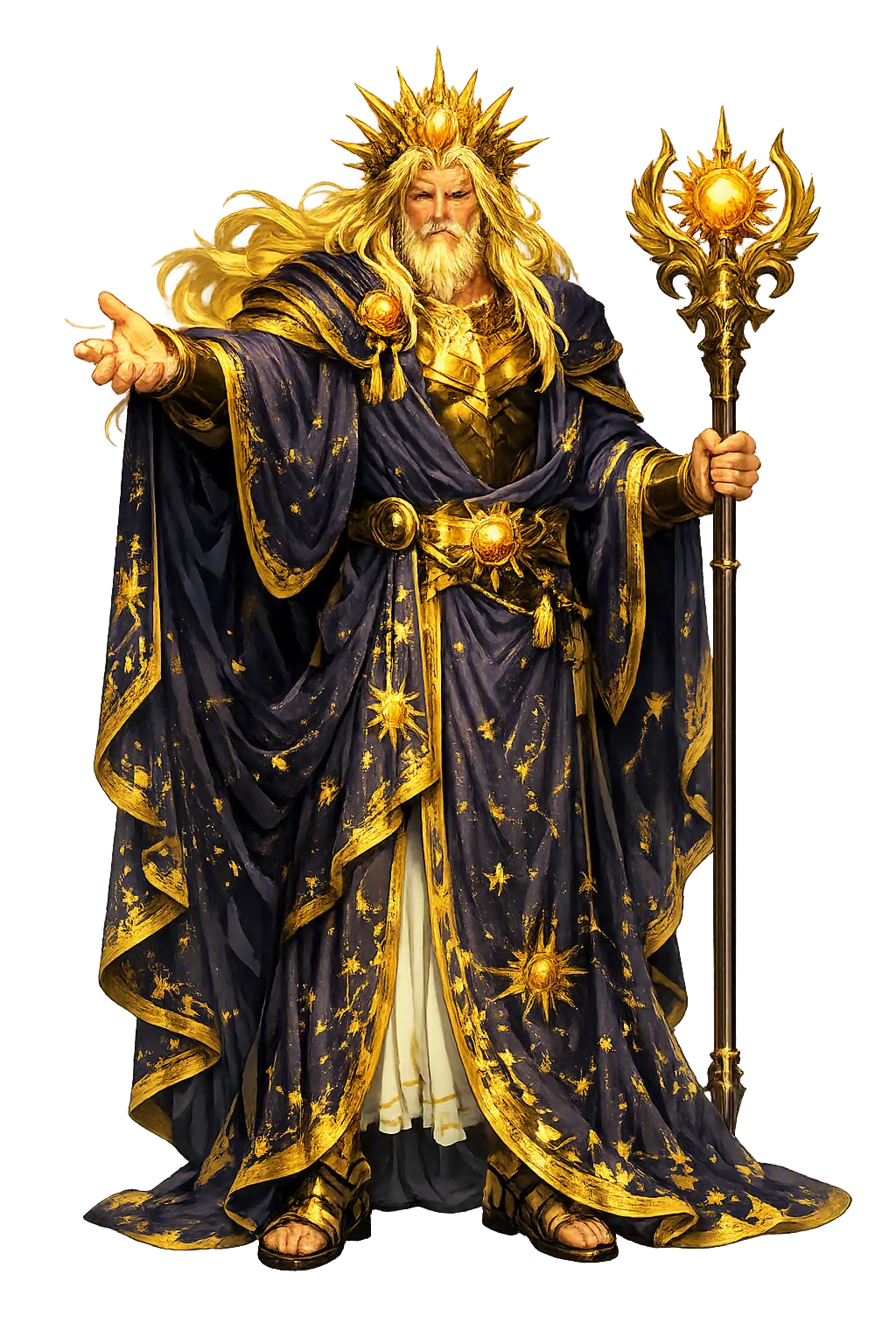
The canonical register: Hyperiōn
Evidence dossier 118 — Hyperiōn. Every exhibit catalogued, every ruling stated with its grounds.
At a Glance
- Canonical form: Hyperiōn
- Original script: Ὑπερίων
- Pantheon: Greek
- Convention: the restored-stress convention: acute and circumflex for pitch, macrons for vowel quantity, exactly as the sources write
- False forms on record: 1
- Contested forms: none attested
- Series: The Canonical Register, No. 118 of 282
The Evidence
Exhibit 1 — the attestation. The name is attested as Ὑπερίων, as LSJ and Beekes record. On the evidence, it means "He who goes above (from ὑπέρ)". The canonical transliteration is Hyperiōn.
Exhibit 2 — the preserved marks. o → ō (Omega: long omicron). Each is verifiable against the sources named in the attestation.
Exhibit 3 — the flattened form. The plain form hyperion is not false — it is a fallback, and the register is exact about what that means. In systems that cannot carry diacritics (legacy databases, older tooling, parts of the address-bar pipeline) the flattened form is the accepted vehicle, and the rulebook names it explicitly as the final rung of the fallback hierarchy: full restoration first, circumflex where attested, macron-only by the academic standard, an attested variant, and only then plain ASCII.
What the fallback status forbids is promotion: hyperion may carry the name where marks are impossible, but it may not represent the name where marks are possible. Every mark it drops — o → ō — is a fact the sources recorded. A fallback is a vehicle, never the primary.
Exhibit 4 — struck from the record: Hypērion. Origin: macron roulette — pages that know a long vowel exists somewhere in the name and plant the bar on the wrong one. Grounds: lengthens e when the attested long vowel is o (Omega: long omicron); moving the bar is not a small error — it asserts a different Greek word.
Exhibit 5 — the physical record. No temple, sanctuary, or civic cult of Hyperíōn is securely attested anywhere in the Greek world; Pausanias, who records altars of such Titans as Kronos and Iapetus, offers him no shrine. He was honoured, if at all, within the cult of his son Hēlios — above all at Rhodes, where the Sun received a major state cult and the great bronze Colossus — so his archaeological trace survives only folded into his children's worship. His monument is textual rather than stone: the name that Homer and Hesiod carved into the language of light.
Exhibit 6 — the continuing record. Hyperíōn's deepest modern life is linguistic: the English prefix 'hyper-' (hyperactive, hyperlink, hyperspace) descends from ὑπέρ, the very root of his name — every 'hyper-' word unknowingly repeats 'he who goes above'. The Titan himself was given fresh stature by Keats's unfinished epic Hyperion (1820), which made his fall after the Titanomachy a meditation on the succession of gods.
The Convention's Own History
The marks this register defends were not invented for typesetting. Ancient Greek carried a melodic pitch accent, and the acute and circumflex were added by Alexandrian scholars — Aristophanes of Byzantium, tradition holds — precisely to preserve it when the spoken language began to level. Vowel quantity (the macron's concern) is older still: it changes meter, meaning, and grammar, and the poets of the Theogony depend on it. To drop either class of mark is to drop two millennia of deliberate preservation. The restored-stress convention simply continues the oldest documented project in European scholarship: keeping the sound of Greek alive in its letters.
The Protocol's Position
Can the canonical form live in the address bar? Almost always, yes. IDNA 2008 admits every mark this register defends — the DNS stores them as `xn--` punycode and modern browsers render them natively. The real frictions are practical, not legal: some registrars stock only part of the IDN space, so a theoretically valid name can be temporarily unbuyable; and stacked combinations (an acute riding a macron) remain awkward to type on mobile keyboards even where the protocol accepts them.
The project's answer is a ranked ladder, not a compromise: the full restoration first, then attested fallbacks in descending order of completeness. The ladder's lowest rung, plain ASCII, is a vehicle for legacy systems — sanctioned, but never presented as the scholarly form.
The Verdict
Case closed on Hyperiōn: canonical, cited, and defended. The keyboard form hyperion rides as the sanctioned fallback — and stays in that lane. The register's files remain open: if a source surfaces that changes any line of this entry, the entry changes. Until then, the temple at /sites/hyperion/ holds the canonical form.
The docket for this ruling: 1 false form ruled against, Hypērion first on the docket; 1 preserved mark verified: o → ō; no contested forms attested; the attestation rests on 9 cited sources — LSJ, Beekes, Hesiod.
The Register Continues
Entry 118 of 282 in the Canonical Register. Around it: the temple's founding dispatch, the Restoration File on the marks themselves, the Resonance File on the archetype at work, and the Rulebook behind all of it.
Continue the register — previous entry: Hygíeia (read it) · next entry: Hýpnos (read it).
The Canonical Register is written from the same canonical record as the lexicon itself. If a false form is missing from this page, it is because the evidence does not support calling it false — or because we have not seen it yet. Show us, with a citation, and the register will answer.