Unicode restoration and ASCII comparison
Ἥλιος
The name in its original Greek form. Hēlios (Ἥλιος) is attested in the source tradition — “Sun (from ἕλος)”. Its acute accents carry the full phonetic and orthographic weight of the source tradition.
helios
Reduced to plain helios, the name loses everything that made it specific: acute accents. What remains is an ASCII string that machines can parse but that no longer speaks with its original voice.
Hēlios
The Unicode restoration recovers what ASCII flattened. Hēlios restores acute accents, returning the name to its original written dignity. The domain encodes to Punycode, but the browser displays the truth.
Hēlios.com → xn--hlios-iza.com
The non-ASCII characters in Hēlios are encoded while the ASCII remains visible. To the DNS, it is Punycode. To humanity, it is Hēlios.
How Hēlios travels from ancient script to the modern URL
Greek Ἥλιος; from ἕλος “sun, warmth"; the personification of the sun.
Sun, Sight, Oaths
The Unicode restoration Hēlios preserves Greek stress and length; the ASCII form helios loses these features.
How Hēlios was spoken
Light, Sight, Oaths, and the Chariot of Day
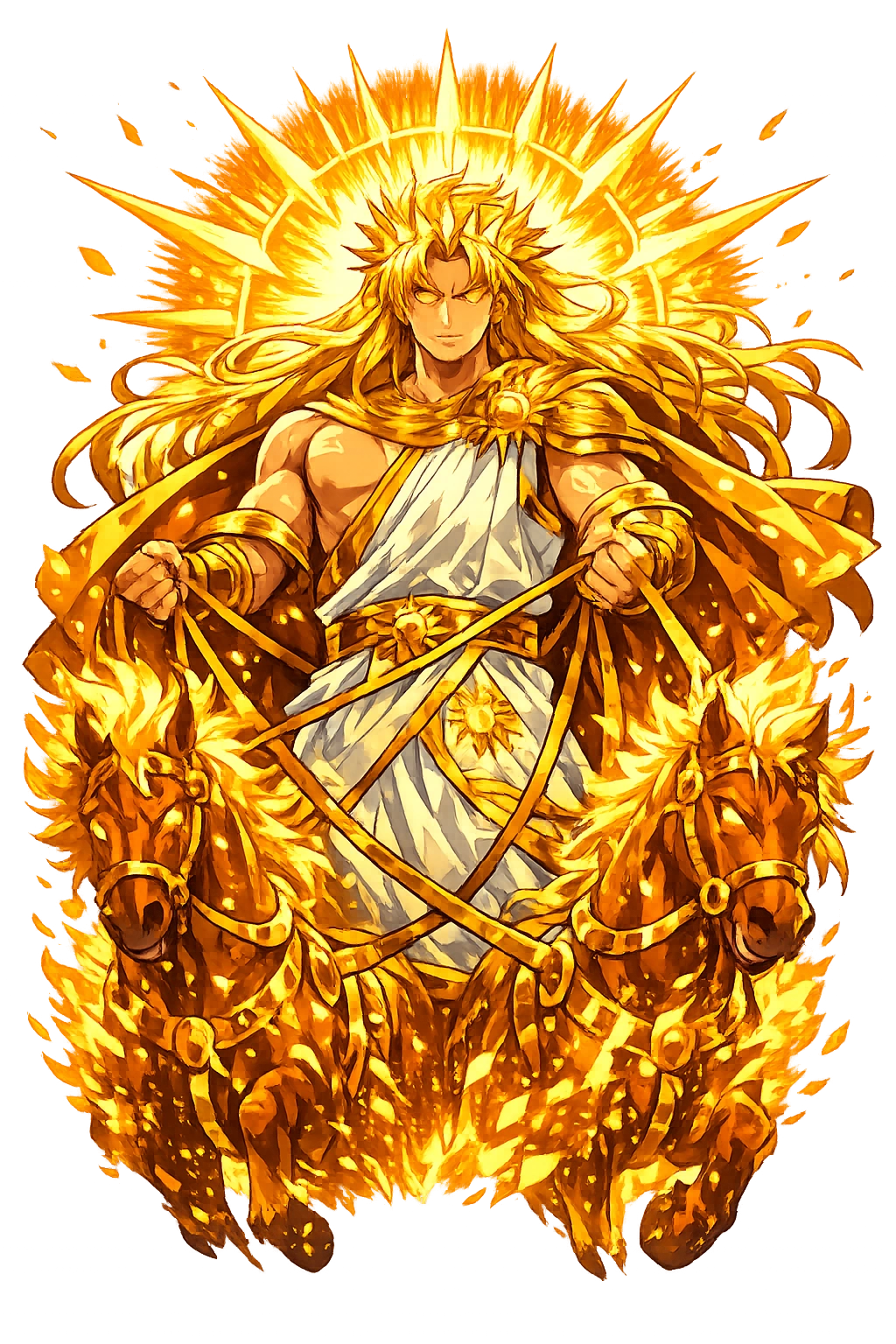
Hēlios is the sun itself: a god who sees everything and drives his blazing chariot across the sky each day. Nothing hidden escapes him, and mortals and gods alike swear oaths by his light.
He rises from Oceanus in the east, crosses the sky, and descends into the western sea.
He sees everything on earth; oaths sworn in his name are binding because he cannot be deceived.
He exposed Aphrodítē's affair with Árēs to Hēphaistos; he told Demeter of Persephone's abduction.
His warmth makes crops grow and bodies live; his withdrawal is winter and death.
Stories of Hēlios
Hēlios's myths all depend on his unique vantage point: he sees everything. This makes him a witness, a revealer, and occasionally a victim of his own children's ambition.
Each dawn Hēlios rises from Oceanus in the east, drawn by four horses in a chariot of fire. At midday he sees the entire world spread below him. In the evening he sinks into the western Ocean, where he is received in a golden cup and conveyed back to the east. The Homeric Hymn to Helios (1–14) describes this journey as the source of all life and growth.
In Odyssey 8.266–366, Hēlios sees Árēs and Aphrodítē committing adultery in Hēphaistos's house and reports it to the cuckolded smith. Hēphaistos then traps the lovers in a net. The episode shows that Hēlios is not merely a celestial body but a moral witness; nothing done in daylight is hidden from him.
Phaethon, son of Hēlios and the nymph Clymene, begged to drive the solar chariot. Hēlios reluctantly agreed, but Phaethon could not control the horses. He scorched the earth, creating the deserts of Africa, until Zeüs struck him down with a thunderbolt. The myth is a warning against claiming divine power without divine skill; it also explains the origin of the Sahara.
In the Odyssey (12.127–141), Hēlios pastures his sacred cattle on the island of Thrinacia. Odysseus's crew, despite warnings, slaughter and eat the cattle. Hēlios demands vengeance and threatens to shine among the dead; Zeüs destroys Odysseus's ship with a thunderbolt. The sun god's cattle are the cosmos's property, and their violation brings universal retribution.
Hēlios is the god of total visibility. He cannot be bargained with or hidden from. In an age of surveillance, we have made our own Hēlios — satellites, cameras, data trails — but without the moral clarity the god represented. For the Greeks, the sun's witness was sacred; for us, visibility is often exploitative.
Enter Extended Lore