PuniCodex

Extended Lore

伏羲 Fúxī

Etymology · Phonology · Orthography · Cultural Legacy · Primary Sources

Tier 1 Fúxī.com
Fúxī — Culture, Writing, Divination
01

Quick Facts

Essential information about Fúxī, Culture, Writing, Divination

Original Script伏羲
Unicode RestorationFúxī
Reconstructed Pronunciation/fu˧˥ ɕi˥/
PantheonChinese
DomainCulture, Writing, Divination
MeaningHidden one
ClassificationTier 1
Primary DomainFúxī.com
Sacred SymbolsThe trigrams, The carpenter's square, The dragon-horse
02

Etymology & Word Family

From original script to Unicode restoration

Original Script 伏羲 Fúxī — "Hidden one"
Unicode Restoration Fúxī Restored stress, length, and script
Modern ASCII fuxi Plain-ASCII fallback

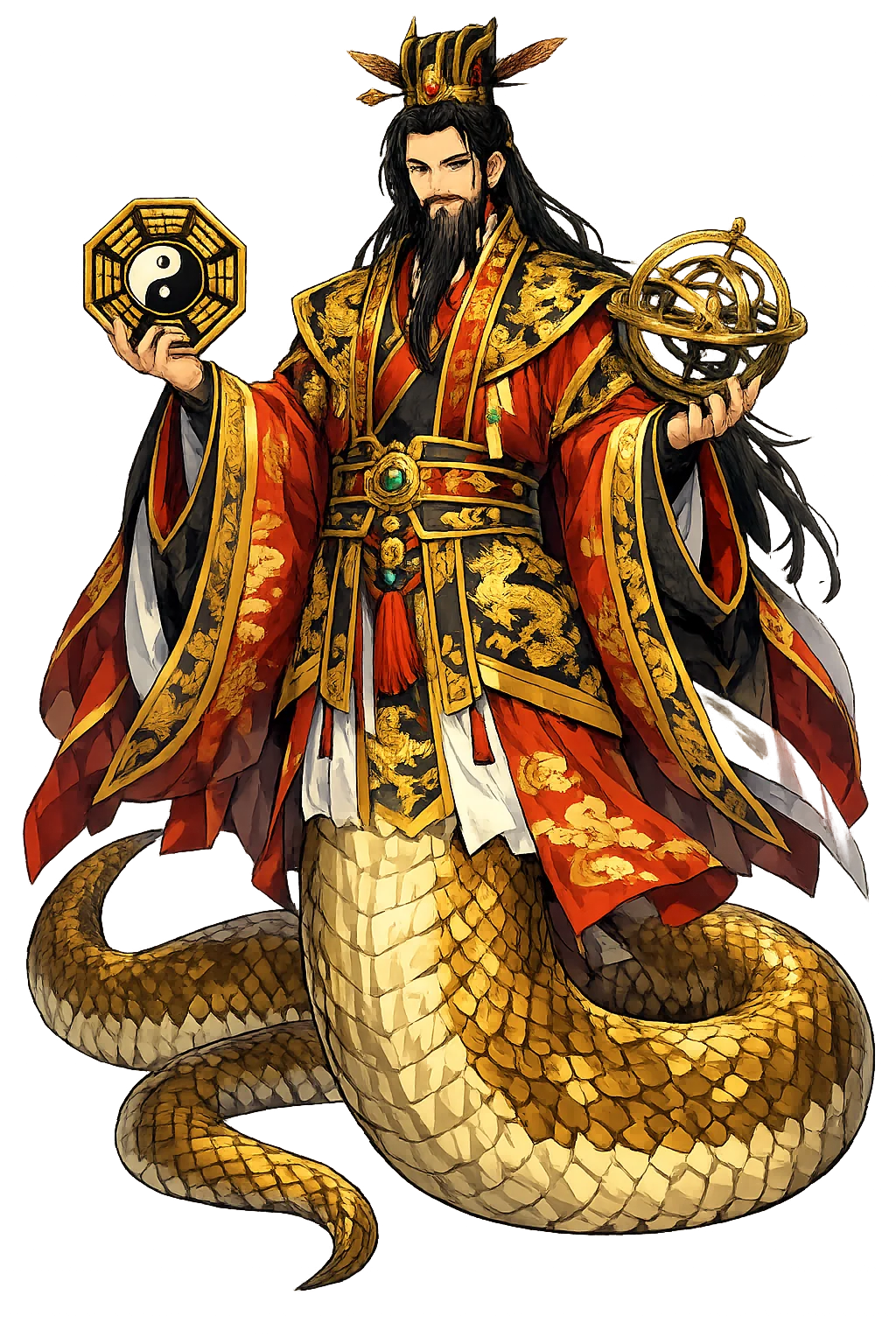
Fúxī 伏羲 carries the rising tone on both syllables in Mandarin; older romanizations write Fu-hsi. The first graph 伏 suggests "to subdue, to prostrate," the second 羲 a sacrificial term — a name older than its etymologies, borne by the first of the Three August Ones. The older romanization Fu-hsi records the same syllables; pinyin's x is the alveolo-palatal fricative of modern Mandarin.

03

Unicode Character Breakdown

Character-by-character philological analysis

CharacterUnicodeNameBlockPhonetic Role
FU+0046Latin Capital Letter FBasic LatinSame, capitalized
úU+00FALatin Small Letter U with AcuteLatin-1 SupplementStress on u
xU+0078Latin Small Letter XBasic LatinSame
īU+012BLatin Small Letter I with MacronLatin Extended-ALong vowel

The Tier 1 classification reflects which ancient features stress, length, or script are preserved in this restoration.

04

Cultural Significance

From ancient cult to modern Unicode

Ancient Domain

Fúxī is where Chinese civilization says it learned to think: the sage-king who looked up at the heavens, down at the earth, and at the markings on birds and beasts — and abstracted the eight trigrams, the first writing of pattern itself.

Fúxī in Later Traditions

He heads most lists of the Three August Ones (Sānhuáng), paired inseparably with Nǚwā — their intertwined serpent forms in Han art echoing, scholars note, the union of measure and generation. Daoist tradition absorbed him as a revealer of the trigrams to the immortal lineages; Confucian tradition kept him as the first historian of pattern. The serpent-pair iconography has been compared by art historians with intertwined pairs from Egypt to India — diffusion debated, the resemblance celebrated.

Modern Legacy

Every reading of the Yìjīng — the book that shaped Confucian statecraft, Daoist alchemy, and Leibniz's binary arithmetic — begins with his act of looking. The eight trigrams appear on the flag of South Korea; the River Chart structures a millennium of cosmological diagrams; and "Fúxī" remains the standard icon for the inventor-ancestor in Chinese cultural memory, the answer to the question of where pattern-thinking began.

Unicode Restoration as Cultural Act

Restoring Fúxī in a domain name is more than orthographic accuracy. It is a statement that the internet should recognize the full range of human writing — not only the ASCII keyboard.

05

Frequently Asked Questions

Common questions about Fúxī, Culture, Writing, Divination, and Unicode restoration

01How do you pronounce Fúxī?

In reconstructed pronunciation, Fúxī is /fu˧˥ ɕi˥/ — approximately foo-shee, rising tone on fu, high level on xi..

02What does Fúxī mean?

Fúxī means Hidden one in the chinese tradition.

03What are the symbols of Fúxī?

Fúxī is associated with The trigrams (Pattern abstracted from nature — the seed of all Chinese correlative thought), The carpenter's square (His emblem in Han art: the earth-measurer's tool (Nǚwā holds the compass of heaven)), The dragon-horse (The creature from the Yellow River whose markings revealed the diagram).

04Why restore Fúxī in Unicode?

Plain ASCII fuxi strips the stress, length, and script that make the name specific. Unicode restoration returns the name to its original written dignity.

05What is the most important myth about Fúxī?

The Yìjīng's Great Treatise records the founding act: Fúxī looked up and contemplated the images of heaven, looked down and contemplated the patterns of earth, contemplated the markings of birds and beasts and the order of the near at hand — and from all three made the eight trigrams, "to comprehend the powers of the spirits and to classify the natures of the ten thousand things." Writing, mathematics, and divination begin as one gesture of attention.

06

Scholarly Sources

The philological foundations of this restoration

Every claim on this page is grounded in established scholarship. The orthographic restorations follow disciplinary convention. The etymological chain follows the best available reference works. This is not invention — it is resurrection through scholarship.

Lexicography & Philology

  • Shan Hai Jing
  • Chinese classics

Primary Texts

  • Primary sources in the chinese tradition for Fúxī.

Archaeology & Art History

  • Material evidence — iconography, inscriptions, and temple archaeology — for Fúxī and related cults.
  • The Wu Liang shrine reliefs (2nd century CE, Shandong) show Fúxī and Nǚwā with serpent bodies entwined, square and compass raised — the canonical image, replicated across Han tomb art from Sichuan to Xinjiang (the famous Astana cemetery banner). The myth's textual archaeology runs from the Zhuangzi and Xunzi mentions to the Tang's flood-cycle records: a steady accretion from sage-king to cosmic progenitor, all preserved in the transmitted classics.

Religious Studies

  • I Ching
  • Shiji
  • Birrell
  • Chinese classics
  • Shan Hai Jing
  • Chinese folklore
Return

The Surface Awaits

You have traced the name from its earliest attestation to its Unicode restoration. Now return to the myth. The story is where the name lives.

Back to Lore
Fúxī mascot