
Ancient Domain
Ēōs is the goddess of dawn, daughter of Hyperion and Theía, sister of Hēlios and Selēnē. Each morning she rises from the sea in a saffron robe and opens the gates of day, scattering light across the world.
Extended Lore
Etymology · Phonology · Orthography · Cultural Legacy · Primary Sources
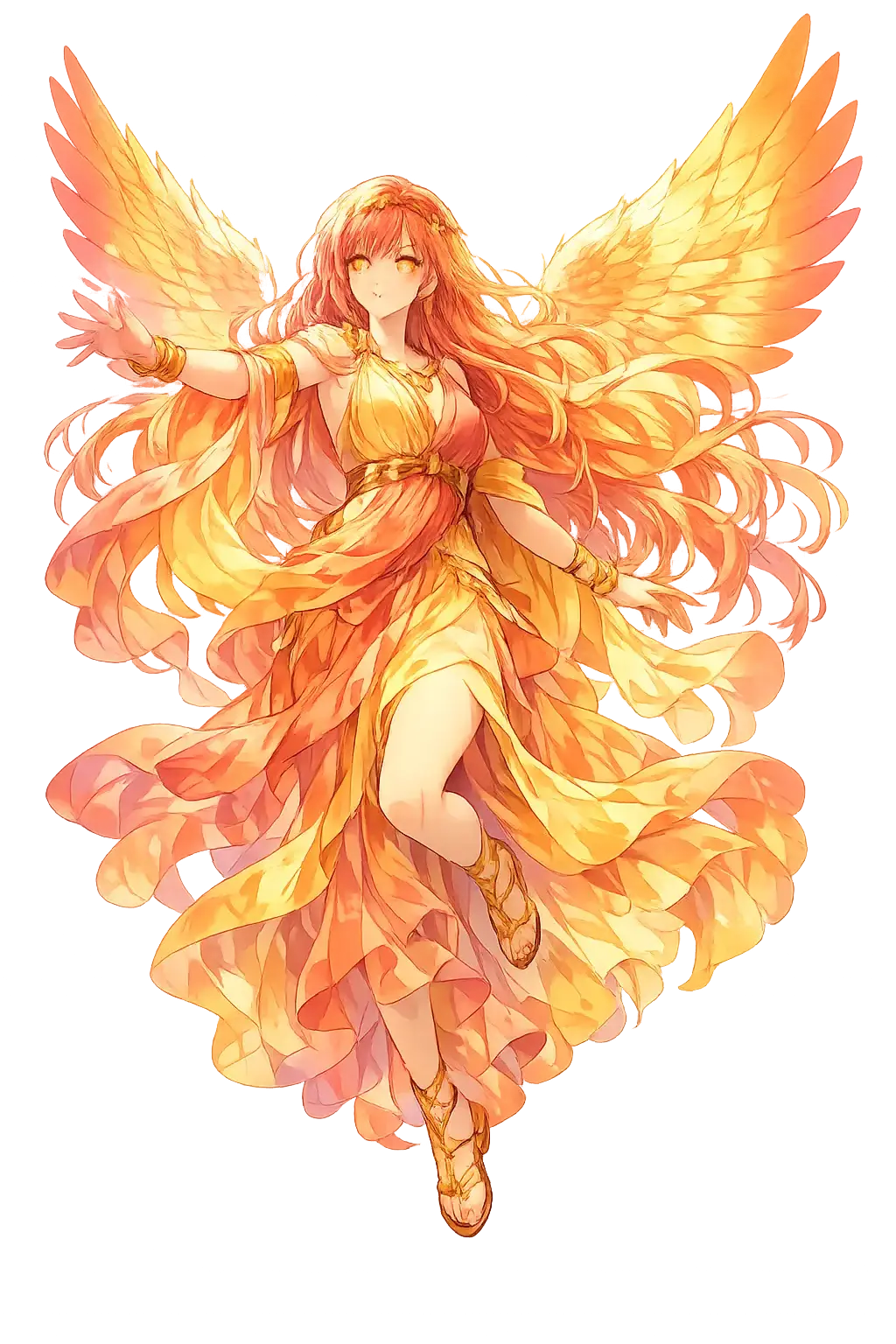
Essential information about Ēōs, Dawn, Morning Red
From original script to Unicode restoration
Ēōs is Tier 1 because the Greek Ἠώς contains two long syllables, the second carrying the acute/circumflex. The name is one of the most securely reconstructed Indo-European divine names.
Character-by-character philological analysis
| Character | Unicode | Name | Block | Phonetic Role |
|---|---|---|---|---|
| Ē | U+0112 | Latin Capital Letter E with Macron | Latin Extended-A | Eta: long epsilon |
| ō | U+014D | Latin Small Letter O with Macron | Latin Extended-A | Omega: long omicron |
| s | U+0073 | Latin Small Letter S | Basic Latin | Sigma |
The Tier 1 classification reflects which ancient features stress, length, or script are preserved in this restoration.
From ancient cult to modern Unicode
Ēōs is the goddess of dawn, daughter of Hyperion and Theía, sister of Hēlios and Selēnē. Each morning she rises from the sea in a saffron robe and opens the gates of day, scattering light across the world.
The Romans called her Aurora and kept most of her Greek iconography. The Greek-Roman Eos-Aurora influenced later personifications of dawn in European poetry and art. Her Indo-European cognates include Sanskrit Uṣás and Lithuanian Aušrinė, suggesting an ancient shared dawn-goddess. Christian tradition transformed her into the herald of the resurrection morning.
Ēōs lives in every image of dawn breaking, every 'rosy-fingered' sunrise in literature, and the scientific name Eos for certain bright birds. She is the goddess of fresh starts — and of the grief that fresh starts cannot undo. Her failed gift to Tithonos remains one of mythology's sharpest warnings: be careful what you ask for, even from the gods.
Restoring Ēōs in a domain name is more than orthographic accuracy. It is a statement that the internet should recognize the full range of human writing — not only the ASCII keyboard.
Common questions about Ēōs, Dawn, Morning Red, and Unicode restoration
In reconstructed pronunciation, Ēōs is /ɛː.ɔ̌ːs/ — approximately 'AY-ohss' — two long syllables, the first level, the second pitched and sustained like the rising sun..
Ēōs means Dawn (from ἠώς) in the greek tradition.
Ēōs is associated with Saffron or rosy light (The color of the dawn sky and her garments), Wings or winged chariot (Her swift passage across the horizon), The morning star (The last star visible as she rises), Tithonos turning into a cicada (The emblem of her failed request for his immortality without youth).
Plain ASCII eos strips the stress, length, and script that make the name specific. Unicode restoration returns the name to its original written dignity.
Ēōs loved the Trojan prince Tithonos and asked Zeus to grant him immortality. She forgot to ask for eternal youth. Tithonos aged endlessly, shrinking until he became a cicada, whose chirping is the sound of immortal old age. The myth is a meditation on the limits of divine gifts.
The philological foundations of this restoration
Every claim on this page is grounded in established scholarship. The orthographic restorations follow disciplinary convention. The etymological chain follows the best available reference works. This is not invention — it is resurrection through scholarship.
You have traced the name from its earliest attestation to its Unicode restoration. Now return to the myth. The story is where the name lives.
Back to Lore