The Authentic Orthography
Supreme God, Father of Gods · The high god of the Canaanite pantheon; the common Semitic word for "god" and a divine name
Unicode restoration and ASCII comparison
𐎛𐎍
The name in its original Canaanite form. Ēl (𐎛𐎍) is attested in the source tradition — “The high god of the Canaanite pantheon; the common Semitic word for "god" and a divine name”. Its original diacritics and script distinctions carry the full phonetic and orthographic weight of the source tradition.
el
Reduced to plain el, the name loses everything that made it specific: original diacritics and script distinctions. What remains is an ASCII string that machines can parse but that no longer speaks with its original voice.
Ēl
The Unicode restoration recovers what ASCII flattened. Ēl restores original diacritics and script distinctions, returning the name to its original written dignity. The domain encodes to Punycode, but the browser displays the truth.
Ēl.com → xn--l-oia.com
The non-ASCII characters in Ēl are encoded while the ASCII remains visible. To the DNS, it is Punycode. To humanity, it is Ēl.
How Ēl travels from ancient script to the modern URL
Ugaritic ʾil is the common Semitic word for “god"; as a proper name Ēl is the high god and father of the gods.
Supreme God, Father of Gods
The Unicode restoration Ēl uses registrable Latin diacritics; the Ugaritic form is not registrable in .com.
How Ēl was spoken
Supreme God, Creator, and King of the Divine Assembly
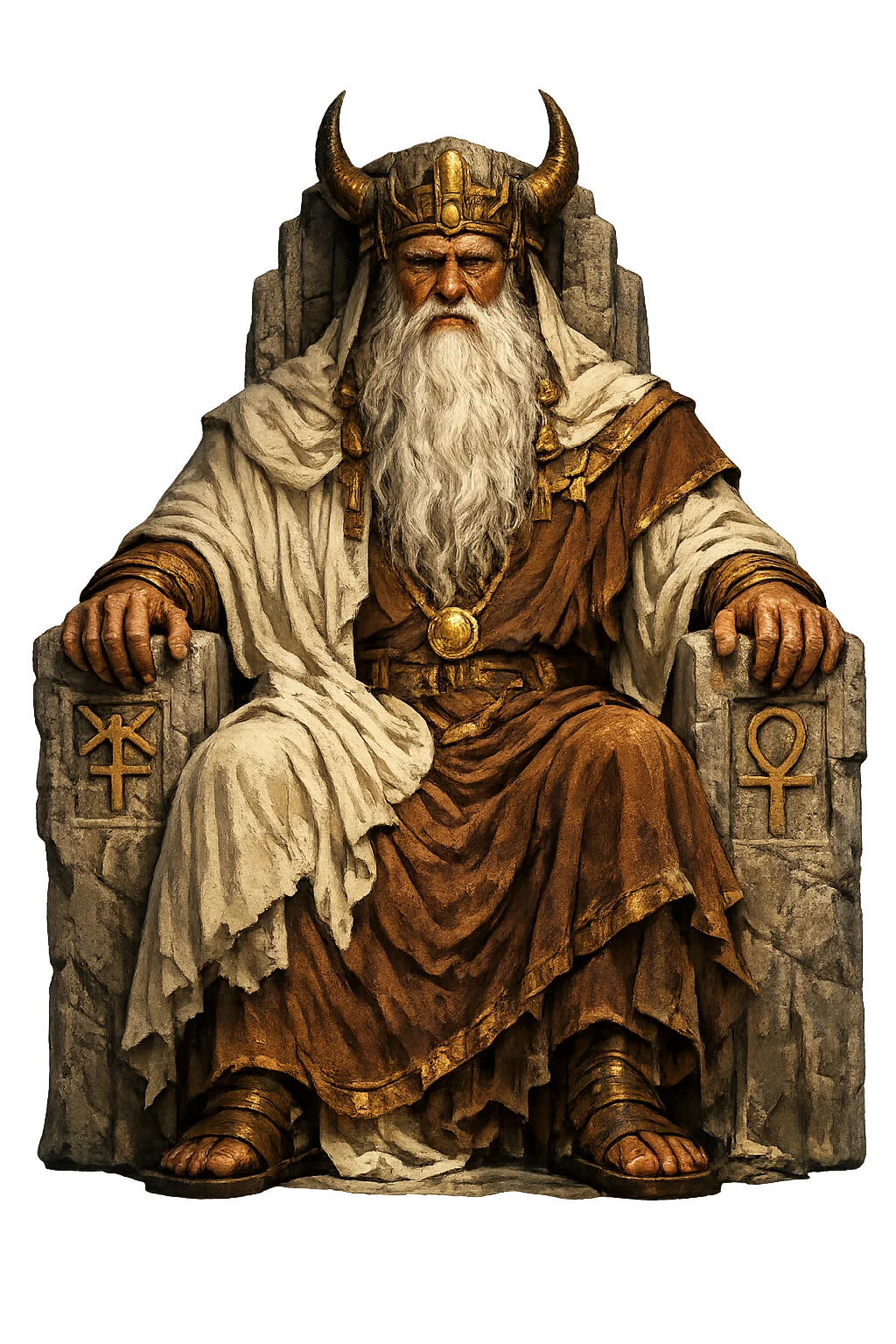
Ēl is the ancient one at the center of the Canaanite pantheon. He is the father of gods and men, the Bull whose creative power generates the divine assembly, and the king whose distant authority nonetheless settles every dispute. Unlike Baꜥal, who acts, Ēl decrees. His throne is at the source of the rivers; his tent is where the gods come to receive judgment.
His epithet bny bnwt, 'Creator of Creatures,' marks him as the ultimate source of all life.
The bull is his animal: strength, fertility, and patriarchal authority concentrated in one image.
The divine assembly gathers before him; kingship is conferred by his word, whether for Baꜥal or for Athtar.
He is 'ab ʾilm, 'father of the gods,' and 'ab ʾadmi, 'father of man' — the origin of all genealogies.
Stories of Ēl
Ēl appears in almost every major Ugaritic myth, yet he rarely takes center stage. He is the one appealed to, the one who gives or withholds blessing, the one whose laughter signals cosmic assent. His mythology is the mythology of authority itself — distant, benevolent, sometimes foolish, always final.
In KTU 1.2 iii, Ēl initially grants kingship to Yamm, the Sea. Later, persuaded by Asherah, he approves Baꜥal's palace and kingship (KTU 1.3 v 36; 1.4 iv 48). Even Baꜥal's triumphant reign depends on the old king's word. Ēl is not the warrior; he is the source from which warrior-kingship flows.
When messengers approach Ēl, they find him at the source of the rivers, in the midst of the divine assembly. His epithet ab šnm, 'father of years,' emphasizes that he is older than the seasons themselves. Yet he is also approachable, even convivial: in KTU 1.114 he gets drunk at a banquet and must be helped home.
In the Epic of Kirta (KTU 1.14–16), Ēl appears to the king in a dream and grants him a son and victory. He is the divine patron of kings, the one who blesses the righteous ruler and ensures the continuity of his house. His mercy is a recurring theme, though it can look like passivity.
In KTU 1.23, Ēl's sexual vitality is celebrated in a myth of the birth of the 'gracious gods' (Shahar and Shalim, Dawn and Dusk). The text's coarse humor underscores the ancient connection between the high god's creative power and the fertility of the cosmos.
Ēl is the god of 'and then what?' He does not rush into battle; he sits at the source of the rivers and lets the younger gods come to him. His authority is so settled that he can afford to be slow, even tipsy, even outmaneuvered by his own wife and children. Yet when he speaks, the cosmos arranges itself around his word.
Enter Extended Lore