PuniCodex

The Authentic Orthography

Διόνυσος Diónysos

Wine, Ecstasy, Theatre · God of Nysa (mountain of ecstasy)
Tier 2 Diónysos.com
Diónysos — Wine, Ecstasy, Theatre
01

The Authentic Name

Unicode restoration and ASCII comparison

Original Script

Διόνυσος

The name in its original Greek form. Diónysos (Διόνυσος) is attested in the source tradition — “God of Nysa (mountain of ecstasy)”. Its acute accents carry the full phonetic and orthographic weight of the source tradition.

ASCII Constraint

dionysos

Reduced to plain dionysos, the name loses everything that made it specific: acute accents. What remains is an ASCII string that machines can parse but that no longer speaks with its original voice.

Unicode Restoration

Diónysos

The Unicode restoration recovers what ASCII flattened. Diónysos restores acute accents, returning the name to its original written dignity. The domain encodes to Punycode, but the browser displays the truth.

Punycode Encoding
Diónysos.com → xn--dinysos-m0a.com

The non-ASCII characters in Diónysos are encoded while the ASCII remains visible. To the DNS, it is Punycode. To humanity, it is Diónysos.

02

Original Script & Provenance

How Diónysos travels from ancient script to the modern URL

Διόνυσος
Greek
Diónysos
Reading: /di.ó.ny.sos/
Reconstruction: /di.ó.ny.sos/
Greek alphabet (Classical / Attic) · left-to-right · Ancient Greek, c. 8th century BCE – present · Greece and the Greek-speaking Mediterranean
Δ
Greek letter Δ
Δ
Letter
Greek letter with its classical phonetic value; accents mark pitch and length.
ι
Greek letter ι
ι
Letter
Greek letter with its classical phonetic value; accents mark pitch and length.
ό
Greek letter ό
ό
Letter
Greek letter with its classical phonetic value; accents mark pitch and length.
ν
Greek letter ν
ν
Letter
Greek letter with its classical phonetic value; accents mark pitch and length.
υ
Greek letter υ
υ
Letter
Greek letter with its classical phonetic value; accents mark pitch and length.
σ
Greek letter σ
σ
Letter
Greek letter with its classical phonetic value; accents mark pitch and length.
ο
Greek letter ο
ο
Letter
Greek letter with its classical phonetic value; accents mark pitch and length.
ς
Greek letter ς
ς
Letter
Greek letter with its classical phonetic value; accents mark pitch and length.
Original Script
Διόνυσος
Indigenous writing
Transliteration
Diónysos
Scholarly reading
Unicode Restoration
Diónysos
Registrable form
Punycode
xn--Dinysos-m0a.com
DNS encoding
ASCII Fallback
dionysos
Flattened spelling

Etymology

Greek Διόνυσος; traditionally “god of Nysa", a mountain of ecstasy; the name is probably pre-Greek.

Meaning

Wine, Ecstasy, Theatre

From original to transliteration

  1. The Greek form Διόνυσος is written in the Classical Greek alphabet.
  2. Letters with acute, grave, or circumflex accents preserve the pitch accent of Ancient Greek.
  3. Macrons and omegas (η, ω) mark long vowels, a feature lost in the plain ASCII form.
  4. The Unicode restoration Diónysos encodes the scholarly spelling as a registrable domain name.
  • Διόνυσος Original script
  • Diónysos Unicode restoration
  • dionysos ASCII fallback
  • Hesiod, Theogony
    c. 700 BCE Greece Hesiod, Theogony 116–125
  • Homeric Hymns
    c. 700–500 BCE Greece Homeric Hymns, selected hymns
  • Homer, Iliad and Odyssey
    c. 750–650 BCE Greece Homer, Iliad and Odyssey, selected passages
Beekes, Etymological Dictionary of GreekTier 1
Chantraine, Dictionnaire étymologique de la langue grecqueTier 2
Liddell-Scott-Jones (LSJ)Tier 1
Pape-BenselerTier 1

DNS / IDN note

The Unicode restoration Diónysos preserves Greek stress and length; the ASCII form dionysos loses these features.

  • !The exact phonetic realization of pitch accent in Classical Greek is reconstructed.
  • !Some letters (e.g., ζ) had dialectal pronunciations that remain debated.
  • !Classical Greek accents originally marked pitch, not stress; the later Byzantine stress pronunciation is conventional today.
  • !Some names may be pre-Greek loans, making purely Greek etymologies uncertain.
03

Pronunciation

How Diónysos was spoken

/di.ˈó.ny.sos/ Attic Greek Reconstruction
Di- Short iota after delta — the first half of the name of Zeus (genitive Dios).
-ó- Short omicron with acute pitch stress; the name's prosodic peak.
-ny- Nu followed by front-rounded upsilon [y], the mysterious Nysa-element.
-sos Final sigma-omicron-sigma, a repeated sibilant like rustling vines.
04

The Ecstasy

Wine, Theatre, Rebirth

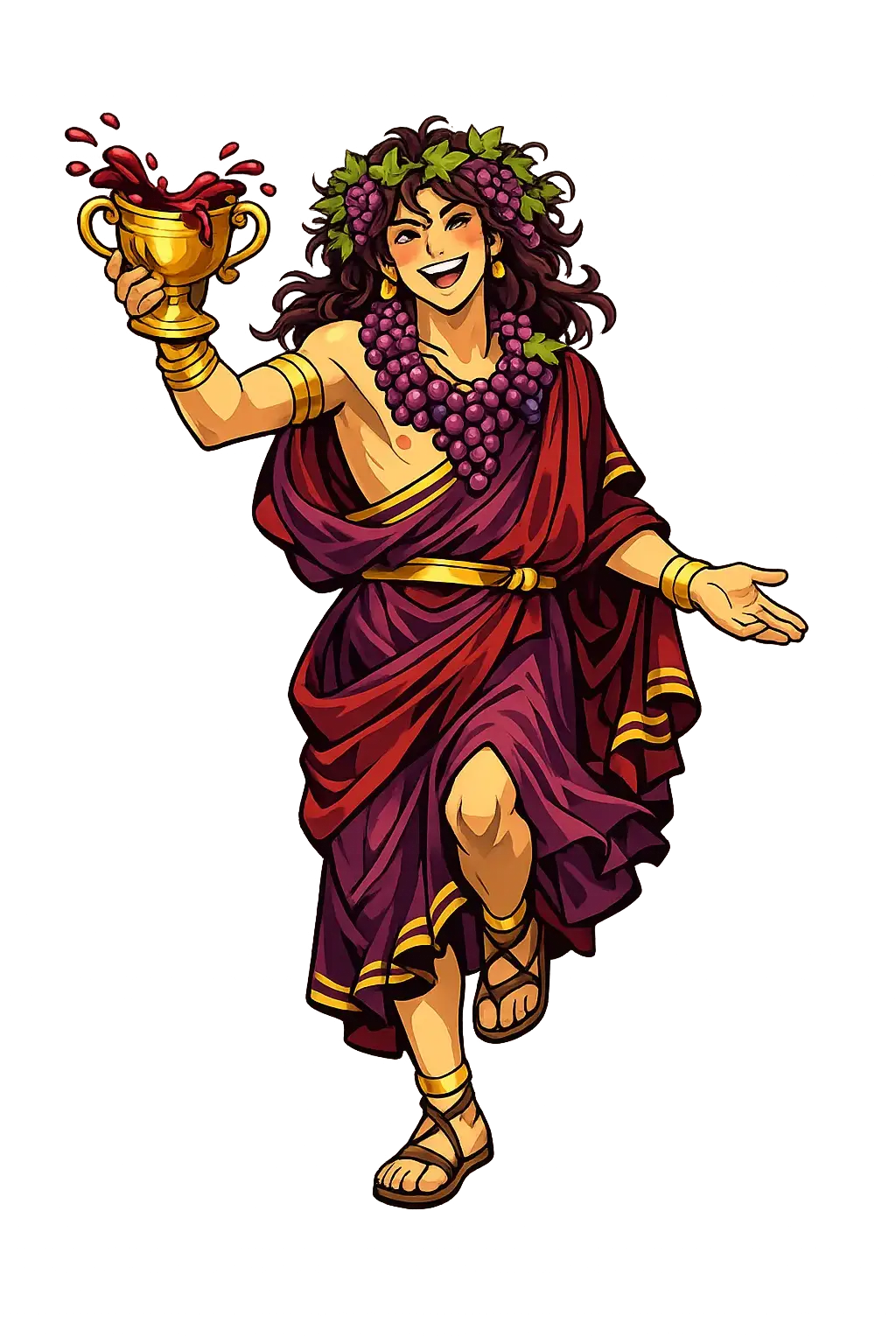
Diónysos is the god who arrives from outside. He comes with wine, with music, with the loss of the self that becomes discovery. He is the foreigner who is already inside you, the madness that heals, the drink that loosens tongues and boundaries alike. Where Apóllōn gives form, Diónysos dissolves it.

Wine

The gift of the vine — intoxication, liberation, and the blood of the god in the cup.

Theatre

Tragedy and comedy were born in his festivals; the mask is his gift to civilization.

The Thyrsus

Fennel-rod tipped with pine cone — the wand of ecstatic procession and vegetative power.

The Bull and the Leopard

His animal forms — the bull's strength and the leopard's untamed grace.

Sacred Symbols

Thyrsus Ecstasy, vegetation, and the piercing of ordinary consciousness
Kantharos The deep wine-cup of the mysteries
Leopard The god's triumphal chariot and untamed nature
Ivy and vine Persistence, intoxication, and the green world that reclaims ruins
Bull Sacrificial power and the animal vessel of the god
Phallus Fertility, comedy, and generative joy
05

Mythology

Stories of Diónysos

Diónysos is born twice, dies once, and comes back everywhere. His myths are stories of arrival — from the east, from the underworld, from the thigh of Zeus — and of the resistance he meets from those who fear losing control.

The Birth

Fire and the Thigh of Zeus

Semele, daughter of Cadmus, asked Zeus to reveal himself in his full divine glory. The sight killed her. Zeus snatched the unborn child from her womb and sewed it into his own thigh. Months later, Diónysos was born from Zeus's body — the "twice-born" god. (Homeric Hymn 1, Apollodorus 3.4.3.)

The Mortal Enemy

Pentheus and Thebes

King Pentheus of Thebes refused to recognize the new god. He spied on the maenads and was torn limb from limb by his own mother and aunts, driven mad by Diónysos. Euripides' Bacchae makes the lesson explicit: the god punishes not disbelief, but hubris — the arrogance of thinking oneself separate from the divine.

The Underworld

Diónysos and the Return

In Orphic and Eleusinian tradition, Diónysos descends to the underworld to retrieve his mother Semele or his bride Ariadne, and returns with the secret of rebirth. The god who dissolves the self is also the one who restores it, transformed.

The Eastern Triumph

The Journey to India

Hellenistic and Roman poets — especially Nonnus in the Dionysiaca — narrated Diónysos's triumphal campaign to India, converting peoples and spreading the vine. The "Thiasos" followed him: satyrs, maenads, panthers, and the old god Silenus.

Go Deeper

Extended Lore

Diónysos is the god you did not invite who becomes the reason the night is remembered. He is wine, but he is also everything that loosens the grip of the everyday self: music, dance, grief, laughter, the crowd becoming one body. His power is not in the temple but in the street, the theatre, the vineyard, the place where boundaries soften and something older than personality takes over.

Enter Extended Lore
Diónysos mascot