
Ancient Domain
Kérberos is the watch-dog of the dead: Hesiod's brazen-voiced, fifty-headed hound of Hades, who fawns on every soul that enters and devours any that tries to leave — the boundary of the underworld made flesh, fur, and teeth.
Extended Lore
Etymology · Phonology · Orthography · Cultural Legacy · Primary Sources
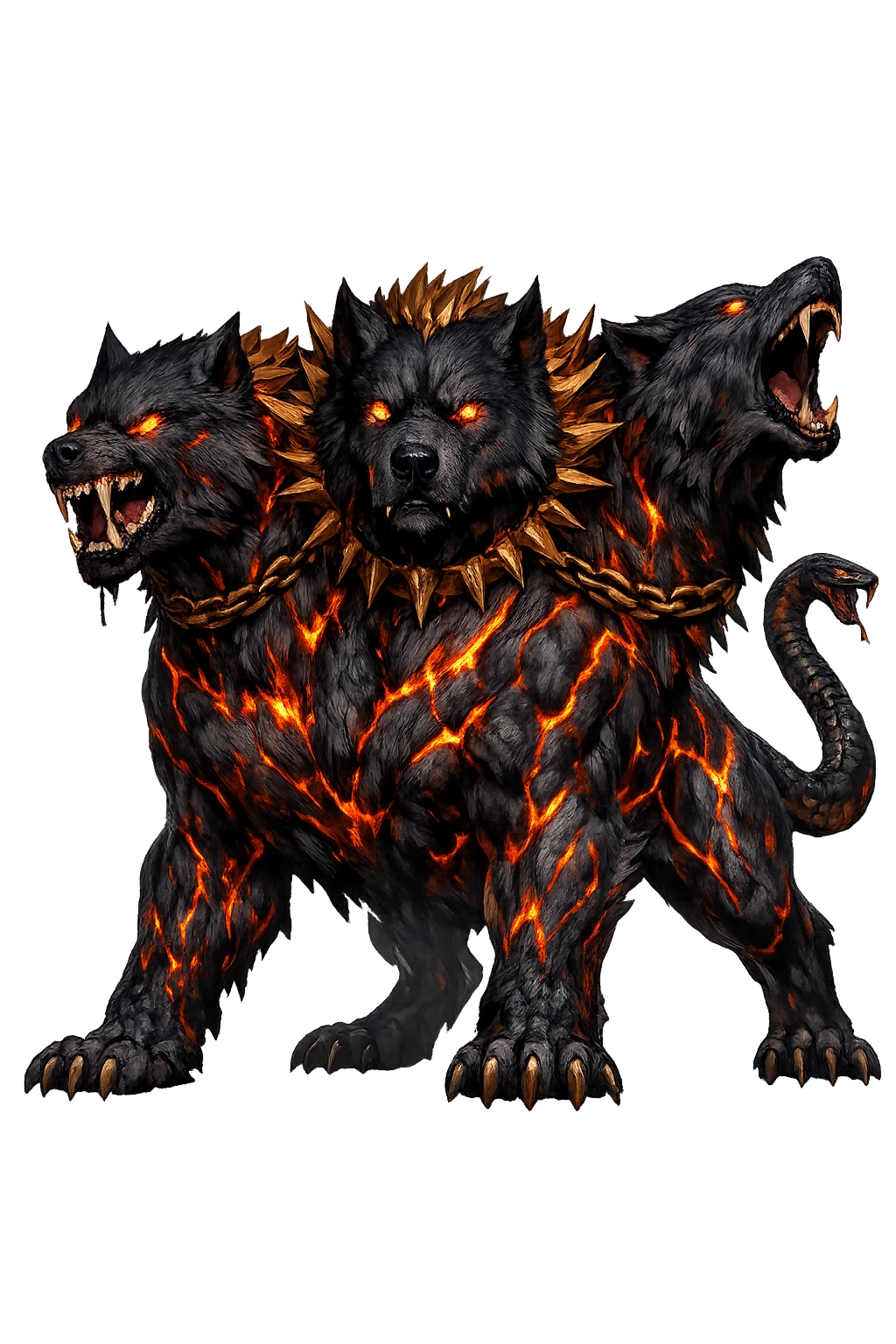
Essential information about Kérberos, Underworld Guardian
From original script to Unicode restoration
Greek Κέρβερος is proparoxytone — the accent rests on the first syllable, exactly as LSJ prints it. The restoration Kérberos keeps that acute; the ASCII "Cerberus" is the Latinized form that lost it. The etymology is genuinely dark: the old comparison with Sanskrit śárvara ("spotted," one of Yama's two hounds) is famous but unproven, and Beekes (EDG) treats the word as likely Pre-Greek. Tier-2 by rule: the single feature preserved is the accent.
Character-by-character philological analysis
| Character | Unicode | Name | Block | Phonetic Role |
|---|---|---|---|---|
| K | U+004B | Latin Capital Letter K | Basic Latin | Greek kappa (Κ) |
| é | U+00E9 | Latin Small Letter E with Acute | Latin-1 Supplement | Acute on e |
| r | U+0072 | Latin Small Letter R | Basic Latin | r same |
| b | U+0062 | Latin Small Letter B | Basic Latin | b same |
| e | U+0065 | Latin Small Letter E | Basic Latin | e same |
| r | U+0072 | Latin Small Letter R | Basic Latin | r same |
| o | U+006F | Latin Small Letter O | Basic Latin | Greek omicron (Latin -u- for Greek -ο-) |
| s | U+0073 | Latin Small Letter S | Basic Latin | s same |
The Tier 2 classification reflects how much of the original phonology this restoration preserves — stress and vowel length for Greek names, distinctive letters and diacritics for every other tradition.
From ancient cult to modern Unicode
Kérberos is the watch-dog of the dead: Hesiod's brazen-voiced, fifty-headed hound of Hades, who fawns on every soul that enters and devours any that tries to leave — the boundary of the underworld made flesh, fur, and teeth.
Rome naturalized him wholesale — Virgil, Ovid, Horace, and Statius all keep him at his post — and Dante demoted him to overseer of the third circle, the three-throated beast clawing the gluttons in the rain until Virgil clogs his throats with earth. His real cross-cultural argument is etymological: the nineteenth century matched him with Yama's spotted hounds of the Ṛgveda (śárvara), a comparison that would make him the oldest watchdog in the Indo-European family; Beekes and the modern handbooks prefer a Pre-Greek origin and leave the match unproven. Either way, the shape of him — the plural-headed guardian of a gate that opens only inward — recurs wherever the dead need keeping.
"Cerberus" is the living language's word for the guardian who cannot be bought: firms, firewalls, and customs houses borrow the name when they want menace with seniority. His labor completed Heracles' curriculum and fixed the katabasis as the hero's final exam, and his three throats gave painters, from black-figure vase-men to modern film, the underworld's most durable mascot. The restoration Kérberos returns the name to its Greek accent — the Latinized Cerberus had been wearing Rome's pronunciation for two thousand years.
Restoring Kérberos in a domain name is more than orthographic accuracy. It is a statement that the internet should recognize the full range of human writing — not only the ASCII keyboard.
Common questions about Kérberos, Underworld Guardian, and Unicode restoration
In reconstructed pronunciation, Kérberos is /ˈker.be.ros/ — approximately KAIR-beh-ros — the acute falls on the first syllable; sound the final -ros with a light trill..
Kérberos means Spot, darkness in the greek tradition.
Kérberos is associated with The many heads (Watchfulness that cannot be flanked: every approach covered, every exit denied), The mane of serpents (The poets and painters crest him with snakes — the underworld's own fur), The honeyed cake (The Sibyl's drugged sop in the Aeneid: the one bribe the gate accepts).
Plain ASCII cerberus strips the stress, length, and script that make the name specific. Unicode restoration returns the name to its original written dignity.
Hesiod sets him in the monstrous brood of Typhon and Echidna (Theogony 306-312): Orthrus the hound of Geryon, then "Cerberus the flesh-eater, the brazen-voiced hound of Hades, fifty-headed, shameless and strong," and after him the Lernaean Hydra and the Chimaira. The family is the underworld's kennel and armory in one: wherever the myths need an impossible guardian, one of Echidna's children is already on duty.
The philological foundations of this restoration
Every claim on this page is grounded in established scholarship. The orthographic restorations follow disciplinary convention. The etymological chain follows the best available reference works. This is not invention — it is resurrection through scholarship.
You have traced the name from its earliest attestation to its Unicode restoration. Now return to the myth. The story is where the name lives.
Back to Lore