
Ancient Domain
Arachnē is the Lydian maiden whose weaving rivaled a goddess's and who was transformed into the first spider. Her myth is a meditation on skill, pride, and the dangerous boundary between human excellence and divine honor.
Extended Lore
Etymology · Phonology · Orthography · Cultural Legacy · Primary Sources
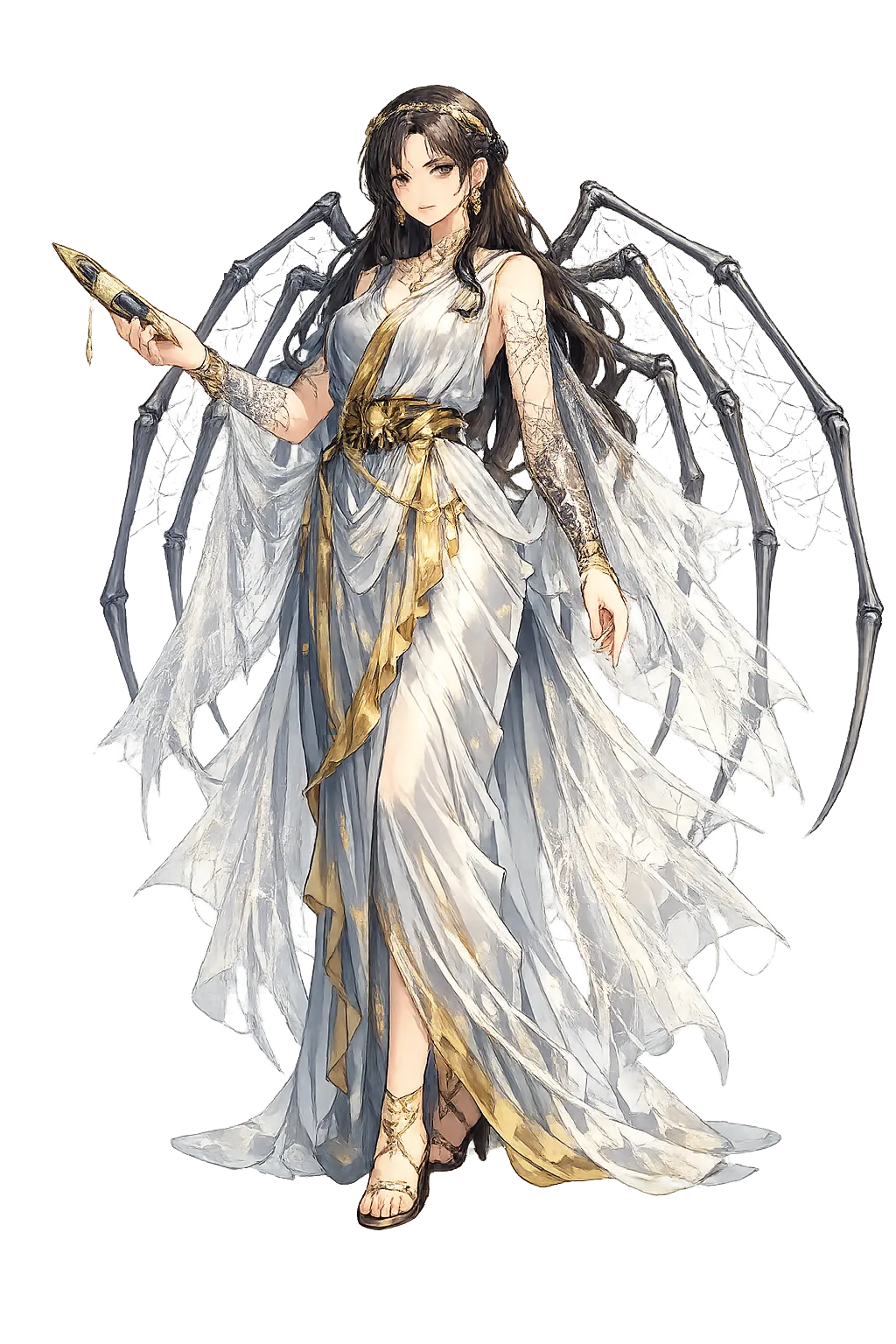
Essential information about Arachnē, Weaver, Turned into Spider
From original script to Unicode restoration
Arachnē is Tier 1 because the Greek ἀράχνη contains both stress (acute on the short alpha of the second syllable, associated with long-final pattern) and length (final η). The aspirated rho is preserved in the classical spelling.
Character-by-character philological analysis
| Character | Unicode | Name | Block | Phonetic Role |
|---|---|---|---|---|
| A | U+0041 | Latin Capital Letter A | Basic Latin | Same |
| r | U+0072 | Latin Small Letter R | Basic Latin | Same |
| a | U+0061 | Latin Small Letter A | Basic Latin | Same |
| c | U+0063 | Latin Small Letter C | Basic Latin | Same |
| h | U+0068 | Latin Small Letter H | Basic Latin | Same |
| n | U+006E | Latin Small Letter N | Basic Latin | Same |
| ē | U+0113 | Latin Small Letter E with Macron | Latin Extended-A | Macron: long eta |
The Tier 1 classification reflects which ancient features stress, length, or script are preserved in this restoration.
From ancient cult to modern Unicode
Arachnē is the Lydian maiden whose weaving rivaled a goddess's and who was transformed into the first spider. Her myth is a meditation on skill, pride, and the dangerous boundary between human excellence and divine honor.
Arachnē has few direct non-Greek parallels, but the motif of the transformed weaver appears in many traditions. The Greeks themselves gave her name to the spider class Arachnida. In Roman and Renaissance art she becomes an emblem of human artistry and its risks. Modern biology still uses 'arachnid' for spiders, scorpions, and mites, preserving her metamorphosis in scientific Latin.
Arachne's name lives in the word 'arachnid' and in every spiderweb glistening with dew. She is the patron spirit of artists who challenge authority, of women whose skill threatens the powerful, and of the punished genius. In feminist readings she is a victim of divine jealousy; in cautionary readings, a warning against hubris. Both readings agree on one point: her art was unforgettable.
Restoring Arachnē in a domain name is more than orthographic accuracy. It is a statement that the internet should recognize the full range of human writing — not only the ASCII keyboard.
Common questions about Arachnē, Weaver, Turned into Spider, and Unicode restoration
In reconstructed pronunciation, Arachnē is /a.rákʰ.nɛː/ — approximately 'ah-RAH-knay' — the middle syllable is stressed and higher-pitched; the final -ē is long..
Arachnē means Mythological weaver who was transformed into a spider in the greek tradition.
Arachnē is associated with Loom (The site of her contest with Athena and the instrument of her fame), Spider web (The eternal trace of her transformed body and her unceasing craft), Hanging thread (Arachne's attempted suicide by hanging, interrupted by Athena's metamorphosis), Tapestry of divine scandals (Her impious but accurate portrayal of Zeus's seductions and deceptions).
Plain ASCII arachne strips the stress, length, and script that make the name specific. Unicode restoration returns the name to its original written dignity.
Arachnē, a Lydian maiden, boasted that her skill surpassed Athena's. The goddess appeared as an old woman and warned her to repent. When Arachnē refused, Athena revealed herself and proposed a contest. Athena wove the glory of the gods; Arachnē wove their thefts and betrayals — Europa, Leda, Danaë, and others wronged by Olympian desire.
The philological foundations of this restoration
Every claim on this page is grounded in established scholarship. The orthographic restorations follow disciplinary convention. The etymological chain follows the best available reference works. This is not invention — it is resurrection through scholarship.
You have traced the name from its earliest attestation to its Unicode restoration. Now return to the myth. The story is where the name lives.
Back to Lore